
Overview
Description
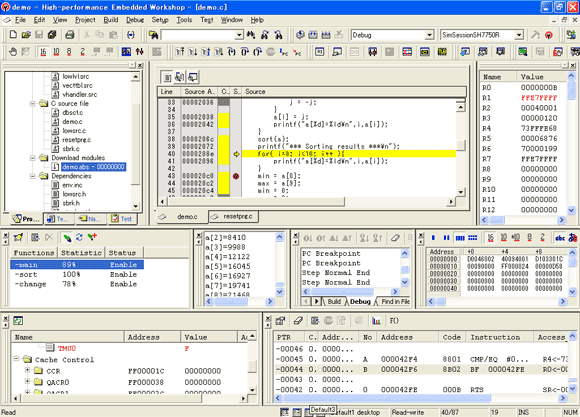
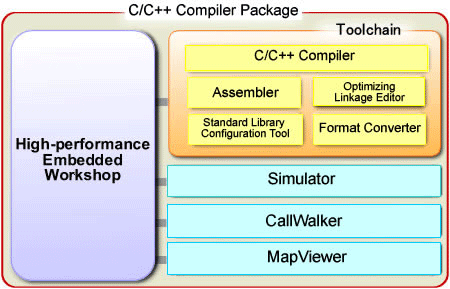
The Renesas SH C Compiler is an optimizing ANSI C and ANSI C++ compiler for the SuperH embedded RISC microprocessor family. The SH C package includes a compiler, assembler and linker is supplied as part of the High-performance Embedded Workshop IDE.
In addition to full ANSI C support, the compiler provides #pragma language extensions and command-line switches to support target specific features and extended compiler functionality.
The SH C compiler has powerful and reliable code generation facilities for SH targets. A variety of optimization features allow you to generate highly optimized PROMable code. In particular, code can be optimized for size or speed to match the requirements of the particular application being developed...
Note:
All products listed as target devices are obsolete or not recommended for new designs.
Features
- High-performance Embedded Workshop
- Tool chain
- Simulator
- Call Walker
- MapViewer
- Learn More
Release Information
Latest Ver.: V.9.04 Release03
Released: Mar 7, 2016
Details of upgrade (See Tool News)
Standard life cycle of Compilers (PDF | English, 日本語)
Note: V.9.xx is Renesas new product. Upgrading from any of older versions, V.8.xx, V.7.xx, V.6.xx and V.5.xx is not available.
Target Devices
Downloads
|
|
|
|
|---|---|---|
| Type | Title | Date |
| Software & Tools - Evaluation Software | [Evaluation Software] C/C++ Compiler Package for SuperH Family V.9.04 Release 03
|
|
| Upgrade - Compiler | C/C++ Compiler Package for SuperH Family V.9.04 Release 03 Upgrade
|
|
| Upgrade - IDE | Device File Updater for SuperH Family V.1.16
|
|
| Upgrade - Compiler | C/C++ Compiler Package for SuperH Family V.9.04 Release 02 Upgrade
|
|
| Upgrade - IDE | High-performance Embedded Workshop V.4.09.01 Differential Update(From V.4.09.00)
|
|
| Upgrade - IDE | High-performance Embedded Workshop V.4.09.01 Full Update
|
|
| Upgrade - IDE | A Patch for High-performance Embedded Workshop
|
|
| Upgrade - Compiler | C/C++ Compiler Package for SuperH Family V.9.04 Release 01 Upgrade
|
|
| Upgrade - Debugger | Simulator Debugger for SuperH Family V.9.10.01 Upgrade
|
|
| Upgrade - Compiler | C/C++ Compiler Package for SuperH Family V.9.04 Release 00 Upgrade
|
|
| Upgrade - Compiler | C/C++ Compiler Package for SuperH Family V.9.03 Release 02 Upgrade
|
|
| Upgrade - Compiler | C/C++ Compiler Package for SuperH Family V.9.03 Release 00 Upgrade
|
|
| Software & Tools - Other | CRC Code generator V.1.00
|
|
| Upgrade - Compiler | C/C++ Compiler Package for SuperH Family V.9.02 Release 00 Upgrade
|
|
| Upgrade - Compiler | C/C++ Compiler Package for SuperH Family V.9.01 Release 01 Upgrade
|
|
| Upgrade - Compiler | C/C++ Compiler Package for SuperH Family V.9.01 Release 00 Upgrade
|
|
| Software & Tools - Other | Guideline for File Operatable Low-level Interface Routines for Simulator and Debugger Utility
|
|
| Upgrade - Compiler | C/C++ Compiler Package for SuperH Family V.9.00 Release 04A Upgrade
|
|
| Upgrade - Compiler | C/C++ Compiler Package for SuperH Family V.8.00 Release 05 Upgrade
|
|
| Upgrade - Compiler | C/C++ Compiler Package for SuperH Family V.9.00 Release 01 Upgrade
|
|
| Upgrade - Compiler | C/C++ Compiler Package for SuperH Family V.9.00 Release 02 Upgrade
|
|
| Upgrade - Compiler | C/C++ Compiler Package for SuperH Family V.9.00 Release 03 Upgrade
|
|
| Upgrade - Compiler | C/C++ Compiler Package for SuperH Family Ver.5.1B Upgrade
|
|
| Upgrade - Compiler | C/C++ Compiler Package for SuperH Family Ver.5.1BR1 Upgrade
|
|
| Upgrade - Compiler | C/C++ Compiler Package for SuperH Family Ver.5.1C Upgrade
|
|
| Upgrade - Compiler | C/C++ Compiler Package for SuperH Family Ver.5.1F Upgrade
|
|
| Upgrade - Compiler | C/C++ Compiler Package for SuperH Family Ver.6.0AR2 Upgrade
|
|
| Upgrade - Compiler | C/C++ Compiler Package for SuperH Family Ver.6.0C Upgrade
|
|
| Upgrade - Compiler | C/C++ Compiler Package for SuperH Family Ver.7.1.05 Upgrade
|
|
29 items
|
||
Documentation
|
|
|
|
|---|---|---|
| Type | Title | Date |
| Tool News - Note | PDF 186 KB 日本語 | |
| Manual - Development Tools | PDF 15.12 MB 日本語 | |
| Tool News - Note | PDF 225 KB 日本語 | |
| Tool News - Note | PDF 144 KB 日本語 | |
| Tool News - Note | PDF 178 KB 日本語 | |
| Application Note |
PDF
1007 KB
日本語
AI-generated Summary:
The document explains key compiler option differences when migrating source code from the SuperH family to the RX family. It highlights that char types default to signed in SuperH but unsigned in RX, requiring the 'signed_char' option to maintain behavior. It also covers the 'auto_enum' option for automatic enum size selection and the 'dbl_size' option to specify double type size, which defaults to 4 bytes in RX compared to 8 bytes in H8 compilers. Configuration steps in the CS+ IDE are provided for each option.
|
|
| Tool News - Note | PDF 101 KB 日本語 | |
| Tool News - Note | PDF 104 KB 日本語 | |
| Guide | PDF 1.30 MB 日本語 | |
| Guide | PDF 352 KB 日本語 | |
| Tool News - Release | PDF 184 KB 日本語 | |
| Tool News - Note | PDF 44 KB 日本語 | |
| Application Note |
PDF
243 KB
日本語
AI-generated Summary:
The document explains how to register and uninstall Call Walker within the High-performance Embedded Workshop (HEW). It guides users to launch HEW without opening a workspace, access the Tools Administration menu, and register the Call Walker tool by specifying the registration file path. After registration, Call Walker version 2.3 appears in the menu. Upon uninstalling HEW, users must manually delete the remaining Call Walker directory. It also provides Renesas Electronics website and contact information for support. The revision history notes the first edition release date.
|
|
| Tool News - Note | PDF 329 KB 日本語 | |
| Tool News - Release | PDF 824 KB 日本語 | |
| Tool News - Note | PDF 204 KB 日本語 | |
| Release Note | PDF 307 KB 日本語 | |
| Tool News - Note | PDF 226 KB 日本語 | |
| Tool News - Release | PDF 205 KB 日本語 | |
| Tool News - Note | PDF 319 KB 日本語 | |
| Tool News - Release | PDF 202 KB 日本語 | |
| Manual - Development Tools | PDF 4.16 MB 日本語 | |
| Tool News - Note | PDF 202 KB 日本語 | |
| Manual - Development Tools | PDF 1.85 MB 日本語 | |
| Release Note | PDF 136 KB 日本語 | |
| Tool News - Release | PDF 595 KB 日本語 | |
| Tool News - Note | PDF 206 KB 日本語 | |
| Application Note |
PDF
280 KB
日本語
AI-generated Summary:
The document details a comprehensive list of methods supported by the <algorithm> class in a compiler package. It covers various template functions such as swap, min, max, copy, fill, mismatch, equal, lexicographical_compare, count, find, search, replace, for_each, adjacent_find, remove_if, generate, unique, reverse, rotate, and random_shuffle. These methods facilitate operations on iterators and ranges, supporting comparisons, transformations, and searches with customizable predicates and binary operations.
|
|
| Application Note |
PDF
478 KB
日本語
AI-generated Summary:
This section explains how to set up the STL (Standard Template Library) environment for RXC or SHC compilers. It details two methods to add the STL include directory: through the HEW toolchain's Options dialog box and via command line by setting environment variables or compiler include options. Step-by-step instructions guide users to specify the STL directory, ensuring the STL becomes available for building projects.
|
|
| Tool News - Release | PDF 422 KB 日本語 | |
| Manual - Development Tools | PDF 212 KB 日本語 | |
| Tool News - Release | PDF 197 KB 日本語 | |
| Application Note |
PDF
147 KB
日本語
AI-generated Summary:
The document details the execution cycles of mathematical function libraries and runtime routines for the SuperH RISC engine C/C++ Compiler V.9.03. It specifies the conditions for creating standard libraries across various CPU types (SH-1, SH-2, SH-3, SH-2E, SH-4, SH-4A, SH-2A, SH-2AFPU) with different options such as endian, floating-point precision, and rounding. Execution speeds for floating-point functions like sinf, cosf, tanf, logf, sqrtf, expf, and powf are tabulated for single and double precision across different CPUs, showing cycle counts and measurement conditions.
|
|
| Application Note |
PDF
339 KB
日本語
AI-generated Summary:
Call Walker is a stack information analysis tool included in the Renesas Compiler Package for various microcontroller families. It reads stack information files (*.sni) generated by the linkage editor or profile information files (*.pro) from the simulator debugger. Users can edit stack sizes, save modified data in call information files (*.cal), and merge multiple files. Procedures to create stack information files differ by microcontroller family, with specific instructions for SuperH, H8, RX, M16C, and R8C families. The tool supports static stack size display and editing for assembly programs.
|
|
| Tool News - Note | PDF 206 KB 日本語 | |
| Tool News - Release | PDF 195 KB 日本語 | |
| Manual - Development Tools | PDF 1.89 MB 日本語 | |
| Manual - Development Tools | PDF 2.67 MB 日本語 | |
| Tool News - Note | PDF 197 KB 日本語 | |
| Tool News - Note | PDF 240 KB 日本語 | |
| Tool News - Release | PDF 205 KB 日本語 | |
| Tool News - Note | PDF 201 KB 日本語 | |
| Tool News - Note | PDF 223 KB 日本語 | |
| Manual - Development Tools | PDF 835 KB 日本語 | |
| Tool News - Release | PDF 195 KB 日本語 | |
| Application Note |
PDF
300 KB
日本語
AI-generated Summary:
The document explains how to use the object uniting function in version 9.2 of the SuperH RISC engine C/C++ compiler. This function, added to the optimization linkage editor (optink.exe) version 9.04.00, merges two or more object files (mot or hex) into one, facilitating multi-core program development by combining files for each core into a single file for easier FlashROM writing. The function checks input data, unites files by ascending address, outputs uniting information, and warns of overlapping addresses. Command line usage and options are detailed, including output file naming and information file generation.
|
|
| Application Note |
PDF
331 KB
日本語
AI-generated Summary:
The document explains how to change the section of a specific symbol within a library, focusing on the _INITSCT() function used when copying programs from ROM to RAM. It details the issue of the _INITSCT() function residing in the same section being copied, causing failures, and how changing its section resolves this. Two methods are described: using the librarian interface and the optimizing linkage editor. The librarian interface allows users to open a library, select the target symbol's section, and rename it to a new section name to ensure successful copying.
|
|
| Application Note |
PDF
665 KB
日本語
AI-generated Summary:
The document details simulator functionalities for embedded development, including simulated I/O, image display, profiler, performance analysis, pseudo-interrupts, timer simulation, event points, and virtual I/O panels. It explains low-level interface routines that enable file and standard I/O operations within the simulator using assembly-coded functions. Sample projects for SH-2A and SH-4 processors demonstrate these features, with instructions on environment setup and usage.
|
|
| Application Note |
PDF
715 KB
日本語
AI-generated Summary:
The document details features added to the SuperH RISC engine C/C++ compiler across multiple versions. Key enhancements include support for SH7600 and SH-3 series, position-independent code, optimization options for speed or size, nested comments, section name switching, embedded functions for multiply-and-accumulate operations and system calls, and support for Japanese character codes. Compiler limits and inline expansions are extended to improve performance and code size efficiency.
|
|
| Tool News - Note | PDF 201 KB 日本語 | |
| Tool News - Release | PDF 198 KB 日本語 | |
| Application Note |
PDF
333 KB
日本語
AI-generated Summary:
The document explains how to use Renesas IDE for efficient project setup, focusing on layered projects and project types. Layered projects involve creating multiple projects for applications and libraries, with dependencies ensuring libraries build before applications. The IDE manages build order for parent and child projects but not for sibling projects. Instructions cover inserting new or existing projects, including library projects, into a workspace.
|
|
| Application Note |
PDF
553 KB
日本語
AI-generated Summary:
The document details the macro-recording support facility and test support facility within the Renesas High-performance Embedded Workshop IDE. It explains how to record, execute, edit, import, and delete macros, which automate tasks such as project changes, builds, and debugging operations. Macros save commands in text files with an .hdc extension. The guide also covers creating and managing test suites and test image files, executing tests, and analyzing results. Step-by-step instructions for recording macros and managing test automation are provided.
|
|
| Application Note |
PDF
1.08 MB
日本語
AI-generated Summary:
The document explains how to use the conditional trace function of the E6000 emulator for the H8S/2214 MCU. It details setting event points, configuring trace conditions, and acquiring trace data during program execution. It also covers software installation steps, including the E8 emulator software and necessary connection drivers. The guide walks through activating the High-performance Embedded Workshop, opening workspaces, downloading programs, and setting various trace conditions such as point-to-point, range, and event trace.
|
|
| Tool News - Note | PDF 194 KB 日本語 | |
| Application Note |
PDF
401 KB
日本語
AI-generated Summary:
The document details extended #pragma directives in the SuperH RISC engine C/C++ Compiler version 9, focusing on reducing program size and improving execution speed. It explains directives like #pragma absn for specifying address ranges (16, 20, 28, 32-bit) to optimize memory usage, inline expansion of functions, assembly function expansion, and register allocation. Usage examples and address range tables clarify how these directives affect code and memory layout.
|
|
| Application Note |
PDF
601 KB
日本語
AI-generated Summary:
The document details compiler optimization options for the SuperH RISC engine C/C++ compiler version 9. It explains three basic optimization modes: speed, size, and a balance of both, describing how each affects execution time and object size. Advanced options allow finer control over performance improvements. Examples use the SH-2 CPU specification but may vary with other CPUs or future compiler updates. The document also shows how to configure these options within the Renesas IDE.
|
|
| Application Note |
PDF
365 KB
日本語
AI-generated Summary:
The document explains the usage of C++ language features with the SuperH RISC engine C/C++ compiler V.9, focusing on global class object initialization and post-processing. It emphasizes the necessity of calling _CALL_INIT before main and _CALL_END after main to properly invoke constructors and destructors of global objects. It provides code examples for implementing this process, especially within embedded applications, and highlights the behavior differences when these calls are omitted.
|
|
| Tool News - Note | PDF 194 KB 日本語 | |
| Tool News - Release | PDF 197 KB 日本語 | |
| Tool News - Release | PDF 199 KB 日本語 | |
| Manual - Development Tools | PDF 1.46 MB 日本語 | |
| Tool News - Note | PDF 230 KB 日本語 | |
| Application Note |
PDF
549 KB
日本語
AI-generated Summary:
This guide explains the installation and usage of the SuperH RISC engine C/C++ Compiler Package within the High-performance Embedded Workshop environment. It covers creating project workspaces, selecting MCU types, configuring compiler options, generating necessary files, and setting stack parameters. The package includes simulators for debugging without hardware and supports adding emulators for real target debugging, enabling a seamless development workflow.
|
|
| Application Note | PDF 537 KB 日本語 | |
| Application Note |
PDF
610 KB
日本語
AI-generated Summary:
The document guides generating sample programs using the SuperH RISC engine C/C++ compiler in High-performance Embedded Workshop (HEW). It details project generator settings, including selecting CPU series and type, and explains how these settings affect source files and memory placement. It also covers reset processing, exception handling, memory initialization, low-level interface routines, and C++ usage precautions. The guide includes steps for creating new workspaces and selecting target CPUs, with notes on adding unsupported CPU types via DeviceUpdater.
|
|
| Application Note |
PDF
649 KB
日本語
AI-generated Summary:
The SH-DSP core features a DSP unit that performs 16-bit fixed-point multiply-and-accumulate operations in a single cycle, enabling high-speed multimedia processing such as JPEG, audio, and filter processing. Unlike previous SH cores where multiply-and-accumulate operations took multiple cycles due to pipeline stalls, the SH-DSP uses separate X and Y data buses to maintain a one-cycle operation time. Pipeline operation examples illustrate efficient instruction execution and data transfer.
|
|
| Application Note |
PDF
1.21 MB
日本語
AI-generated Summary:
The document details the use and specifications of Floating-point Processing Units (FPUs) in SuperH RISC engines SH-2E, SH2A-FPU, SH-4, and SH-4A. It explains floating-point number representations, including single and double precision formats, internal bit configurations, and value types such as normalized, non-normalized, zero, infinity, and non-number. It also covers FPU features like rounding modes, exception handling, and processing modes. The guide includes compiler options for floating-point calculations and programming techniques to optimize FPU usage.
|
|
| Application Note |
PDF
305 KB
日本語
AI-generated Summary:
Efficient programming techniques for the SuperH RISC engine C/C++ compiler focus on improving execution speed and reducing program size. Key strategies include optimizing frequently executed statements, using common code for similar processing, and revising complex functions. Performance depends on compiler-generated code and hardware factors such as memory architecture and cache hit rates. The document lists 17 techniques, evaluating their impact on ROM, RAM, and execution speed, with practical CPU options and measurement considerations.
|
|
| Application Note |
PDF
248 KB
日本語
AI-generated Summary:
The document details coding techniques and compiler options for the SH-2A/SH2A-FPU using the SuperH RISC engine C/C++ Compiler V.9.01. It highlights new SH-2A instructions that improve performance and reduce program size, such as 20-bit long immediate load, relative load/store with 12-bit displacement, load/store multiple registers, auto-increment/decrement, division, multiplication, saturation comparison, bitwise operations, branching without delay slots, and barrel shift instructions. It also explains the use of the register bank and jump table base register (TBR) for faster processing. The 20-bit immediate load instruction embeds larger immediate data directly in instructions, reducing code size and memory access, with compiler pragmas to optimize address usage.
|
|
| Tool News - Release | PDF 203 KB 日本語 | |
| Tool News - Note | PDF 201 KB 日本語 | |
| Application Note |
PDF
5.54 MB
日本語
AI-generated Summary:
These notes explain how to efficiently create application programs using the SuperH RISC engine C/C++ Compiler Package V. 9.00, covering installation, debugging, combining C and assembly, HEW options, and optimization techniques. They include detailed sections on programming methods, extended compiler functions, and frequently asked questions, supported by related manuals for hardware and software tools.
|
|
| Tool News - Notification | PDF 192 KB 日本語 | |
| Tool News - Release | PDF 197 KB 日本語 | |
| Tool News - Release | PDF 196 KB 日本語 | |
| Tool News - Note | PDF 205 KB 日本語 | |
| Tool News - Release | PDF 202 KB 日本語 | |
| Tool News - Note | PDF 235 KB 日本語 | |
| Tool News - Note | PDF 199 KB 日本語 | |
| Tool News - Note | PDF 195 KB 日本語 | |
| Tool News - Note | PDF 223 KB 日本語 | |
| Tool News - Note | PDF 192 KB 日本語 | |
| Tool News - Release | PDF 208 KB 日本語 | |
| Tool News - Note | PDF 213 KB 日本語 | |
| Tool News - Note | PDF 195 KB 日本語 | |
| Tool News - Notification | PDF 194 KB 日本語 | |
| Tool News - Release | PDF 198 KB 日本語 | |
| Tool News - Note | PDF 194 KB 日本語 | |
| Tool News - Note | PDF 195 KB 日本語 | |
| Tool News - Note | PDF 199 KB 日本語 | |
| Tool News - Note | PDF 195 KB 日本語 | |
| Tool News - Note | PDF 196 KB 日本語 | |
| Tool News - Note | PDF 195 KB 日本語 | |
| Tool News - Note | PDF 196 KB 日本語 | |
| Tool News - Release | PDF 195 KB 日本語 | |
| Tool News - Note | PDF 215 KB 日本語 | |
| Tool News - Release | PDF 218 KB 日本語 | |
| Tool News - Note | PDF 194 KB 日本語 | |
| Tool News - Note | PDF 197 KB 日本語 | |
| Tool News - Release | PDF 201 KB 日本語 | |
| Manual - Development Tools | PDF 120 KB 日本語 | |
102 items
|
||
Design & Development
Additional Details
Functions
[C/C++ Compiler]
- Language specification: Exception handling and Template functions are supported according to ANSI/ISO standards.
- Complies with C/C++ language in ANSI specification
- Supports C89, C99 (subset of functions*), and C++98. * long long, // comments
- Optimizing function: The dedicated optimization which are for each microcomputer have been implemented in addition to the general optimization techniques that are deletion of common expression, register allocation, etc. Furthermore, the optimization function has also realized the optimization over between source files at the time of a link.
- Introduces the latest optimization technology developed for supercomputers
- Optimization at recompilation using link information (optimization of access to external variable)
- Inter-module optimization of access to external variable
- Embedded function: Interruption function description, system command description, etc., which are not supported by ANSI C/C++ language Specification and which are useful to support the function for the embedded program as an extended function.
- Extended language function for SuperH RISC engine family
- Intrinsic functions
- Section address operators
- #pragma directives
- Object generation in all CPUs from SH-1 to SH-4
- Improved output way of compile list
- Standard object format (ELF/DWARF2)
- Embedded C++ language spec-compliant class libraries
- High performance DSP library optimized by DSP instruction
- The header file fixed.h that defines various limitations concerning the internal representation of fixed-point numbers is also added
- Supports DSP-C language
- Loosening limits on number of switch statements: 256 -> 2048
- DSP library of fixed-point type is supported
- Specify bit-field of union
- Enhanced to 4096 level of nesting by combination of iteration statement and selection statement
[Assembler]
- Pre-processor function: A source program is described efficiently by pre-processor functions such as a file inclusion function, conditional assembly function, macro function, etc..
- Instruction support to all CPU from SH-4 to SH-1 include DSP
- Description of Double accuracy floating point constant is possible
- File include function
- Assembly function with condition
- Macro function
- Support ELF/DWARF2 format
- Floating-point arithmetic operations can be specified in the assembler directive for reserving floating-point data
- Supports .STACK Directive which enables the stack size of a function written in the assembly language to be reflected in the stack analysis tool
- The number of characters in a replacement symbol specified in .DEFINE was extended from 32 characters to unlimited
[Optimizing Linkage Editor]
- Optimizing function: It executes optimizations that are memory allocation and code optimizations that related functions callings. These optimizations can not be done in the C/C++ compiler.
- Output file: Linkage Editor outputs several formats like ELF from, S type form and HEX form. And it is available to output the symbol reference list.
- Compression function of debug information
- Inter-module optimization function
- Plurality load module selection
- Relocatable ELF format
- Absolute ELF format
- S type format.
- HEX format
- Binary format
- Support ELF/DWARF2 format
- Creation and edition of library file is possible
- Analysis by list file output
- Output the number of times of symbol reference
- Output symbol reference information (cross-reference information)
- Changing error level when a section address is overlapped
- A boundary alignment value can be specified for the section specified by the binary option.
[Standard Library Configuration Tool]
Generate the standard library file, which is provided by a compiler, by using the user-specified option. Select of the optimization and generation of the standard library file that is the reentrants type (case of SH) are available by options.
- Customize of standard library by generating standard library for every project is possible.
- Support reentrant library.
- Variable change per malloc reservation size (Saving of RAM capacity is possible).
- Variable change of the number of open file (Saving of RAM capacity is possible).
- Support for simple I/O (Generate a small size function with no supporting floating point).
[Format Converter]
- Conversion from the old format to ELF format
- Conversion from ELF format to the old format
Components
For details, refer to the "C/C++ Compiler Package for SuperH Family Software Component List (PDF | English, 日本語)".
Supported MCU core, DSP Instructions, Object Format
| Compiler Package Version | Supported Devices (MCUs) | DSP Instructions (Note1) Support | Object Format | Device File Updater (Note2) |
|---|---|---|---|---|
| V.9 Windows version | SH-1, SH-2 (Note5), SH-2E, SH2-DSP, SH-2A, SH2A-FPU, SH-3, SH3-DSP, SH-4, SH-4A, SH4AL-DSP, SH-Mobile (Note4) | DSP-C language Assembly language DSP library (Note3) | ELF/DWARF2 | Available |
| V.9 UNIX version (Discontinued) | SH-1, SH-2 (Note5), SH-2E, SH2-DSP, SH-2A, SH2A-FPU, SH-3, SH3-DSP, SH-4, SH-4A, SH4AL-DSP, SH-Mobile (Note4) | ELF/DWARF2 | Unsupported | |
| V.8 (Discontinued) | SH-1, SH-2, SH-2E, SH2-DSP, SH-3, SH3-DSP, SH-4, SH-4A, SH4AL-DSP, SH-Mobile (Note4) | ELF/DWARF2 | ||
| V.7 (Discontinued) | SH-1, SH-2, SH-2E, SH2-DSP, SH-3, SH3-DSP, SH-4 | Assembly language DSP library (Note3) | ELF/DWARF2 | |
| V.6 (Discontinued) | ELF/DWARF2 | |||
| V.5 (Discontinued) | SYSROF |
Notes
- Available only for MCU/MPU with a DSP module.
- Device File Updater is a utility tool which adds or updates automatically the High-performance Embedded Workshop's source files such as a start-up routine, I/O header file, etc.
- The DSP library is included in this C/C++ compiler package.
- If you use middleware, make sure the version of your C/C++ compiler package is supported by the middleware to be used. (Please inquire of the middleware distributor.)
- Supports little endian. (V.9.00 Release01 or later)
(Discontinued): This version is no longer marketed.
Support
Support Communities
- New to SH-4A family
... some basic things about processor and tools. Currently I'm using HEW version 4.07.00 , SH-4A E10A-USB Emulator V.3.01.02, C/C++ compiler package for SuperH RISC engine family V.9.03 Release 02, SuperH RISC engine family Simulator Debugger V.9.10.00 ...
Jun 25, 2010 - New to SH-4A family
... some basic things about processor and tools. Currently I'm using HEW version 4.07.00 , SH-4A E10A-USB Emulator V.3.01.02, C/C++ compiler package for SuperH RISC engine family V.9.03 Release 02, SuperH RISC engine family Simulator Debugger V.9.10.00 ...
Jun 25, 2010 - HEW Compiler vs e2Studio and GNU for SH2A
... based on Renesas SH2A 7269 I would like to carry the existing code realized with HEW v4.09.01.007 and C++/C compile package for SuperH RISC engine family V.9.04 Release 02 to e2Studio v6.2.1 or v5.4.0.023 and the GCC compiler ...
Feb 15, 2019
Knowledge Base
- Can you tell me the status of simulator CPU series in compiler package?
Bundled simulator CPU series differ from versions of the compiler packages.SuperH RISC engine family C/C++ Compiler PackageVer.7 and previous: SH1,SH2,SH3,SH3-DSP,SH4 Ver.8*: SH1,SH2,SH3,SH3-DSP,SH4,SH4A,SH4AL-DSP Ver.9*: SH1,SH2,SH3,SH3-DSP,SH4,SH4A ...
Sep 10, 2007 - Why did I fail even I execute debugging C source program at source level?
... a program to be debugged is being specified by both a compiler and an optimization linkage editor. Machine code is being used as an output format of the compiler. ELF/DWARF format is being specified as an output format of the optimization linkage editor. A module and ith debug ...
Sep 10, 2007 - [HEW V.4, V.3] Are there methods for accomplishing the standard I/O?
When using the C/C++ compiler package for SuperH family or C/C++ compiler package for H8SX,H8S,H8 family.To accomplish the standard I/O, click to select the [Use I/O library] check box when creating a new project with the High-performance Embedded ...
Jul 27, 2010

Support Communities


