
Overview
Description
This product is a real-time operating system (real-time OS) that is an implementation of the μITRON4.0 specification. μITRON is the predominant real-time OS for embedded systems in Japan. Its low resource requirements, outstanding real-time performance, and broad range of service calls make it very suitable for embedded systems requiring true real-time and multi-tasking capabilities.
In addition, its high degree of compatibility with the compiler package from Renesas Electronics and multitasking debugging on the IDE will help you greatly reduce development times and get your products to market more quickly.
The H8SX family supports interrupt control mode 2.0 and CPU operating mode supports advanced mode. The H8S family supports interrupt control mode 3.2.1.0 and CPU operation mode supports advanced mode and normal mode.
Features
- Conformance with the µITRON4.0 Specification
The design conforms with the µITRON4.0 Specification, which prescribes a representative OS architecture for embedded control. - Real-time performance
Task switching time is 7.4μsec, which is even faster than the previous product. Time it takes a target task to be activated after a wup_tsk is issued. (H8SX/1650@35MHz, when on-chip memory is used) [Learn More] - Superb functionality
Supports more than 70 service calls.They support various applications.[Learn More] - Equipped with the configurator
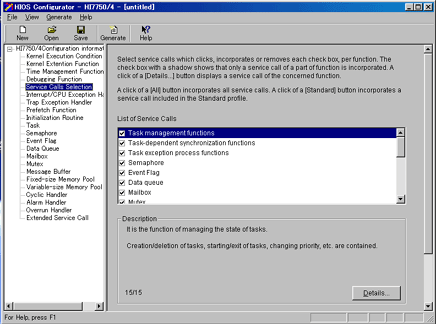
The configurator is equipped which makes the setup of OS construction parameters easier.[Learn More] - Supports the multi-task functionality in High-performance Embedded Workshop
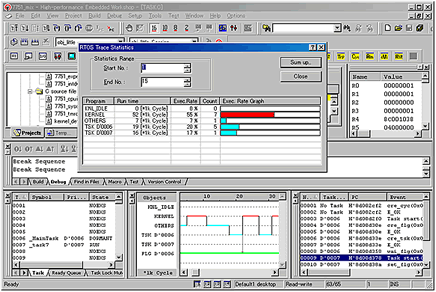
The Debugging Extension is an optional software which supports the following functions:[Learn More]:- Displaying the states of OS control objects such as tasks, semaphores, etc.
- Issues the service calls for task activation and event flag setting etc.
- Graphically-displayed service call history
- Cooperation with 3rd parties
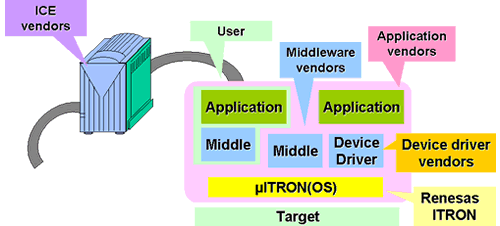
We provide various solutions to deliver great environments for debugger/application software development, distribution of middleware, customization, and hardware platform etc. in conjunction with our partner vendors. - Target CPU: H8S Family, H8SX Family, AE-5 Series smart card MCU
- Supported compiler: C/C++ Compiler Package for H8SX, H8S, H8 Family
- Learn More
Release Information
Latest Ver.: V.1.06 Release 00
Released: Nov 16, 2008
Details of upgrade (See Tool News)
Operating Environment
Agreement Details
Target Devices
Downloads
|
|
|
|
|---|---|---|
| Type | Title | Date |
| Upgrade - OS | Realtime OS for H8SX, H8S Family HI1000/4 V.1.06 Release 00 (No source code attached) Upgrade
|
|
| Upgrade - OS | Realtime OS for H8SX, H8S Family HI1000/4 V.1.06 Release 00 (Source Code attached) Upgrade
|
|
| Upgrade - OS | Realtime OS for H8SX, H8S Family HI1000/4 V.1.05 Release 01 (No source code attached) Upgrade
|
|
| Upgrade - OS | Realtime OS for H8SX, H8S Family HI1000/4 V.1.05 Release 01 (Source Code attached) Upgrade
|
|
| Upgrade - OS | Realtime OS for H8SX, H8S Family HI1000/4 V.1.05 Release 00 (No source code attached) Upgrade
|
|
| Upgrade - OS | Realtime OS for H8SX, H8S Family HI1000/4 V.1.05 Release 00 (Source Code attached) Upgrade
|
|
| Upgrade - Debugger | Real-time OS Debugger Debugging Extension V.1.08 Release 00 Upgrade
|
|
| Upgrade - OS | Realtime OS for H8SX, H8S Family HI1000/4 V.1.04 Release 00 (Source Code attached) Upgrade
|
|
| Upgrade - OS | Realtime OS for H8SX, H8S Family HI1000/4 V.1.04 Release 00 (No source code attached) Upgrade
|
|
9 items
|
||
Documentation
|
|
|
|
|---|---|---|
| Type | Title | Date |
| Application Note |
PDF
750 KB
日本語
AI-generated Summary:
Real-time OS aware debugging supports various real-time operating systems including HI7200/MP, ThreadX, uC/OS-II, and TOPPERS variants. It operates within High-performance Embedded Workshop on Windows platforms and integrates with SuperH Family RISC engine simulators/debuggers. The document details environment setup, program downloading, OS definition selection, task state monitoring, execution history, and timing display functions.
|
|
| Guide | PDF 371 KB 日本語 | |
| Application Note |
PDF
265 KB
AI-generated Summary:
The document details the specifications and usage of the M3S-TFS-Tiny filesystem library for microcontrollers in the R8C, H8/300H Tiny, and M16C/Tiny series. It supports FAT16 on media sizes from 32 MB to 1 GB, with features like multiple drive support, fixed 64-byte logic sectors, and variable file sizes allocated in blocks. The library includes type definitions, explanations of key terms such as logic sectors and drives, and provides a sample program with memory driver interfaces and error codes.
|
|
| Tool News - Release | PDF 196 KB 日本語 | |
| Tool News - Note | PDF 197 KB 日本語 | |
| Tool News - Release | PDF 196 KB 日本語 | |
| Tool News - Note | PDF 194 KB 日本語 | |
| Tool News - Note | PDF 196 KB 日本語 | |
| Tool News - Release | PDF 197 KB 日本語 | |
| Tool News - Note | PDF 195 KB 日本語 | |
| Tool News - Note | PDF 192 KB 日本語 | |
| Tool News - Release | PDF 199 KB 日本語 | |
| Manual - Development Tools | PDF 1.53 MB 日本語 | |
| Application Note |
PDF
3.03 MB
AI-generated Summary:
The document provides important disclaimers and usage guidelines for semiconductor products, emphasizing that the information is for reference only and subject to change. It highlights that Renesas assumes no liability for damages or third-party rights infringements arising from the use of the data. Safety considerations are stressed, advising users to design circuits with protective measures to prevent injury or damage. Export control restrictions and the need for prior approval for reproductions are also noted.
|
|
| Tool News - Notification | PDF 199 KB 日本語 | |
| Tool News - Notification | PDF 206 KB 日本語 | |
16 items
|
||
Additional Details
Functions
The HI1000/4 kernel consists of the following modules. Each module is provided by functions (service calls) .
- Scheduler
Manages execution sequence of multiple tasks based on their priority levels. - Task management
Manages task status such as RUNNING, READY, WAITING or SUSPENDED. - Task-dependent synchronization
Changes task status from other task, and synchronizes tasks. - Interrupt processing
Returns from an interrupt handler. - Time management
Sets system timer used by HI1000/4 kernel and starts user-defined cyclic handler. - System State Management
Reports information such as version number of HI1000/4 kernel. - Synchronization/communication
Carries out synchronization and communication between tasks. The following function modules are available:- Event flag
Tasks are synchronized by the status of flags managed by the kernel. - Semaphore
Tasks are synchronized by the semaphore counter value managed by the kernel. - Mail box
Tasks are synchronized by sending or receiving a message. - Data queue
Tasks are synchronized by communicating 4-byte data.
- Event flag
- Extended Synchronization/Communication
Carries out synchronization and communication between tasks. The following function module is available:- Mutex
Makes use of priority ceiling protocol for avoiding priority inversion to synchronize tasks.
- Mutex
- Memory pool management
Dynamically allocates/frees memory area used by tasks. Enables efficient use of memory. - Cyclic handler function
Controls the execution of a handler activated periodically.
Kernel specifications
| Specifications/Functions: | Compliant with μITRON 4.0 specification
|
|---|---|
| Scheduling types: | Priority basis type / Event-driven type |
| Service call number: | 79 (Count xxx_yyy plus ixxx_yyy as one) |
| Maximum object number: | 255 (Only the cycle handler and the alarm handler have 15 each) A maximum value can be selected with the configurator |
| Maximum Priority number: | 31, A maximum value can be selected with the configurator |
| Performance (Time takes for a target task to be executed after the wup_tas is issued.) : | 7.4 microseconds (H8SX/1650, 35MHz, when on-chip memory is used in the advanced mode) 17.2 microseconds (H8S/2655, 20MHz, when on-chip memory is used in the advanced mode ) |
| Kernel code size : | From 2.3K bytes to 27.2K bytes |
| Kernel RAM usage per task: | Data: 20 bytes Stack: 50 bytes |
Components
| Item | Description | Note |
|---|---|---|
| Kernel source program | Kernel source program | Provided only with mass- production licenses which include source code. |
| Kernel library | Kernel library for system configuration | Supports advanced mode |
| Standard header files |
| Header files are provided both in Assembler and C languages |
| Configurator | To setup configuration parameters | — |
| Various sample programs |
| — |
| Workspace for configuration | HEW workspace for system configuration | — |
| Manual | HI1000/4series user's manual | — |
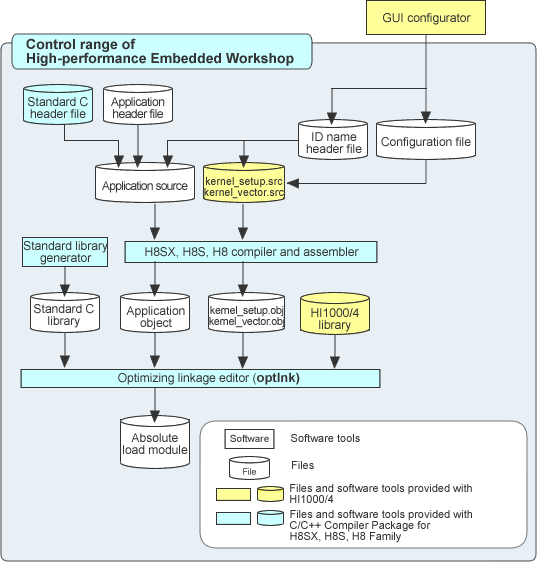
Processing Flow
Target Devices
Support
Knowledge Base
- How to display time in task trace window and task analyze window?
Time is not displayed if you use E10A-USB. (except SH2A-DUAL)
Dec 7, 2009 - Why are Task trace window and task analyze window not displayed?
E8a emulator does not support task trace window and task analyze window. Also if you use E10A-USB emulator with a cable for 14 pins connector, task trace window and task analyze window are not displayed.You can display task trace window when using a cable for 36 or 38 ...
Dec 7, 2009

Support Communities


