The acceleration in technological growth and research drives growing adoption and interest in leveraging new capabilities to enhance and supplement existing processes and workflows, especially in the field of robotics.
Robots have existed since the 1950's, with one of the first industrial robots, Unimate, being a hydraulic manipulator arm patented in 1953 and installed at a General Motors plant in 1961. The robot arm specialized in repetitive tasks like welding and die-casting to revolutionize manufacturing automation. Since then, the technologies behind robotics, from motor drives and controls to functional safety, have evolved and enabled robots to do more complex tasks and become adopted in more industries.
Today's robots are no longer stationary and confined to a singular, repetitive task, but are actively working in dynamic environments that warrant more fine and precise interactions with the environment and the things in it. The modern robots of today and tomorrow require the dexterity of "hands" to interface and interact with the environment and objects around them.
The Essentials of Hands in Robotic Applications
The hands of a robot provide finer motor movement and control to interact with objects and the environment in a more precise manner. While a specific image may come to mind when thinking of robotic hands, the look and function of a hand will not be the same across robots of different purposes.
For example, a robot meant to only pick the ripe strawberries in a field would have a much different hand requirement than a robot aiming to gather and pick up big space rocks on Mars. Likewise, a stationary robot deployed in a recycling facility trying to correctly pick and sort recyclables coming down a conveyor belt would have different hands and systems than a robot doing standardized picking and placement of large metal pieces for car assembly.
The ultimate form factor, ability, and precision depend on the specific end application and use case.
Dexterity considerations for robotic hands, like how many joints should the robot have, how many motors/actuators, what is the precision level required, should there be active processing/decision making, etc., can be thought of as follows:
- Environment: What is the environment that this robot is deployed in?
- Stationary vs. Dynamic: Is the robot fixed in place and interacting within a limited space or is it moving or interfacing in a changing/dynamic environment?
- Interaction Scope: Is the robotic hand an extension of an autonomous robot, a workflow with a human involved, or even an extension of a human (ex., a prosthetic hand)?
- Object Interaction: What are the objects that the robot hand is interacting with?
- Uniform vs. Variable: Are the objects uniform (ex., the same screws or metal panels in an assembly line process) or different each time (ex., a robot trying to pick up different types of litter around the highway)?
- Fragility: How fragile or delicate is the object?
- Size: How big or small are the objects being handled?
The important considerations of what the hands are handling and where they're handling it determine system functionalities like:
- Integrated Artificial Intelligence (AI) or fixed control algorithm
- Motor quantity
- Motor control and motor drive precision
- Motor feedback provisions and sensors
Enabling Dexterity in Robotic Hands
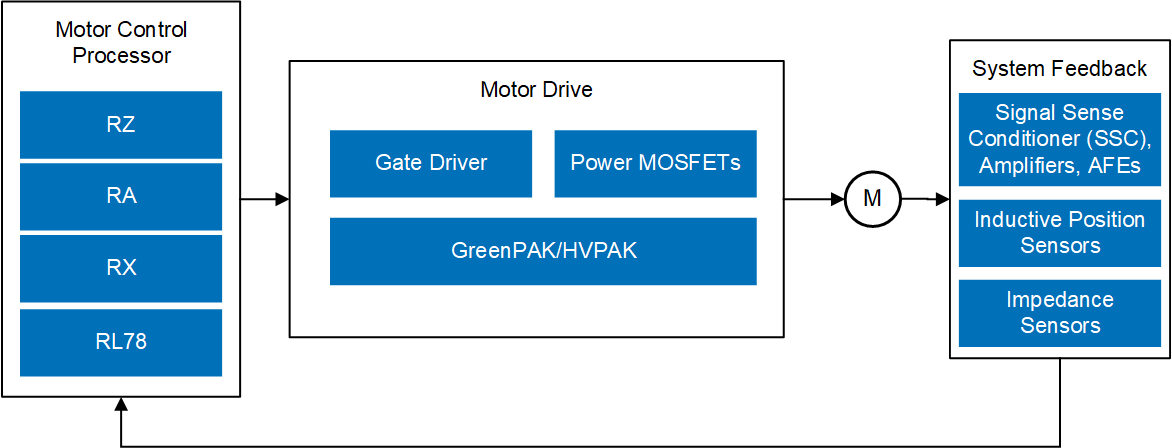
The fundamental building blocks to drive a robotic hand system to complete are comprised of the following subsystems and functions:
- System Governance: Action dictation based on pre-defined algorithms or AI for real-time decision making.
- Motor Control: Control signal and logic management.
- Motor Drive: Power amplification from control signals to drive motors to meet the required movement.
- Motor & Hand Feedback: Feedback from motor performance for determination.
System Governance
System governance determines what prompts the action of a robotic hand and is dependent on the task level corresponding to a robot's autonomy: Handling dynamic tasks (requiring active decision making in cases of a dynamic environment and/or variable objects) vs. standardized tasks (static environment, expected workflow, uniform objects).
An industrial robot deployed and tasked with picking up and holding metal panels in place for car assembly would need to be streamlined and fast. Thus, the system governance may be handled by an Industrial Programmable Logic Controller (PLC) with a fixed system governance to streamline its actions and strive for high process efficiency.
On the other hand, a food delivery robot (or Service Robot) that is tasked to deliver food in a restaurant to the right table and place the plate on the table without spilling its contents would likely need an AI-enabled system governance where its governance processing system can sense (and/or see) and make active decisions on how the hands should behave (ex. holding the bowl to place correctly on the table with the right person, making sure the content doesn't spill depending on how full the bowl is, etc.).
The actions of a robotic hand depend on the system governance—whether that is a streamlined control algorithm or a dynamic AI-enabled system.
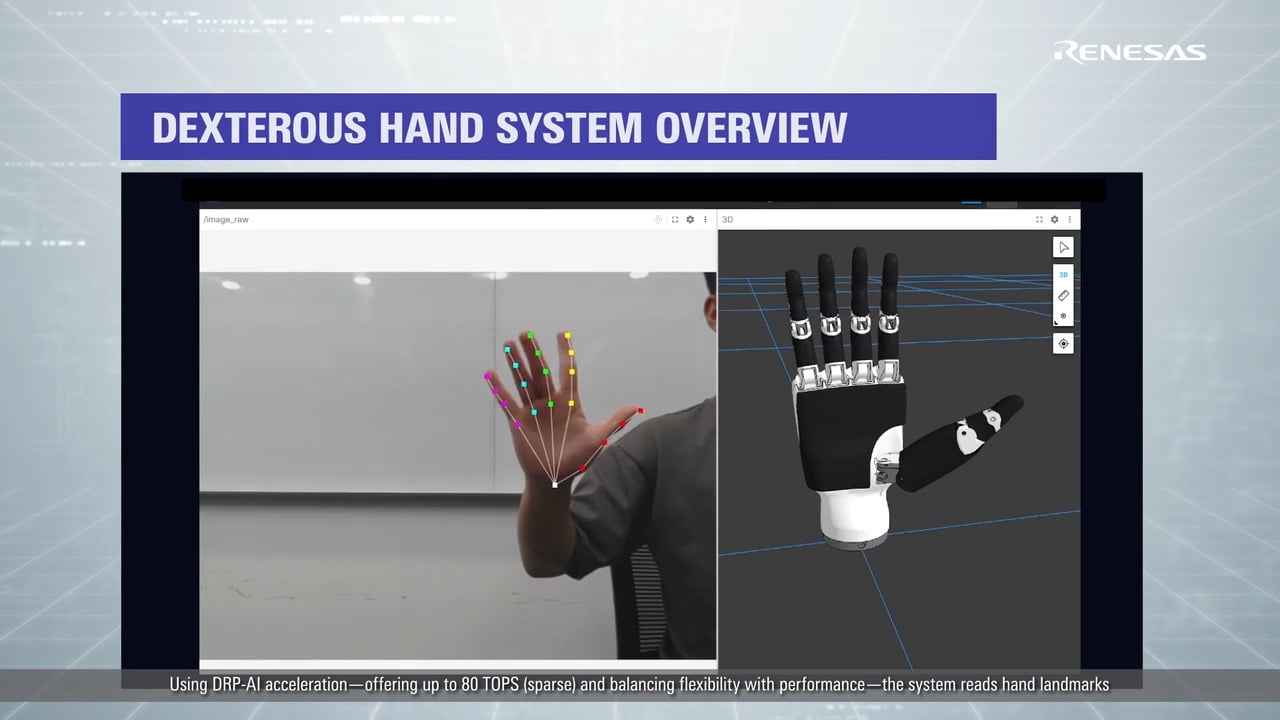
An example of a dynamic AI-enabled system in a robotic hand application is Renesas' demonstration of a Dexterous Hand System with AI Vision leveraging a high-performance Vision AI MPU to enable intelligent gesture-based control. The Vision MPU interfaces with cameras for visual input and runs edge AI processing to accurately control and enable a robotic hand to mimic the movements detected by the camera.
Motor Control
Once the system governance has decided to order an action, it is sent to the robotic hand system, where motor control handles the real-time control signals and logic management that drive motion.
In robotic hands, motor control is where high-level intent becomes physical interaction. A hand may need to close around an object without crushing it, maintain grip as the robot moves, and coordinate multiple joints so fingertips follow a smooth, repeatable path. These behaviors depend on how quickly and accurately each motor can be commanded, and how well the controller can close the loop using position, current/torque, and force feedback. As the use case shifts from simple pick-and-place of uniform parts to handling fragile, variable objects in dynamic environments, the motor-control demands (and the architecture behind them) scale accordingly.
This function is typically handled by a microcontroller (MCU) or microprocessor (MPU), which interfaces with the system governance or user interface and connects to sensors, feedback circuits, and the motor drive stage. In addition to handling communications and signal routing, the motor-control processor runs the control algorithms that determine how each motor is driven. Key selection inputs include the number of motors to be controlled, the required control-loop performance and computational complexity, and the types of sensing and feedback used at the motor and hand level.
The motor control of the hand may be cascaded and used with multiple motor control and drive systems and subsystems. Depending on the subsystem (motor control for the wrist, finger, etc.) and the fragility and/or size of objects that the hand is interacting with, picking the controller requires considerations of the motion, accuracy, and precision needed for the task.
A few examples of different motor control configurations (which also include the motor drive circuitry) to suit a variety of hand interactions and needs (from motor type to influence motion types and object interactions to the number of motors able to be controlled, provisions for industrial communication and functional safety, sensor interface provisions, and more) are shown below.
Example Motor Control Application Block Diagrams
- Servo Motor Control: Stepper motors for angular motion and holding torque
- BLDC Motor Control with Resolver: BLDC motors for smooth continuous motion and high precision
- 6‑ and 9‑Axis Industrial Motor Control with Ethernet: Scalable high-performance motor control with advanced arithmetic processing, motion planning, and trajectory formation.
- Motor Control System with Industrial Network and Functional Safety: High-performance and high precision motor control for multiple motors (up to 9) and integrated functional safety architecture
The motor control of a robotic hand ultimately depends on the end application use case for what the robot is doing: how dexterous the hand needs to be, what tasks it's doing, what types of objects it's handling, and more.
From our prior examples, an industrial robot helping within factory assembly lines may require a Motor Control System with Industrial Network and Functional Safety to comply with safety regulations for its intended use case. On the other hand, if the intended use case of a robotic hand is to function as an assistive dexterous arm to help feed individuals with physical impairments, a BLDC Motor Control with Resolver can provide smooth and continuous motion while delivering high precision for fine motor tasks.
The right motor control processor can enable and elevate a robotic hand's use case. You can refer to our motor control processor guide to help you in starting to select the right device for your robotic hand needs.
Motor Drive
After the motor-control processor determines what each actuator should do, the motor drive provides the electrical power needed to make that motion happen. A motor drive is required because a controller's outputs can only generate low-power command signals (such as PWM, step/direction, or current targets), while the motors in a robotic hand require higher current and specific voltage waveforms to produce torque and movement.
In practice, the drive stage combines power amplification, phase switching, current regulation, and protection features so the hand can move efficiently and respond predictably across varying loads and contact conditions.
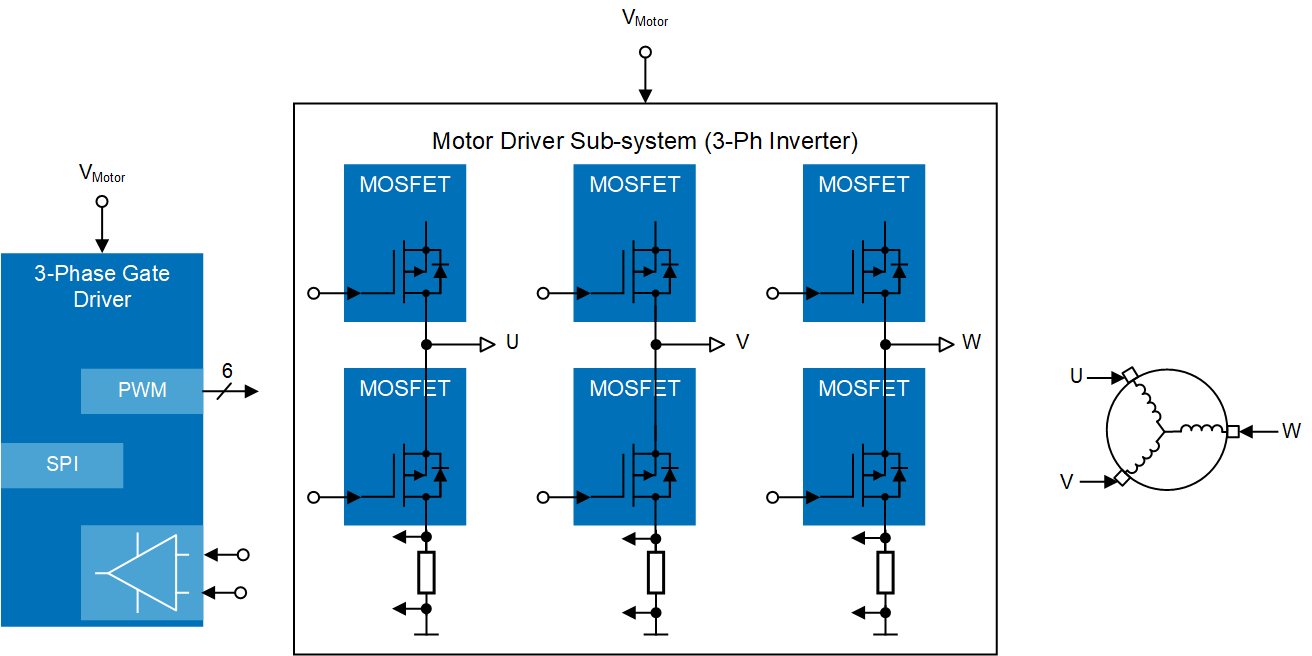
Motor-drive implementations can look very different across a single hand, depending on the motor type (servo, stepper, BLDC) and the power level of each joint or finger. At a high level, a drive chain typically includes building blocks such as gate drivers and power MOSFETs to switch and regulate current, along with supporting circuitry for sensing and fault handling. In some architectures, programmable mixed-signal devices (ex., HVPAK - high-voltage programmable mixed-signal devices) can also be used to implement or offload glue logic and protection functions around the drive stage.
An example drive chain leveraging a 3-phase inverter architecture with a gate driver can be used as follows:
Motor & Sensor Feedback
A robotic hand does not stop at only determining what the hand should do, but also how it should be controlled and driven. Motor feedback and sensors are critical to enable closed-loop interactions such that the hand is measuring and actively correcting its actions in real-time.
Feedback is essential for hands as they are interacting with the objects and environments around them: loads change when objects are lifted, unexpected collisions or stalling can occur, and so much more. Continuous sensing of essential parameters such as motor position, speed, torque, contact forces, and more ensures that the hand can maintain its action accuracy, regulate grip or contact force, detect faults, and adapt to variation in object size, shape, and fragility.
A variety of sensors and signal conditioning can be integrated into a robotic hand to provide:
- Position and velocity feedback to confirm where each joint is and how fast it is moving for accurate trajectories and repeatable grasps.
- Current/Torque feedback to help regulate motor torque and achieve smooth motion and control grip strength.
- Force/Tactile feedback with force sensors and pressure arrays to indicate contact, slip, and applied force at the fingertips for delicate handling.
Different sensors are placed in key areas in the hand system to measure different parameters like pressure and position. These readings need to be amplified, conditioned, and processed such that the system controller can accurately and reliably read this sensor data and act accordingly to correct the hand's motion and behavior.
Especially as hands scale to multiple degrees of freedom, feedback becomes even more important. The controller must coordinate many joints while also using force and torque information to avoid damaging objects or the hand itself.
In an earlier example of a robotic hand picking strawberries, the hand must be able to detect contact forces and slip to adjust its grip in real time, picking up a strawberry without crushing it and improving repeatability with more delicate manipulation. Likewise, if a robotic hand were functioning as an assistive feeding arm for a human, it needs to know where to stop when it comes into contact with someone's mouth and does not move further.
Force sensing helps distinguish free motion from contact, enabling safer interaction and more controlled grasping. With closed-loop force feedback and a consistent sensor interface, the hand can achieve higher repeatability during grasping and placement tasks.
Some critical signal conditioning and sensors to enable a robotic hand's feedback can be explored here:
- Signal Conditioning
- Sensors
Putting it all Together: Building a Dexterous Hand System
With the essential building blocks of system governance, motor control, motor drive, and feedback systems, you can design the system architecture of a dexterous hand to suit whichever use case and end application you require.
For example, the diagram below shows the architecture for a high-performance dexterous hand system with 17 degrees of freedom (DOF) that can be deployed onto a humanoid robot or other system to enable the ability to do complex, fine motor movement tasks.
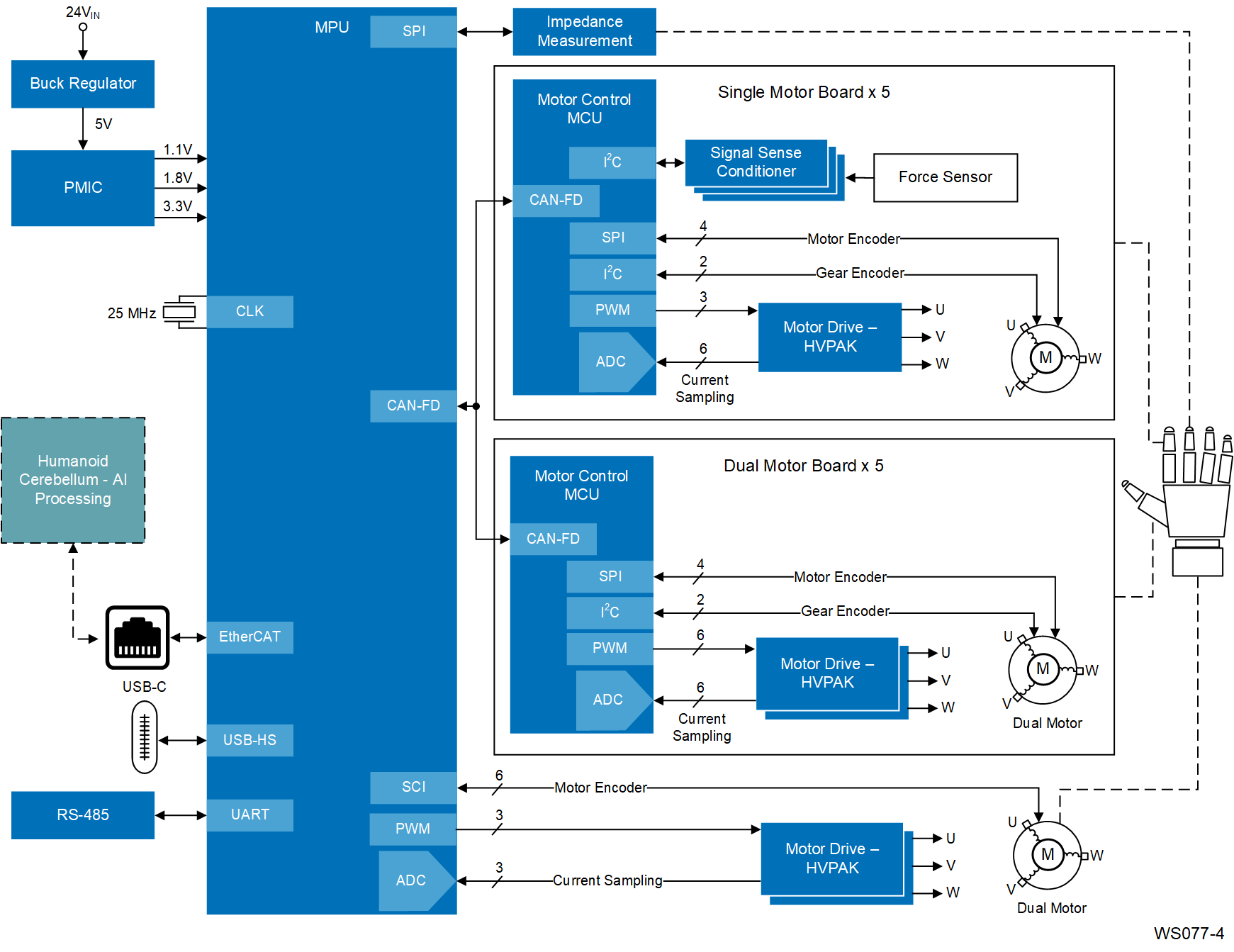
System Governance: Beginning with what spurs the hand's action, we start with system governance. This example architecture leverages a dynamic system governance, where it's connected to the "cerebellum" of a larger humanoid robot to perform AI processing and system integration. A humanoid robot would leverage Vision AI, voice recognition, visual mapping/navigation, etc., to process and then send commands to the hand system to act accordingly.
A fixed system governance can also be realized through connections over the available interfaces of EtherCAT®, USB, or RS-485 to have the hand be controlled via a laptop GUI, PLC, etc., depending on the end application use case.
Motor Control and Drive: As this dexterous hand architecture is a high-performance hand system capable of 17-DOF, there are multiple motor control processors to interface with each moving part of the hand, from multiple finger joints to wrist movement. Each foundational hand movement is controlled by a motor control processor, equipped to do the motor system control of each dedicated part, as well as a motor drive to move the hand/finger/joint in the right manner.
Many of these systems can be stacked and interconnected through interfaces like CAN FD to provide seamless integration and fluid movement. This is done for this 17-DOF architecture, as many motor subsystems are required for each joint articulation.
Take, for instance, the motor control processor controlling the distal joint (end/furthest joint) of a finger, which controls a single motor system. It takes a system governance action from the main hand controller and handles the logic processing and algorithms of how to drive the single distal joint. It then coordinates with the motor drive component (HVPAK) to provide joint actuation as well as other logic and signal inputs, such as gear or motor encoding to provide the intended joint articulation.
Sensor Integration and System Feedback: Beyond just driving signals such as PWM or encoding logic, the motor control processor also integrates feedback from the motor and sensors deployed.
In this example, pressure sensors and force sensors are interlaid within the hand itself, such that it knows when it's touching something, how hard to grip something, etc. ICs providing impedance measurement, signal sense conditioning, and current sensing to sense themselves or interface with sensors are critical to close this feedback loop with the motor controller, such that the hand operates safely and correctly with the objects and environment around it.
Conclusion
Robotic hands are not one-size-fits-all: The environment, the variability and fragility of the objects being handled, and the level of autonomy all drive what "dexterity" means for a given system.
The top-level requirements of a robotic hand map into the core building blocks behind hand actuation: Starting with system governance (what the hand should do), then motor control (how motion is commanded and coordinated), motor drive (how electrical power is delivered to the actuators), and finally motor and sensor feedback (how the system measures results and corrects in real time).
Curious to learn more? Check out our example system block diagram of a Dexterous Hand or visit our Robotics application page to get more system block diagrams, reference designs, and products to enable dexterity in your robotic hands!