The field of humanoid robotics is one of the most dynamic and expansive innovation opportunities of the century. Concurrent breakthroughs in AI, embedded computing, sensing, motion control, and power efficiency are fueling growth projections that could double annually through the end of the decade. And long-term expectations are even more ambitious, with humanoid robot deployments potentially reaching one billion by 2050.
For Renesas, this is more than the emergence of a new product category. From our vantage point at the nexus of multiple enabling technologies, we believe our humanoid robotics business will help lead the next phase of artificial intelligence evolution.
For the past decade, much of the technology industry's focus has been on what many call intelligent edge computing. AI models moved closer to end devices, enabling faster responses, lower latency, and reduced dependence on cloud connectivity. Humanoid robotics encapsulates the next stage of that journey: physical AI.
Physical AI represents the evolution of AI into the physical domain and operates on a different model from traditional AI applications.
A generative AI chatbot can return an incorrect answer. A recommendation engine can make a poor suggestion. A humanoid robot operating in the physical world does not have that luxury. Every decision has real-world consequences involving movement, object manipulation, and safety thresholds that must be maintained with each human-to-machine interaction. The robot system must continuously perceive its environment, make decisions, and execute actions with deterministic, low-latency responsiveness.
This transition poses a major architectural challenge. While cloud resources support training, updates, fleet learning, and higher-level planning, humanoid robots cannot rely entirely on a cloud-based brain when critical decisions must be made instantly. As intelligence moves closer to the machine, functions such as balance, movement, perception, and safety require local processing at the edge.
That requires a distributed intelligence model that combines cloud computing with edge-based decision making. This is where Renesas expects to play a significant role.
Why Physical AI Changes the Game
The rise of physical AI expands the conversation—and opportunity—far beyond silicon.
Much of today's AI discussion centers on processors and accelerators. Humanoid robotics certainly requires powerful compute resources, but this is only one element of a much larger system. Every robot must sense its environment, interpret data, control motion, manage power, and interact safely and reliably with people and objects.
That reality creates a full-stack opportunity where physical AI works as a coordinated system spanning sensing, processing, connectivity, actuation, power management, functional safety, software, and development tools.
For Renesas, this is not a new challenge. It is the convergence of capabilities the company has been developing for decades.
Our expertise spans industrial automation, automotive electronics, advanced driver assistance systems, motor control platforms, embedded processing, sensing technologies, power management solutions, and factory-floor safety systems. Those skills are directly transferable to humanoid robotics and the unique requirements of physical AI.
Breaking Complexity into Four Domains
Complexity is one of the defining characteristics of humanoid robotics. It requires a structured approach that has led Renesas to organize its business around four interconnected domains: Brain and Motion, Sensing, Actuation, and Power Management.
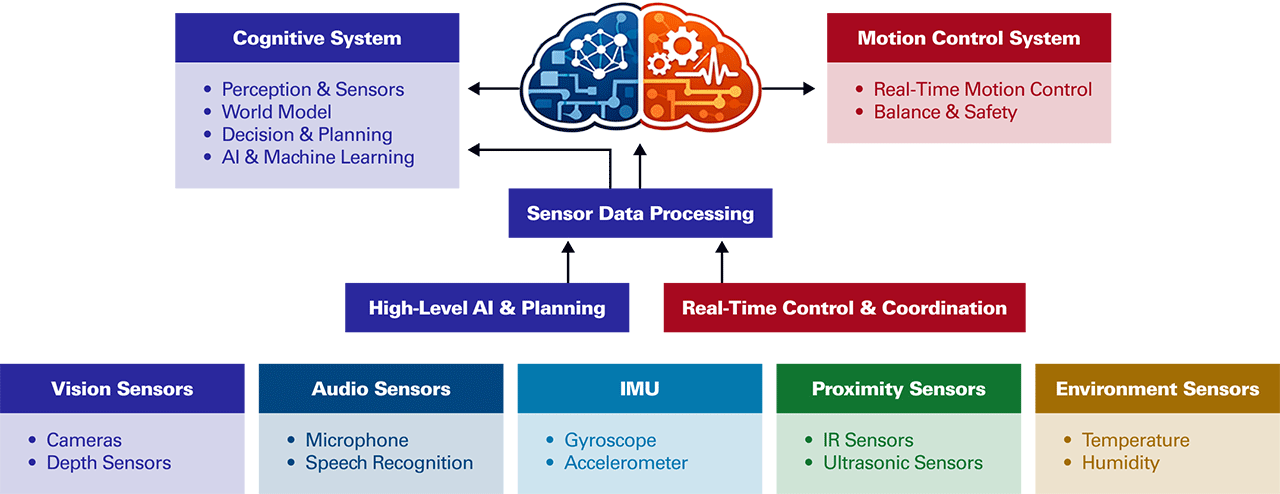
Together, Brain and Motion combine edge AI with deterministic real-time control while operating within strict constraints that govern latency, memory, compute resources, and power consumption. This domain enables robots to interpret information and coordinate movement in real time.
Sensing acquires and interprets information from the physical world. For humanoid robots, this requires synchronized inputs from vision systems, inertial sensors, and position sensors, in addition to sensors that measure and react to force, touch, and the environment. These inputs must be captured with high accuracy and minimal latency.
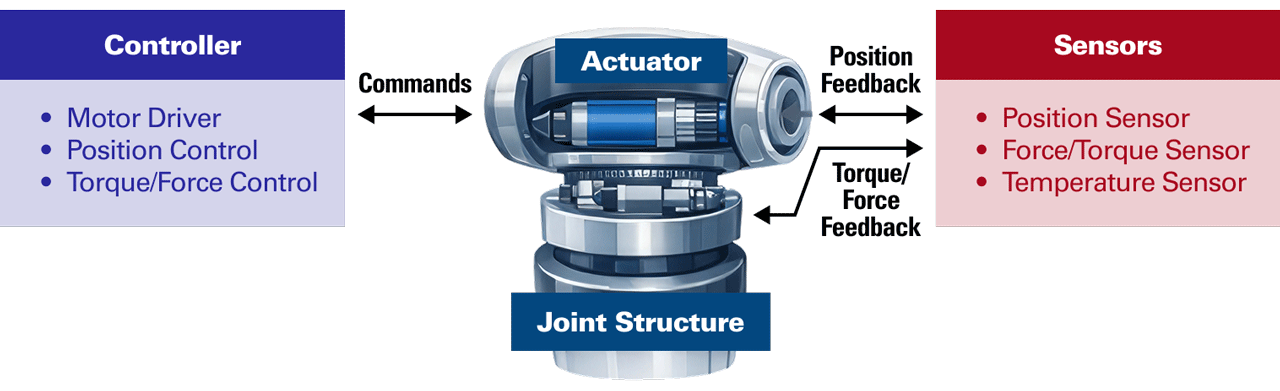
Actuation transforms intelligence into motion. It combines motor control microcontrollers, gate drivers, power devices, feedback loops, and control algorithms to enable precise and responsive movement.
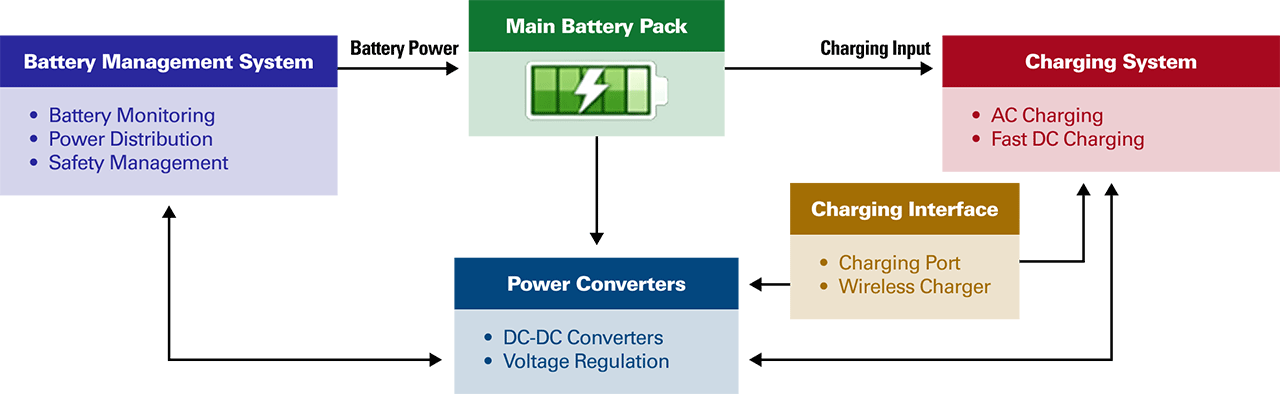
Power Management ensures that increasingly sophisticated robots operate efficiently and reliably. Battery management, power conversion, charging systems, thermal optimization, and distributed power delivery ensure robot operation and autonomy.
Renesas views these domains as interdependent subsystems that must operate together as a unified platform. The challenge is not solving individual technical problems but understanding how subsystems connect and interact as part of a whole.
Building on a Legacy of Innovation

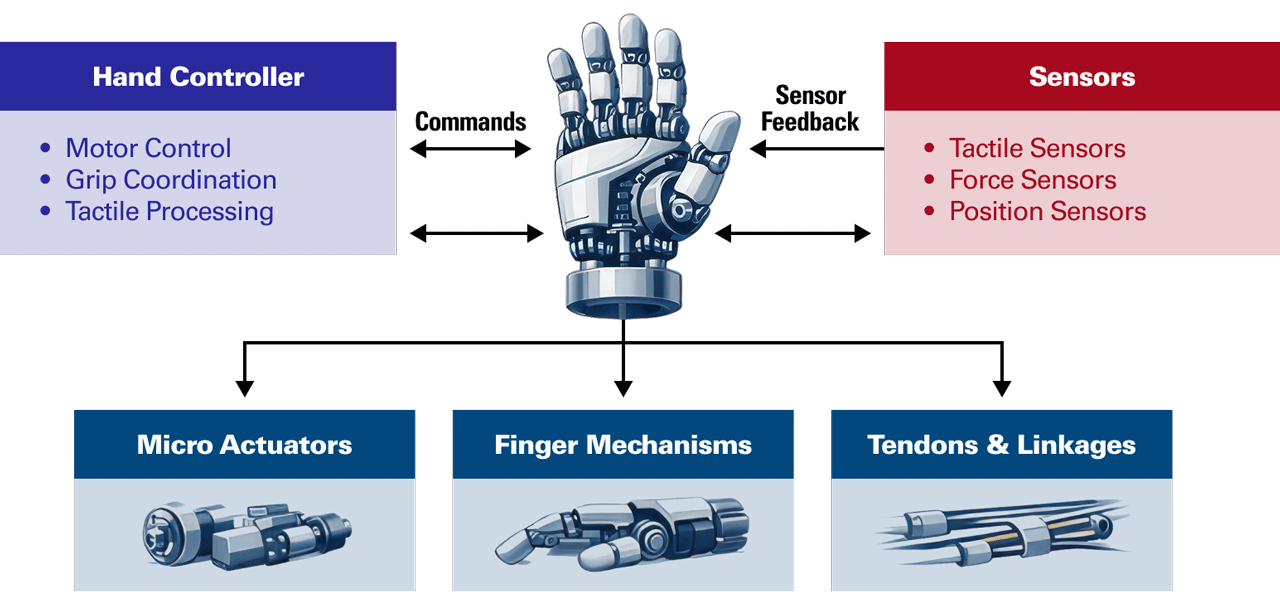
Renesas' industrial robotics experience provides a strong foundation for precise motion control, position sensing, and real-time system management. We have years of expertise designing robotic arms and other automated systems where accuracy, efficiency, and reliability are paramount. Those same requirements apply to humanoid joints and limbs.
Likewise, our automotive development expertise translates directly into humanoid systems by parlaying what we've learned by enabling modern vehicles into physical AI applications.
Cross-industry knowledge transfer gives Renesas a significant advantage by adapting proven capabilities to emerging robotics requirements without developing an entirely new technology stack.
From Components to Systems
Another important shift is the move from individual semiconductor components toward complete robotic subsystem and platform solutions. Customers need reference designs, software frameworks, development environments, simulation tools, and implementation guidance to reduce complexity and accelerate deployment.
Renesas is investing in subsystems and platforms such as dexterous robotic hands, servo motor control systems, sensing architectures, high-performance vision, robot development kits, and safety pre-certifications that accelerate compliance and deployment to help customers move from evaluation to implementation more quickly. These efforts simplify development while helping ecosystem partners focus on differentiation rather than rebuilding foundational technologies.
We are also training new development tools and environments, like Renesas 365, our intelligent, cloud-based platform for embedded systems design and lifecycle management. Renesas 365 connects the design process end to end so customers can reduce friction between software and hardware teams and move faster from concept to implementation. These pre-validated solutions accelerate compliance and deployment.
This reflects Renesas' broader design and commercialization philosophy. Success in humanoid robotics will not be determined solely by who builds the most powerful processor. It will depend on how effectively the industry integrates multiple best-of-breed technologies into cohesive and complementary systems.
The Road Ahead
Humanoid robotics is in its early stages, but the trajectory is clear. As AI moves from digital environments into the physical world, system complexity will continue to rise. That will create demand for advanced computing architectures as well as the sophisticated development ecosystems that surround and enable them.
Renesas views this transition as a natural extension of our broader intelligent edge computing and digitalization strategy. By bringing together expertise in Brain and Motion, Sensing, Actuation, and Power Management, we're helping customers navigate the transition from intelligent edge systems to physical AI.
In many important ways, humanoid robotics is not a new frontier for Renesas. It's a convergence of multiple worlds we already know well.