Renesas Electronics Corporation

Description

The RL78/G16 Fast Prototyping Board, featuring the RL78/G16 microcontroller, is ideal for various prototype developments. It supports Modbus ASCII/RTU communication and so on by sample code. The built-in emulator circuit that is equivalent to E2 emulator Lite allows programming and debugging without extra tools. Additionally, it has Arduino Uno and Pmod™ interfaces, access to all microcontroller pins, and high scalability. It includes two touch buttons and one slider using a capacitive sensor unit, unique to RL78/G16. Renesas also provides an Arduino library that supports creating various programs (sketches) on the Arduino IDE.

Note: This board comes with two touch buttons and one slider using a capacitive sensor unit for simple evaluation, but when designing an actual board, please check the Capacitive Sensor Microcontrollers CTSU Capacitive Touch Electrode Design Guide (R30AN0389) and use the Capacitive Touch Evaluation System for RL78/G16 (RSSK-RL78G16) for evaluation.
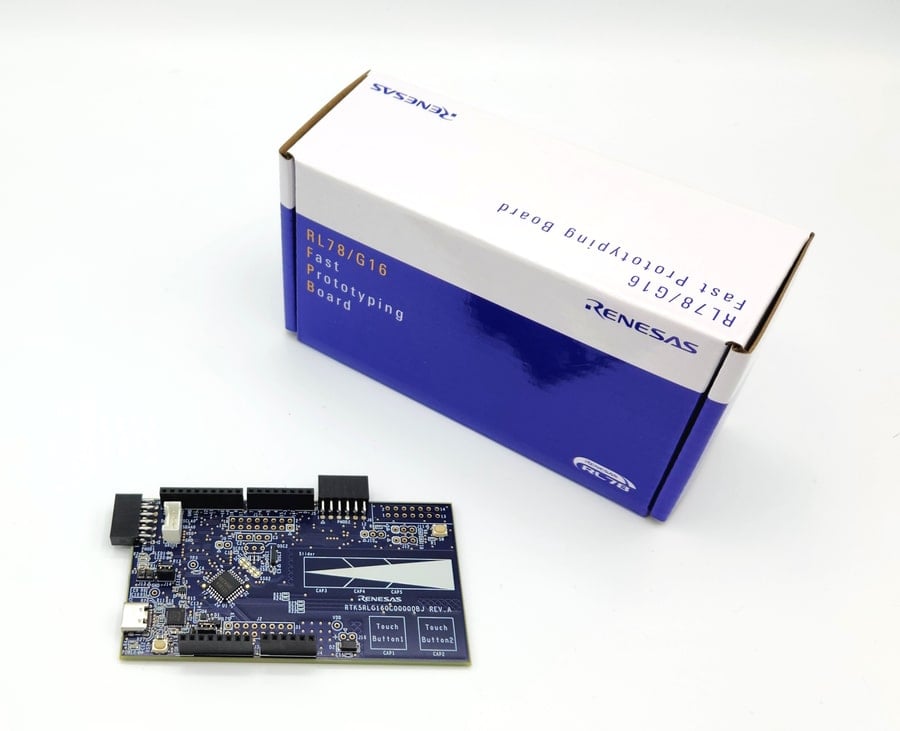
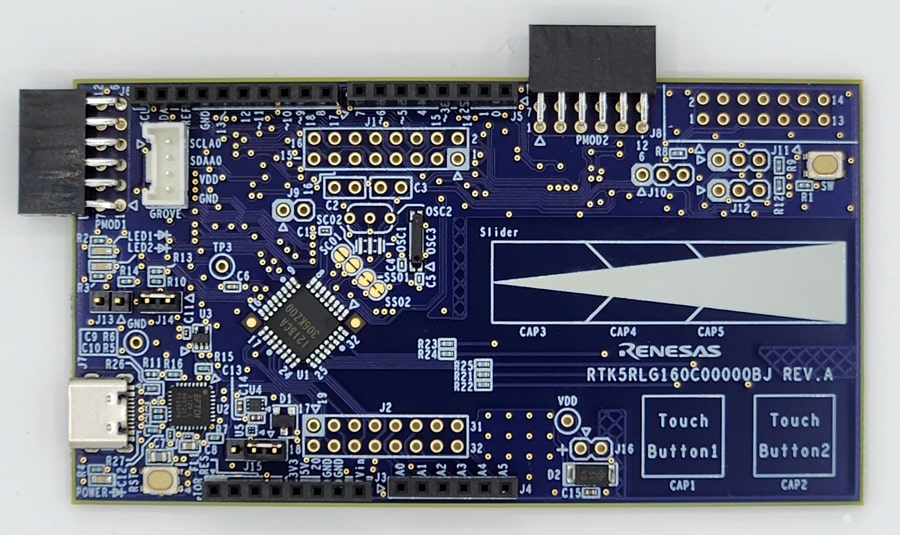
Features

  • Equipped with an RL78/G22 16-bit microcontroller (R5F121BCAFP)
    • 32MHz, RL78-S2 Core
    • ROM: 32KB, RAM: 2KB, Data Flash 1KB
    • 32-pin LQFP, 7mm x 7mm x 1.7mm, 0.8mm pitch
  • Programs can be written and debugged via the COM Port communication by connecting it to a PC with a USB cable
  • Able to access all the microcontroller pins
  • Comes standard with Arduino Uno, Pmod™ and Grove interfaces
  • Arduino library available
  • Equipped with capacitive touch sensor buttons
  • Support for various RL78 software and tools

Applications

Type Title Date
Manual - Development Tools PDF 3.67 MB 日本語
Quick Start Guide PDF 509 KB
Schematic PDF 1.08 MB 日本語
Other PDF 231 KB 日本語
Application Note PDF 5.29 MB 日本語
AI-generated Summary: The document explains how to develop capacitive touch applications using the RL78/G22 fast prototyping board and the standalone version of QE for Capacitive Touch. It details creating projects with the Smart Configurator, tuning touch interfaces, and monitoring their operation. The development environment includes CS+ IDE, Smart Configurator, and QE tools. It supports RL78 family devices with capacitive sensing units and covers hardware and software setup, touch interface configuration, and sample application development. The document also provides detailed procedures for hardware timer use and code generation.
Application Note PDF 408 KB 日本語
AI-generated Summary: Fast Prototyping Boards for RL78/G15 and G16 disable using the reset pin as an I/O port via option byte settings, causing inability to write or debug via COM port after programming with PORTSELB = 0. This occurs because the reset pin, required for entering Flash Memory Programming Mode, functions as a port during COM connection, preventing flash programming. Recovery involves rewriting option bytes to PORTSELB = 1 using an IDE, Renesas Flash Programmer, or a dedicated recovery application that holds the reset pin low during connection to enable flash erase and rewrite operations.
Application Note PDF 405 KB 日本語
AI-generated Summary: The document explains how to implement handshake-based SPI master transmission and reception using the serial array unit (SAU) with the RL78/G16 microcontroller. It details the use of chip select (CS) and BUSY signals for slave device selection and handshake synchronization. The communication follows the CSI protocol, utilizing serial clock (SCK), serial data input (SI), and serial data output (SO) lines. Commands such as status check, receive, transmit, and transmit/receive operate in 1 ms slots. Peripheral functions including timers and ports are configured to support these operations. Timing charts illustrate the command sequences and data flow between master and slave devices.
Application Note PDF 324 KB 日本語
AI-generated Summary: The document explains handshake-based SPI slave communication using the serial array unit (SAU) in RL78/G16 microcontrollers. It details how the slave device uses chip select (CS) and BUSY signals to synchronize and communicate with the master via clock-synchronous serial interface (CSI). Communication occurs in 1 ms slots, supporting commands such as status check, transmit, receive, and transmit/receive. The BUSY signal indicates slave readiness, ensuring proper handshake during data transfer. Peripheral functions like serial array unit, port pins, and external interrupts facilitate this communication. Timing charts illustrate command execution and data flow between master and slave.
Application Note PDF 368 KB 日本語
AI-generated Summary: Distance measurement to an object uses an ultrasonic sensor controlled by the RL78/G16 microcontroller's Timer Array Unit (TAU). The sensor emits a trigger signal and measures the echo signal's high-level width, which corresponds to the time-of-flight of the ultrasonic wave. This time is converted to distance using the speed of sound. The measured distance is displayed on a 16×2 LCD via I2C communication. The system averages multiple measurements to reduce noise and updates the display continuously, handling distances up to 999.9 cm with an 'OVER' indication beyond that range.
Application Note PDF 280 KB 日本語
AI-generated Summary: The document explains how to use the fixed-cycle interrupt and alarm interrupt functions of the RL78/G16 Realtime Clock 2 (RTC2). It details setting the RTC2 to display time on an LCD and control output ports, including toggling port P12 every 0.5 seconds and triggering an alarm interrupt on port P15 five seconds after a set time. The document covers initialization of RTC2, I/O ports, serial interface IICA0 for LCD communication, and LED control. It also specifies operation conditions, hardware configuration, and software flowcharts for implementing these functions effectively.
Application Note PDF 199 KB 日本語
AI-generated Summary: The Timer Array Unit (TAU0) on the RL78/G16 measures pulse intervals by capturing timer counts at valid rising edges on the TI00 input pin. Each detected edge triggers a capture interrupt, storing the measured interval in on-chip RAM. The process involves initializing TAU0 channel 0 in capture mode, enabling interrupts, and repeatedly measuring pulse intervals up to eight times. The document details the hardware setup, software flow, and operation conditions required for accurate pulse interval measurement using TAU0.
Application Note PDF 1.46 MB 日本語
AI-generated Summary: Modbus communication operates using a single-master/multi-slave architecture over serial interfaces, primarily Modbus ASCII and Modbus RTU modes. Modbus ASCII sends data as ASCII characters, making parsing easier but increasing transmission time, while Modbus RTU transmits binary data, reducing transmission time but requiring precise timing for parsing. The protocol supports up to 247 slaves, each with a unique address, and commonly uses RS-485 physical layers. The RL78 microcontroller combined with Renesas RS-485 transceivers enables efficient Modbus communication for industrial automation, supporting low-power operation and I/O control. The document details hardware and software configurations, including UART settings, timing measurements, and interrupt handling for both master and slave modes in ASCII and RTU formats.
Application Note PDF 224 KB 日本語
AI-generated Summary: The interval timer function of the RL78/G16 Timer Array Unit (TAU) controls LED inversion based on timer interrupts (INTTM00). The timer interrupt cycle changes according to switch press counts, altering LED on/off intervals through preset timing steps (500 ms to 62.5 ms). The setup involves initializing TAU0 in interval timer mode, configuring I/O ports, and setting external interrupts for switch input detection. Timer interrupts count to 250 before toggling the LED, and switch inputs adjust the timer cycle dynamically. The document details peripheral functions, operation flow, hardware configuration, and sample code for implementation.
Application Note PDF 201 KB 日本語
AI-generated Summary: The Timer Array Unit (TAU0) measures pulse intervals by detecting rising and falling edges on the TI00 input pin, capturing timer counts to determine high-level and low-level pulse widths. Measurement results store in on-chip RAM. The process uses capture end interrupts to ensure accurate timing, discards invalid short pulses, and repeats measurements multiple times. Initialization involves setting TAU0 channel 0 to capture mode with both-edge detection and enabling interrupts. The sample code operates under specified hardware and software conditions, including RL78/G16 MCU, 16 MHz clock, and various development environments.
Application Note PDF 365 KB 日本語
AI-generated Summary: The PWM output function uses the timer array unit (TAU0) channels 0 and 1 to control LED brightness by adjusting the duty cycle of PWM signals at 500 ms intervals. Channel 0 operates as a master timer generating interrupts every 2 ms, counting up to 250 interrupts to trigger duty cycle changes on channel 1, which acts as a slave. The duty cycle cycles through 10%, 30%, 50%, 70%, and 90%, inversely affecting LED brightness. The TO01 pin outputs the PWM signal with an active-low level, and the program uses timer interrupts to synchronize duty cycle updates and LED indication inversion.
Application Note PDF 503 KB 日本語
AI-generated Summary: The document details the implementation of slave transmission and reception using the RL78/G16 serial interface IICA in a single-master I2C system. It covers slave address handling, data transmission, and reception protocols, including register address specifications and communication timing. The slave device supports reading and writing multiple bytes within a defined serial RAM area. The document also explains IIC communication timing charts, interrupt handling, and control registers essential for managing data flow and acknowledgements between master and slave devices.
Application Note PDF 170 KB 日本語
AI-generated Summary: The RL78/G16 A/D converter converts analog voltages input through the P03/ANI2 pin into 10-bit digital values, storing results in internal RAM. The CPU enters HALT mode during conversion and resumes upon an interrupt signaling conversion completion. The conversion result is right-shifted by six bits before storage. Hardware configuration includes specific pin usage and voltage requirements. Operation has been validated on the RL78/G16 MCU with detailed development environment and compiler support. Sample code and flowcharts illustrate initialization, interrupt handling, and data processing steps.
Application Note PDF 603 KB 日本語
AI-generated Summary: The document explains how to implement master transmission and reception using the RL78/G16 microcontroller's serial interface IICA in a single-master system. It details address transmission, data transmission, and reception procedures, assuming slaves with specific addressable registers and serial RAM. The master selects slaves by their unique 7-bit addresses and communicates through IIC protocol timing and control signals. It includes hardware and software configurations, timing charts, sample code, and peripheral function usage for effective IIC communication.
PCB Design Files ZIP 1.97 MB
19 items

Software & Tools

Software & Tools

Software title
Software type
Company
E2 emulator [RTE0T00020KCE00000R]
On-chip debugging emulator. Also available as a flash memory programmer. [Support MCU/MPU: RA, RE, RH850, R-Car D1, RL78, RX, RISC-V MCU]
Emulator Renesas
E2 emulator Lite [RTE0T0002LKCE00000R]
On-chip debugging emulator. Also available as a flash memory programmer. [Support MCU/MPU: RA, RE, RL78, RX, RISC-V MCU]
Emulator Renesas
C Compiler Package for RL78 Family [CC-RL]
C Compiler Package for RL78 Family [IDE: CS+, e² studio]
Compiler/Assembler Renesas
CS+
Renesas integrated development environment (IDE) [Support MCU/MPU: RH850, V850, RX, RL78, 78K0R, 78K0] (Note: CS+ is not generally promoted to U.S. and European customers.) (Note: To use Smart Configurator on CS+ for RL78/G23 and RX family MCUs, install the Smart Configurator for each MCU family separately downloading from ”Design & Support” > ”Development Tools” > ”Smart Configurator”)
IDE and Coding Tool Renesas
e² studio - information for RL78 Family
Eclipse-based Renesas integrated development environment (IDE).
IDE and Coding Tool Renesas
IAR Embedded Workbench for Renesas RL78
IAR Embedded Workbench provides extensive support for RL78 devices. IAR Embedded Workbench is a complete set of development tools with leading optimization technology for creating powerful automotive applications.
IDE and Coding Tool IAR Systems
Renesas IAR Embedded Workbench Device-Support-Packages
Renesas IAR Embedded Workbench Device-Support-Packages include all device-specific files to be used with the Embedded Workbench IDE.
IDE and Coding Tool Renesas
QE for Capacitive Touch: Development Assistance Tool for Capacitive Touch Sensors
In developing embedded system using the capacitive touch sensor of MCUs, you can easily setup initial configurations of the touch interface as well as process the tuning of sensors, and reduce development time. [Plugin for Renesas IDE "e2 studio"] [Standalone Version] [Support MCU/MPU:RA, RL78, RX, Renesas Synergy™]
Solution Toolkit Renesas
8 items

Software Downloads

Type Title Date
Board Description File ZIP 1 KB
1 item

Sample Code

Sample Code

Filters
Type Title Date Date
Sample Code
[Toolchains=CC-RL|V1.15.00]
Log in to Download ZIP 23.20 MB 日本語
Application: Consumer Electronics, Industrial
Compiler: CC-RL Function: Application Example, HMI IDE: CS+ for CC
Sample Code
Log in to Download ZIP 1.44 MB 日本語 Function: Programmer IDE: Microsoft Visual Studio Community 2022
Sample Code
[Toolchains=CC-RL|V1.13.00;IAR Compiler for RL78|v.5.10.1]
Log in to Download ZIP 7.61 MB 日本語
Application: Consumer Electronics
Compiler: CC-RL, ICCRL78 Function: Communication IDE: CS+ for CC, e2 studio, IAR EWRL78
Sample Code
[Toolchains=CC-RL|V1.13.00;IAR Compiler for RL78|v.5.10.1]
Log in to Download ZIP 7.33 MB 日本語
Application: Consumer Electronics
Compiler: CC-RL, ICCRL78 Function: Communication IDE: CS+ for CC, e2 studio, IAR EWRL78
Sample Code
[Toolchains=CC-RL|V1.12.01;IAR Compiler for RL78|v.5.10.1]
Log in to Download ZIP 8.33 MB 日本語
Application: Consumer Electronics
Compiler: CC-RL, ICCRL78 Function: Other IDE: CS+ for CC, e2 studio, IAR EWRL78
Sample Code
[Toolchains=CC-RL|V1.12.01;IAR Compiler for RL78|v.5.10.1]
Log in to Download ZIP 5.99 MB 日本語
Application: Consumer Electronics
Compiler: CC-RL, ICCRL78 Function: Timer IDE: CS+ for CC, e2 studio, IAR EWRL78
Sample Code
[Toolchains=CC-RL|V1.12.01;IAR Compiler for RL78|v.5.10.1]
ZIP 6.48 MB 日本語
Application: Consumer Electronics
Compiler: CC-RL Function: Timer IDE: CS+ for CC
Sample Code
[Toolchains=CC-RL|V1.12.01]
Log in to Download ZIP 5.70 MB 日本語
Application: Industrial
Compiler: CC-RL Function: Communication Interface IDE: e2 studio
Sample Code
[Toolchains=CC-RL|V1.12.01;IAR Compiler for RL78|v.5.10.1]
Log in to Download ZIP 7.05 MB 日本語
Application: Consumer Electronics
Compiler: CC-RL, ICCRL78 Function: Timer IDE: CS+ for CC, e2 studio, IAR EWRL78
Sample Code
[Toolchains=CC-RL|V1.12.01;IAR Compiler for RL78|v.5.10.1]
Log in to Download ZIP 6.49 MB 日本語
Application: Consumer Electronics
Compiler: CC-RL, ICCRL78 Function: Timer IDE: CS+ for CC, e2 studio, IAR EWRL78
Sample Code
[Toolchains=CC-RL|V1.12.01;IAR Compiler for RL78|v.5.10.1]
Log in to Download ZIP 5.77 MB 日本語
Application: Consumer Electronics
Compiler: CC-RL, ICCRL78 Function: Communication Interface IDE: CS+ for CC, e2 studio, IAR EWRL78
Sample Code
[Toolchains=CC-RL|V1.12.01;IAR Compiler for RL78|v.5.10.1]
Log in to Download ZIP 6.33 MB 日本語
Application: Consumer Electronics
Compiler: CC-RL, ICCRL78 Function: Serial Interface IICA IDE: CS+ for CC, e2 studio, IAR EWRL78
Sample Code
[Toolchains=CC-RL|V1.12.00;IAR Compiler for RL78|v.5.10.1]
Log in to Download ZIP 5.38 MB 日本語
Application: Consumer Electronics
Compiler: CC-RL, ICCRL78 Function: A/D Converter IDE: CS+ for CC, e2 studio, IAR EWRL78
Sample Code
[Toolchains=CC-RL|V1.12.01;IAR Compiler for RL78|v.5.10.1]
Log in to Download ZIP 6.74 MB 日本語
Application: Consumer Electronics
Compiler: CC-RL, ICCRL78 Function: Serial Interface IICA IDE: CS+ for CC, e2 studio, IAR EWRL78
14 items
Part NumberStatusStockBudgetary Price (USD)Sampleable
RTK5RLG160C00000BJActiveIn Stock1u | $23.53Available
Support Communities

Support Communities

Get quick technical support online from Renesas Engineering Community technical staff.
Browse Articles

Knowledge Base

Browse our knowledge base for helpful articles, FAQs, and other useful resources.
Submit a Ticket

Submit a Ticket

Need to ask a technical question or share confidential information?
Icon showing CD-ROM illustration, indicating compact disc storage.

ROM Ordering

Embed your custom code into Renesas masked MCUs during manufacturing for tailored device functionality.