Two megatrends—an aging global labor force and rapidly evolving AI infrastructure—are fueling the humanoid robotics market, with a consensus CAGR of roughly 35% through 2035. To sustain that blistering pace, the electronics industry must accelerate the transition from intelligent edge computing to physical AI in order to enable machines capable of perception and real-world decision making—without relying on the cloud.
But that’s not all.
I concluded my recent blog, "From Intelligent Edge to Physical AI: Why Humanoid Robotics Are Renesas' Next Opportunity," with an observation: the industry is less dependent on who builds the most powerful processor than on how well we collectively integrate best-of-breed technologies into highly complementary systems.
That reality creates extraordinary innovation potential. This is because successful robotics deployments require collaboration across a diverse engineering community capable of organizing hundreds of interconnected hardware and software technologies into intelligent systems. To describe it another way, the humanoid robotics market for Renesas is less of a semiconductor play than an opportunity to build and support a new ecosystem.
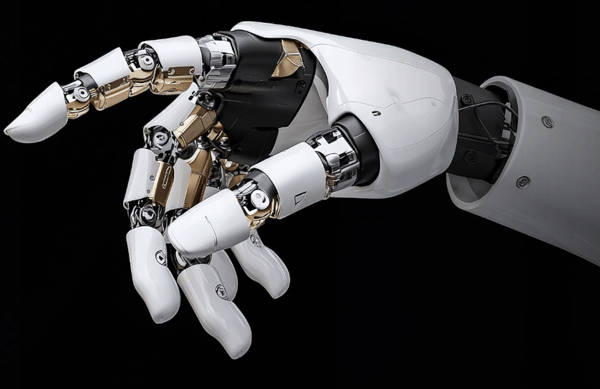
Physical AI Changes the Engineering Equation
Traditionally, embedded systems were designed around discrete engineering domains, with separate teams responsible for processing, sensing, power, and other hardware subsystems, while software integration occurred later in the development cycle. Physical AI changes that equation in that a humanoid robot must continuously observe its environment, fuse data collected by dozens or even hundreds of sensors, control complex motion, manage power efficiently, and make decisions in milliseconds. In this scenario, every subsystem influences the performance of every other subsystem. The challenge is no longer designing the best components or function blocks in isolation. It is uniting them into one organized and interdependent whole. That distinction matters because complexity grows exponentially as new features are added. A more capable vision system affects compute requirements. Additional sensing influences power budgets. More sophisticated motion control changes the software architecture. Functional safety spans the entire design rather than existing as an isolated development exercise.
The Ecosystem Is Becoming the Product
Today, no single company possesses every technology required to build a commercial humanoid robot.
Developers depend on AI framework providers, silicon foundries and semiconductor ODMs, cloud platforms, robotics software developers, systems integrators, standards organizations and, ultimately, customers who validate designs in real-world environments.
For Renesas, this level of collaboration is not unique. The automotive industry followed a similar path during the transition to electrification and software-defined vehicles. Early discussions focused on batteries, electric motors, and ECUs, but it soon became evident that EVs and SDVs required an entirely new ecosystem encompassing charging infrastructure, thermal management, software, functional safety, zonal architecture, manufacturing, and supply-chain coordination. Market adoption accelerated only after that ecosystem matured.
Humanoid robotics is approaching a similar inflection point.
Today's engineering discussions often center on processors or AI models, but commercial success will depend on how efficiently organizations can coordinate an expanding network of technologies, development partners, and design methodologies.
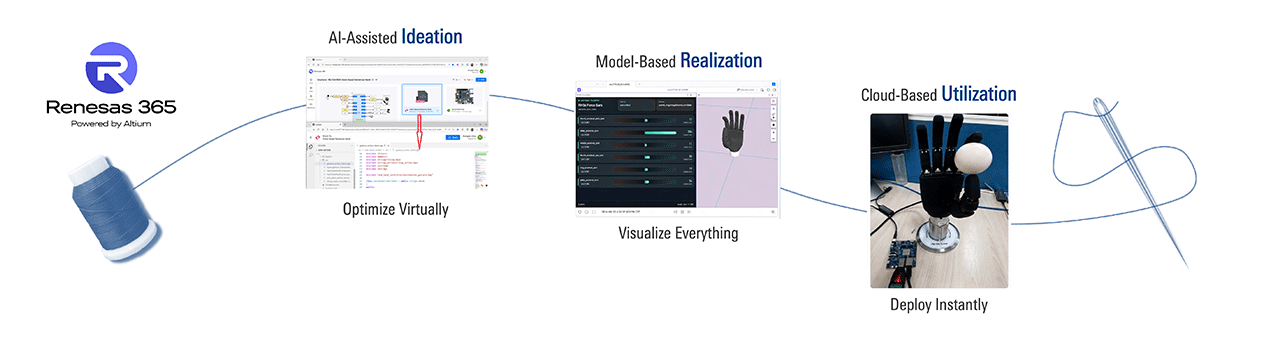
Breaking Down Complexity
One lesson we've learned is that complexity can’t be attacked as a single problem. Instead, it must be broken into relational subsystems that engineers can optimize independently while maintaining a clear understanding of how those subsystems ultimately interact.
This carries over to our robotics design philosophy. Rather than viewing a humanoid as one enormous engineering challenge, we organize development around domains such as Brain and Motion, Sensing, Actuation, and Power Management. Each domain presents unique technical challenges that require specialized expertise and different optimization goals.
Interfaces, software frameworks, development tools, and validation methodologies must work together as seamlessly as the hardware itself. System integration becomes as important as component innovation.
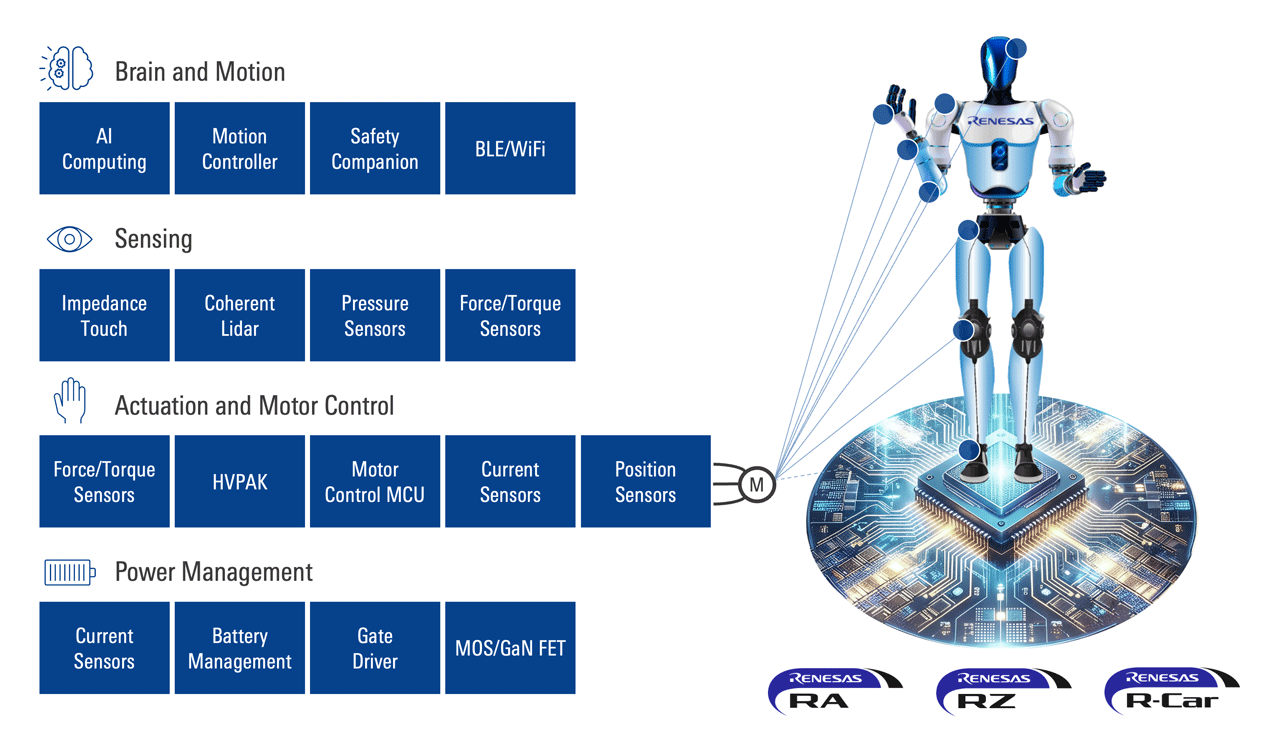
The Evolution of the Partner-Supplier
This perspective changes our role within the ecosystem so that our primary objective is to reduce engineering friction throughout the development process.
That means delivering semiconductor solutions alongside subsystem reference designs, development kits, software frameworks, functional safety resources, documentation, and partner collaborations that accelerate development rather than forcing customers to assemble every element independently.
As projects become more sophisticated, customers need guidance to integrate sensors with actuation, connect AI inference with real-time control, validate hardware before deployment, and pivot efficiently from simulation to physical implementation.
Helping customers solve their integration challenges is where systems enablement creates value.
Digitalization Extends Beyond Software
As we examined the best approach to assemble our corner of the robotics ecosystem, one theme that emerged repeatedly is that digitalization is frequently misunderstood to represent software platforms or online development tools.
Our perspective is that digitalization is about creating continuity across the entire engineering journey. By focusing on the customer's unique user experience (UX), we are better able to help them at each stage of development – from discovery, evaluation, design, and simulation, to implementation, validation, and lifecycle management.
That approach informed our decision to invest in subsystem reference designs, integrated software environments, engineering collateral, partner ecosystems, and cloud-based development platforms like Renesas 365.
Using Renesas 365 to Improve Robotic Hand Dexterity
An example of the customer UX in action can be seen in this short demonstration video, where we apply a system-level approach to the development of a dexterous robotic hand. Using AI vision, tactile sensing, and force feedback, the hand system recognizes different objects and automatically adjusts grip strength to match the task, applying greater force to lift a can, a lighter touch to hold a paper cup, and delicate control to grip an egg. Renesas 365 provides the digital framework that preserves engineering context throughout the development process by connecting hardware, software, schematics, firmware, and system logic into a unified workflow.
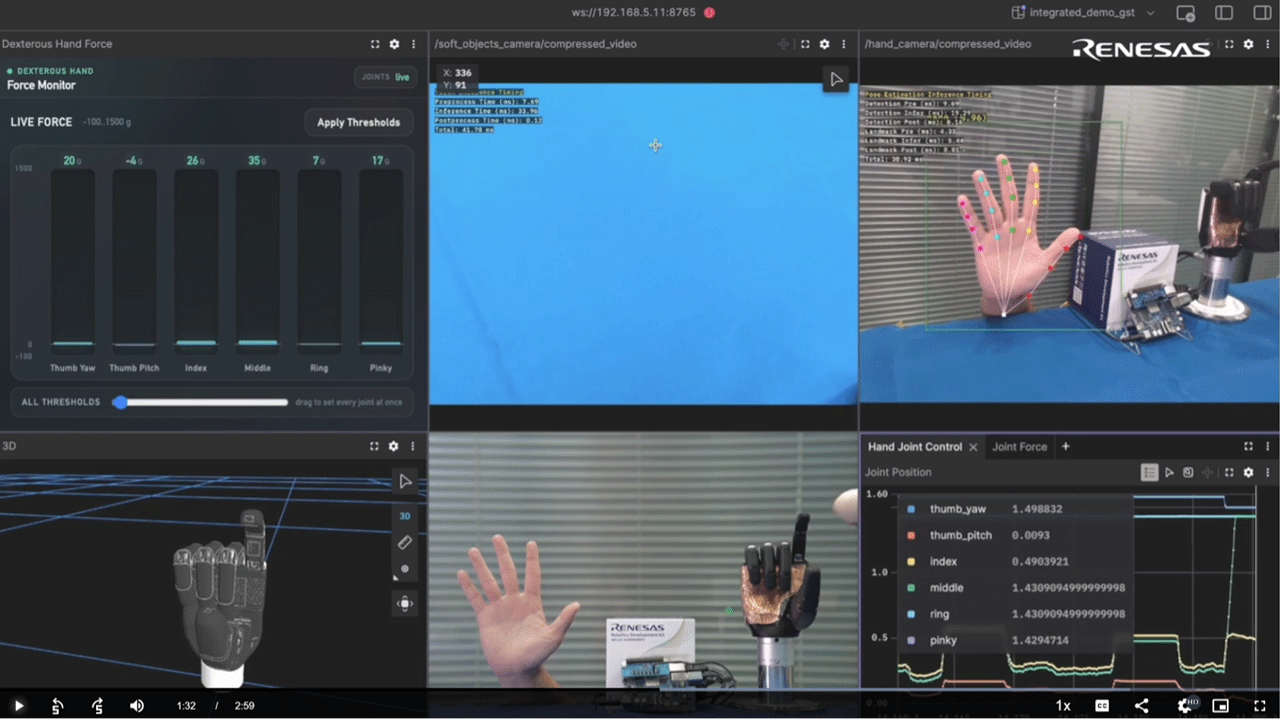
Engineers remotely deploy designs to target hardware, monitor live telemetry such as processor utilization, power consumption, and frame rates, and iteratively refine system performance without disrupting the overall development flow. Rather than functioning as a standalone software tool, Renesas 365 bridges virtual design and physical deployment to enable developers to move more efficiently from concept to a working robot.
Better Design Begins with Better Engineering Experiences
Humanoid robotics is an emerging market. But what's already clear is that success depends heavily on how effectively we enable engineers to navigate system complexity.
In the semiconductor industry, UX is often associated with software interfaces or digital tools. For Renesas, the user experience means making technologies easier to discover, evaluate, integrate, validate, deploy, and manage across the entire system lifecycle. With that in mind, we believe that systems enablement will differentiate the physical AI era. And the companies leading the way will be those best able to help their customers navigate the entire development ecosystem and enable hundreds of technologies to work together seamlessly and safely.
Videos & Training
See how Renesas is advancing dexterous robotic hand technology with sensor fusion, Vision AI, tactile sensing, and precision force control. This demo shows how the solution identifies different objects, calibrates grip force across individual fingers, and adapts handling for everything from solid produce to delicate items like paper cups and eggs. Powered by Renesas RZ/V Vision AI processing, impedance sensing, and sensor signal conditioning, the system combines perception, touch, and AI/ML to enable safer, more responsive human-robot interactions. The video also highlights how Renesas 365 streamlines development with cloud-based solution management, remote board deployment, and live performance metrics from cloud to edge.