A Docking-Based Charging Model for Humanoids
As humanoid robots move beyond research labs into real-world deployment, system designers face a new set of expectations across a wide range of environments. These robots are increasingly being considered for use in homes, industrial facilities, and commercial spaces such as restaurants, hospitals, and warehouses. In each of these settings, humanoids must operate safely around people, fit naturally into existing spaces, and function autonomously with minimal user intervention.
One of the most fundamental challenges in enabling true humanoid autonomy is reliable, safe, and repeatable recharging without human supervision. Traditional charging methods that rely on exposed connectors and cables can be inconvenient, prone to mechanical wear, and difficult to protect in environments where dust, dirt, or frequent human interaction are common. For humanoid robots that may need to recharge regularly without supervision, exposed wiring can also introduce safety and maintenance concerns.
A fixed docking station with wireless power transfer offers a practical alternative to plug-in charging. When a humanoid completes its tasks or reaches a low-battery level, it can return to a designated location, align itself, and begin charging during idle periods. By centralizing power transfer at a fixed docking point, this approach helps eliminate exposed cables, supports sealed mechanical designs, and enables more predictable and repeatable charging behavior across both consumer and industrial environments.
Why Ki® Wireless Power for Humanoid Docking?
Ki wireless power, developed under the Wireless Power Consortium (WPC), is designed for higher power wireless energy transfer than traditional low-power consumer charging. Ki combines inductive wireless power transfer with near field communication (NFC) communication so the transmitter and receiver can coordinate power delivery safely and dynamically.
For humanoid docking stations, this approach offers several advantages:
- Scalable power delivery: Renesas Ki wireless power architectures support a wide range of wireless power delivery, scaling from approximately 20W up to 2.2kW. Many humanoid platforms use higher voltage battery systems, commonly in the 24V to 48V range, with battery capacities that drive meaningful recharge energy needs. In this context, 2.2 kW refers to available dock power for charging and docked operation, which helps reduce reliance on frequent battery pack swapping by enabling routine autonomous recharging at a fixed station. Because Ki supports this wide power range, the same Ki-based docking approach can also be applied to smaller robots, such as robotic lawn mowers or assistive robots in healthcare, by scaling power delivery down as needed.
- Receiver-controlled charging: Power delivery is controlled from the robot side, allowing the humanoid to request only the power it needs and adjust charging behavior as operating conditions change.
- Integrated identification and control: NFC communication provides identification, authentication, control, and safety gating before high-power transfer begins.
Together, these characteristics make Ki wireless power a strong fit for docking-based humanoid charging.
System Level Docking Architecture
A Ki-enabled humanoid docking system is built around two coordinated elements:
- A wireless power transceiver integrated into the docking station
- A wireless power receiver embedded inside the humanoid robot
Together, these elements enable autonomous docking, controlled power delivery, and a sealed charging interface that supports usable wireless power levels from approximately 20W to 2.2kW.
In this architecture, NFC communication establishes identification and coordination between the docking station and the humanoid before any power transfer begins. Once coordination is established and alignment is achieved, wireless power transfer starts. This approach keeps power conversion and battery management inside the robot, enabling a sealed, cable free interface without compromising usable power levels.
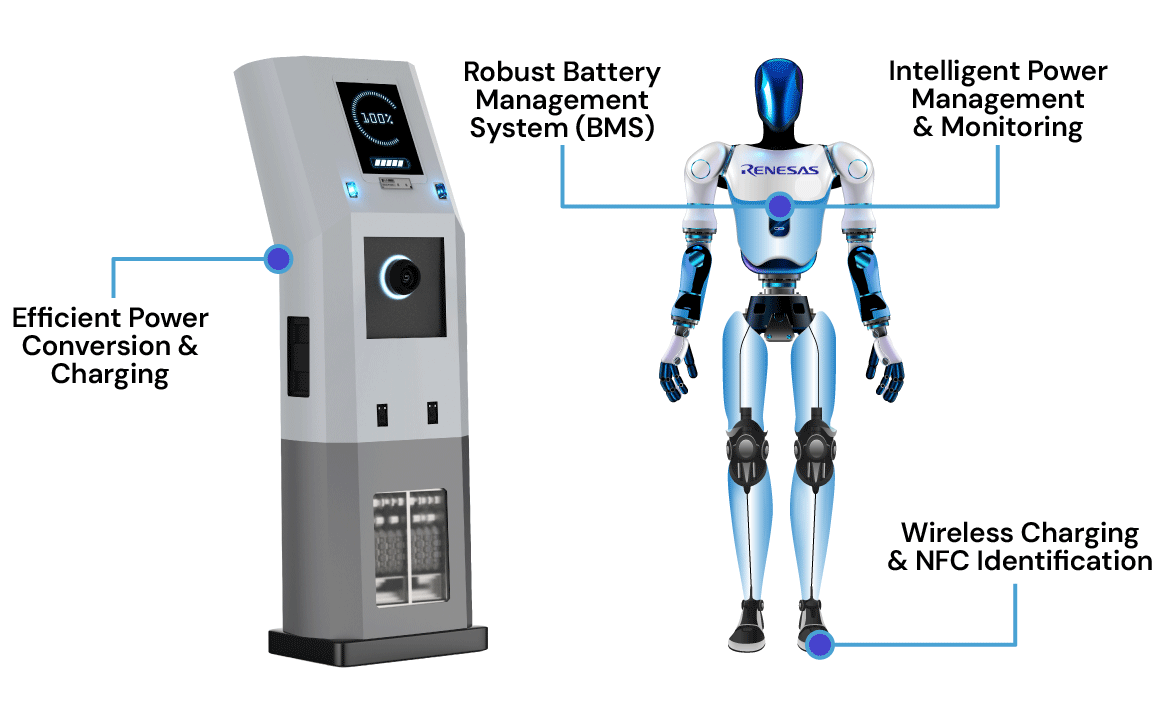
This architecture can be implemented through our Ki Wireless Power Transceiver System (Tx), and Ki Wireless Power Receiver System (Rx) designs. These solutions are designed to map directly onto a complete Ki wireless docking system, allowing system architects to integrate wireless charging without having to design the power, control, and communication stack from scratch.
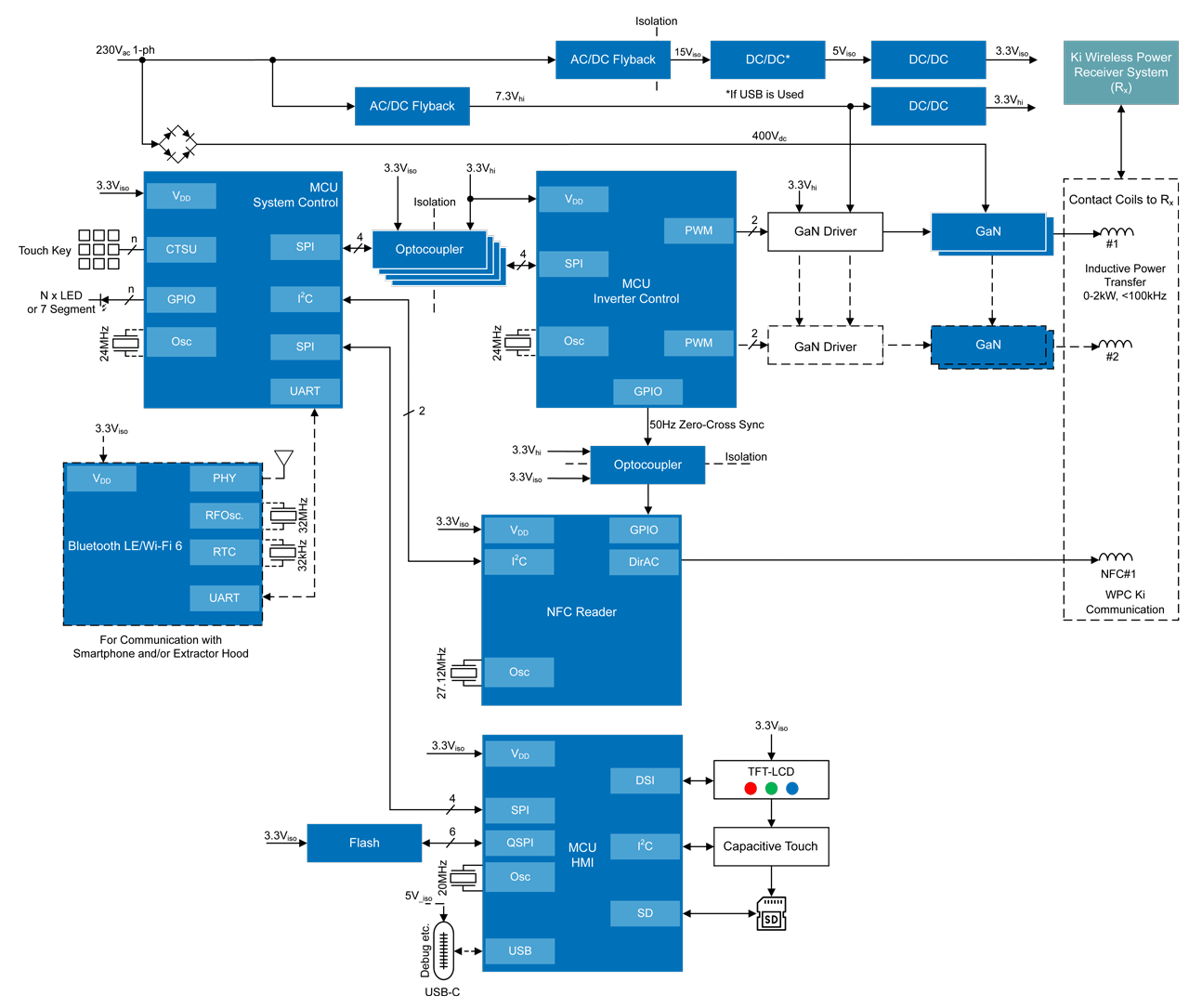
The Ki Wireless Power Transceiver System (Tx) implements the docking station and acts as the fixed infrastructure side of the Ki system. It provides the wireless power transmitter and NFC communication required to deliver energy from a known physical location. With the transmitter fixed in a known position, the humanoid can self-align consistently and achieve repeatable wireless coupling.
In addition, the Ki Wireless Power Transceiver System (Tx) is available in richer variants that support advanced interaction and system integration. These variants incorporate a graphical user interface with capacitive touch, providing visibility into charging status, delivered power, and system state. Integrated wireless connectivity through Bluetooth® Low Energy (LE) or Wi-Fi enables remote monitoring, configuration, and integration with higher-level control.
Simplified variants remove the user interface and wireless connectivity to support fully concealed installations where charging operates transparently, allowing the same transmitter architecture to be reused across different docking station designs.
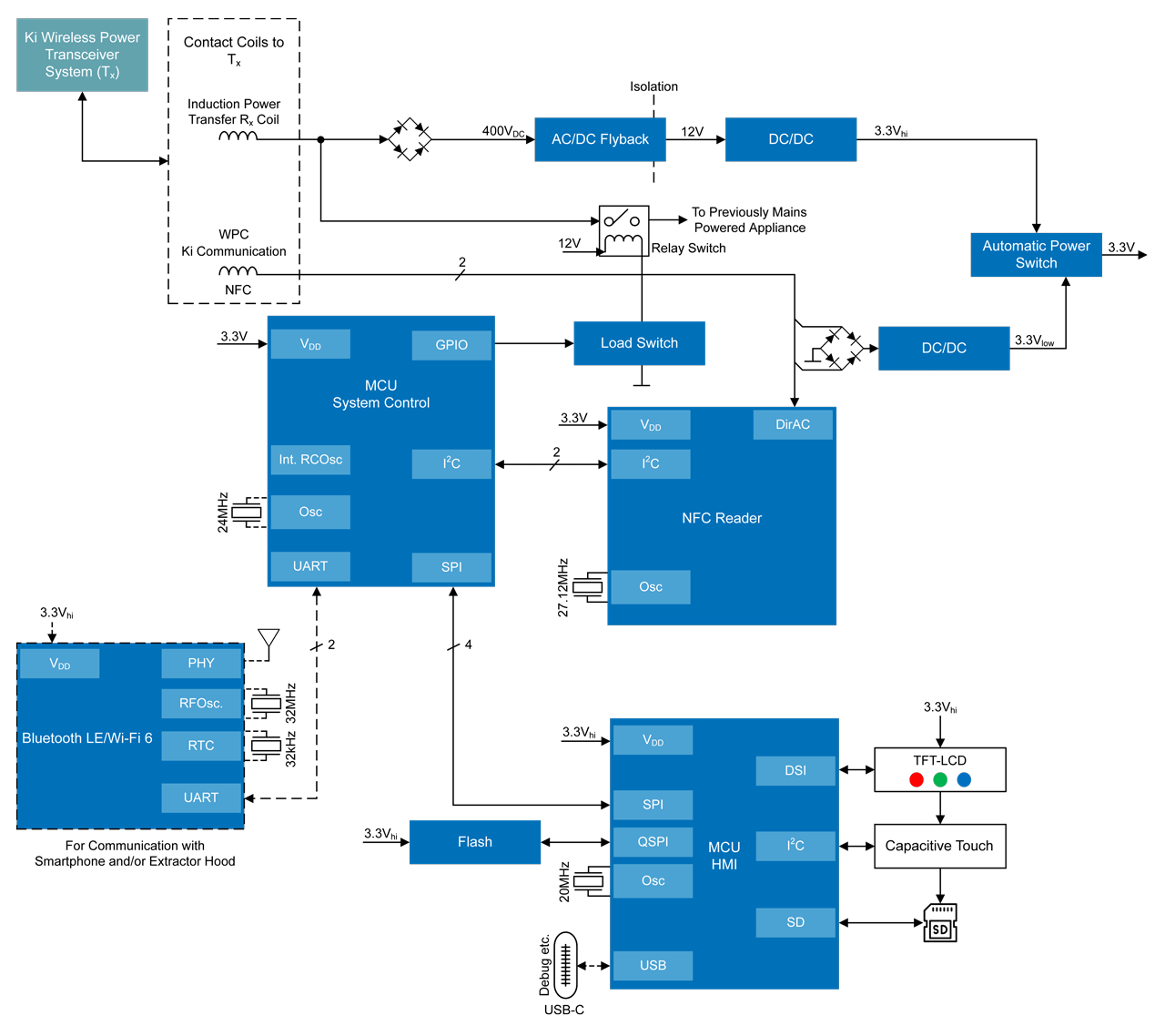
The Ki Wireless Power Receiver System (Rx) implements the receiver side of the Ki system inside the humanoid robot. It receives wireless energy from the docking station, regulates delivered power, and interfaces directly with the robot's internal power and battery management systems.
Richer variants extend this capability with a local graphical interface and optional wireless connectivity. A built-in display allows the humanoid to expose charging state, power flow, and diagnostic information directly on the robot, while Bluetooth LE or Wi-Fi connectivity enables integration with external monitoring tools or fleet management systems. This added visibility can be useful during development, commissioning, and service, as well as in deployed environments where insight into robot status is important.
Simplified variants remove the user interface and wireless connectivity to support compact, fully sealed designs where minimal interaction is required, allowing the same receiver architecture to scale across different humanoid platforms.
Together, the Ki Wireless Power Transceiver System (Tx), and Ki Wireless Power Receiver System (Rx) form a coordinated Ki Wireless docking system for humanoid robots.
By utilizing these winning combinations, system designers can start with a proven Ki wireless power implementation that already accounts for scalable power transfer, coordination, and safety requirements, with key system behaviors configurable through software rather than hardware redesign.
This approach reduces development effort, simplifies system integration, and allows architects to focus on higher level robot behavior. As humanoid platforms evolve, the availability of multiple variants on both the docking station and robot side also provides a clear upgrade path without requiring fundamental changes to the system architecture.
In addition to hardware variants, key system behaviors such as power scaling, authentication, and coordination are enabled through software configuration within the Ki architecture, without requiring changes to the underlying hardware.
Key Engineering Considerations for Humanoid Docking
Humanoid robots are meant to work around people, move through spaces designed for humans, and recharge themselves as part of everyday operations. They may dock multiple times a day, often without supervision, and in environments where exposed hardware, long downtime, or unsafe behavior is not acceptable. For system designers, this means the docking and charging system must work reliably every time, without adding complexity to robot operation or maintenance. Reliable alignment allows the robot to dock on its own; charging efficiency affects how quickly it can return to work, and safety is essential when higher power charging happens close to people and everyday objects. A fixed docking station combined with Ki wireless power helps address these needs in a practical and scalable way.
- Alignment: Reliable alignment is critical for autonomous humanoid docking, as efficient wireless power transfer depends on consistent transmitter/receiver positioning. Unlike manual charging, docking is a repeated behavior that humanoids must perform autonomously throughout their lifecycle. A fixed docking station provides a known physical target, allowing the robot to approach, align, and dock in a repeatable manner. This improves coupling consistency, reduces sensitivity to positional variation, and enables predictable charging performance across fleets of robots.
- Efficiency: While wired connections can offer higher absolute efficiency, Ki wireless systems balance efficiency with usability, safety, and mechanical sealing. In practical docking conditions with proper alignment, Ki systems can achieve wireless power transfer efficiency on the order of 90%, while maintaining a sealed, cable-free interface. This is worth the small differences in absolute efficiency compared to wired charging.
- Safety: Humanoid robots operate near people, tools, and everyday objects, making safety a fundamental design requirement. Ki includes built-in safety mechanisms such as foreign object detection (FOD), which helps prevent unintended power transfer when objects are present between coils, supporting safer operation around people. Ki NFC communication also supports authentication, allowing docking stations to verify trusted receivers before enabling power transfer. This helps ensure that only authorized robots are charged or powered, which is particularly important in shared or public environments.
Enabling Autonomous Docking and Charging
For humanoid robots operating in shared human environments, the best charging experience is one that users rarely notice. Ki-enabled docking stations allow humanoids to manage their own energy needs autonomously while maintaining a sealed, connector-free charging interface.
By implementing a fixed docking station architecture using Ki wireless power, system designers can enable reliable autonomous charging without designing the charging system from scratch. Proven building blocks, such as the Ki Wireless Power Transceiver System (Tx) and Ki Wireless Power Receiver System (Rx), provide a ready starting point on both sides of the docking interface, with variants that scale from compact, concealed designs to richer implementations with visibility and connectivity.
Explore how the Ki Wireless Power Transceiver System (Tx), and Ki Wireless Power Receiver System (Rx) can support the next generation of humanoid docking architectures and how Renesas is enabling the technologies to shape the future of humanoid robotics.