Governance
Governance | Risk Management | Ethics and Compliance | Information Security | Executive Compensation | Tax Policy
Risk Management
At Renesas we understand that early identification and analysis of Group-wide risks and early responses to resolve them are vitally important management issues, and we are continually working on strengthening our risk management.
Risk Management System
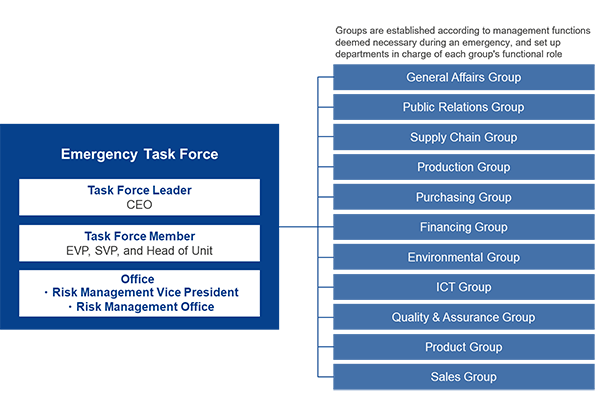
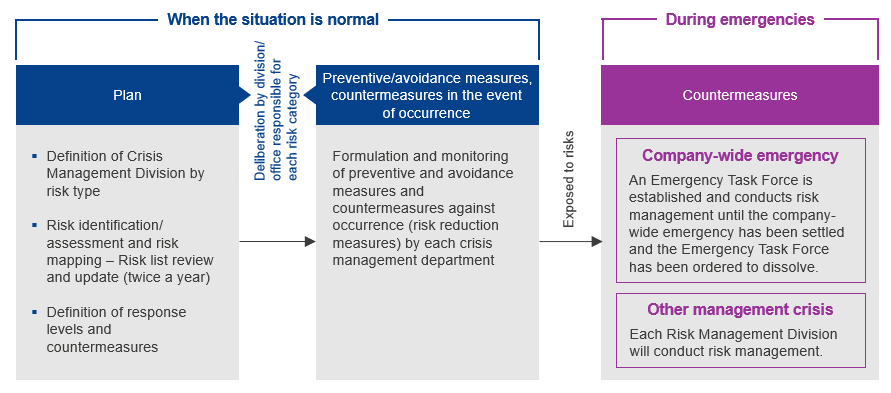
We have established a group-wide risk management system based on the “Renesas Electronics Group Risk and Crisis Management Regulations”. We regularly maintain our risk management system for possible risks that may occur, and for each one a department will be put in charge of crisis management according to the type of risk, and that department will conduct the day-to-day risk management. We also attempt to identify and group risks in advance that are then represented realistically in our Risk List, while at the same time formulating contingency measures to prevent those risks, as well as systems and response policies in the event of such risks happening. Furthermore, in the event of an emergency, we establish an Emergency Task Force (ETF) led by CEO, which brings information together, proposes countermeasures, and takes measures to minimize losses.
Establishment of Emergency Task Force (ETF) in the event of a company-wide emergency
(taken from the “Renesas Electronics Group Risk and Crisis Management Regulations”)
- An ETF will automatically be set up in the event of an earthquake with a seismic intensity of lower 6 or higher
- Other than the above, CEO will make the decision to call for an ETF (if there are risks such as accidents, disasters, or incidents that are recognized as having a major social impact on the group, or when he feels it is essentially necessary).
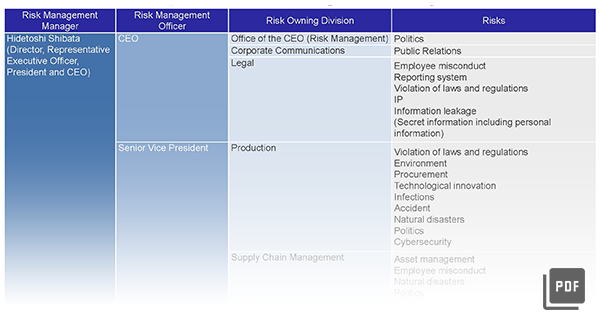
Renesas Group's Risk Management System
Emergency Task Force
Renesas Group Risk Management Control Flow
We disclose business risks identified by Renesas' Risk Management System led by our CEO at “Business Risk Factors”. Please refer to the table below for detailed descriptions of emerging risks we expect to have the greatest impact and our planned actions to minimize the impact on our business operation.
| Name of the Emerging Risk | Large-scale earthquake | Procurement | Cyber attack | Product quality |
|---|---|---|---|---|
| Category | Natural Disaster | Geopolitics | Information System | Quality |
| Description | Large-scale earthquakes may cause damage to our facilities, operational disruptions, and impact on employee safety. In addition, disruptions to supply chain and logistics may lead to delays or suspension in production and supply, significantly affecting customer commitments and business continuity. | Risk of procurement, production, and supply disruptions due to geopolitical conflicts and tightened tariffs/trade regulations. Potentially causing material shortages, price increases, production stoppages, supply delays, higher costs, and reduced competitiveness and corporate value. | Cyber risk of system outages, data breaches, and AI-driven data manipulation or erroneous outputs caused by cyberattacks or unauthorized access. Potentially disrupting critical and design operations, leading to regulatory violations, liabilities, reduced data integrity, and significant impact on business continuity and corporate value. | Defects, anomalies, or failures in the product that cannot be discovered at the time of shipment may result in the return or replacement of the product, compensation for loss, or discontinuation of use of the product, which could adversely affect our business results and financial condition. |
| Impact | Serious | Serious | Serious | Significant |
| Mitigating Actions |
|
|
|
|
Formulation and Implementation of Our Business Continuity Management (BCM) Plan
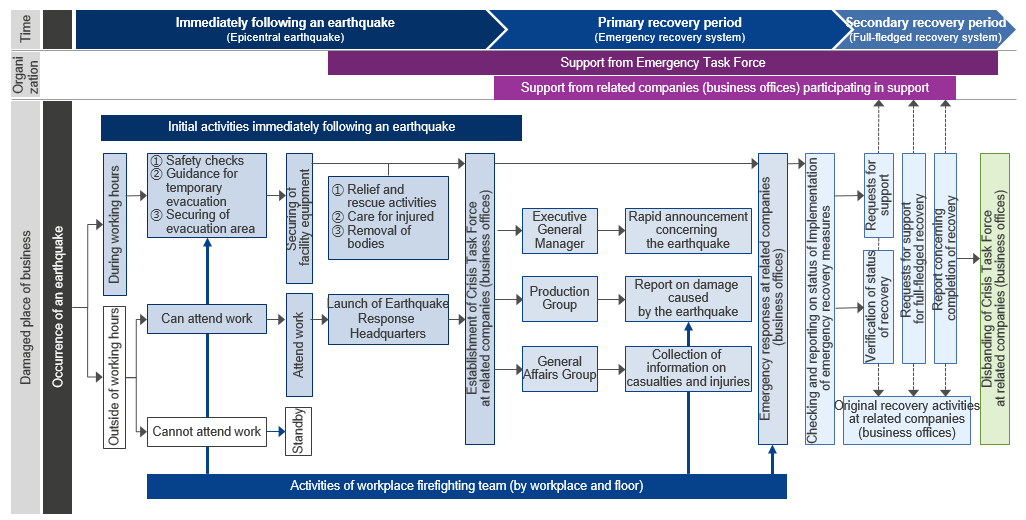
There are many risks that threaten economic and social activities, such as the worldwide spread of COVID-19 in 2020, or natural disasters such as frequent large-scale earthquakes and typhoons. We have a Business Continuity Management (BCM) plan as an integral part of our efforts to strengthen our resilience, aiming to minimize the impact of business interruptions and achieve rapid recovery and early restoration even if such events occur. All Renesas Group companies work together to formulate and promote our BCM plan in order to ensure the safety of employees, ensure a stable supply of materials and services, and also the conservation of operational resources.
We are currently carrying out a comprehensive inspection and review of our BCM plan, drawing on the experiences from damages to the manufacturing sites caused by the Great East Japan and Kumamoto Earthquakes, as well as the predicted damage scenarios of an earthquake directly beneath the Tokyo metropolitan area and a Nankai Trough Earthquake (note) to further strengthen our BCM plan. Specifically, these measures include the improvement of the restoration operations after a disaster (restoration procedures, clarification of personnel in charge, etc.) as well as measures to enhance earthquake resistance in manufacturing sites in preparation of large-scale earthquakes, the establishment of alternative production networks in case a manufacturing site is impacted by such disasters, and also strengthened risk communication with our customers even in normal times.
Each department involved in these issues has developed and implemented the aforementioned countermeasures sequentially. These measures are also shared across the entire Group, thus enhancing our business continuity capabilities and fulfilling our social responsibilities.
Note: Based on the estimated impact caused by either a Nankai Trough Earthquake, a Subduction Zone Earthquake around Japan Trench and Chishima Trench, an earthquake directly beneath the Tokyo metropolitan area, or earthquakes directly beneath the Chubu and Kinki areas, which have all been listed by the Japanese Cabinet Office as large-scale earthquakes likely to occur in the near future.
BCM flow