The Boundary Between Human Machine Interfaces (HMIs) and IoT Is Disappearing
Every year, the functionality required from embedded devices continues to increase and HMIs, which are traditionally focused on display and operation, are now expected to serve as IoT devices through network connectivity, cloud integration, and Over-the-Air (OTA) updates.
The devices we depend upon daily, such as EV chargers, building management systems, home appliances, and industrial HMIs, not only need more conventional GUI display functions, but also cloud connectivity and edge processing. In many cases, this requires ever-growing CPU performance to execute multiple tasks simultaneously.
Still, not every HMI product requires a high-performance processor. The semiconductor market covers a wide range of needs, from cost-focused entry models to mid-range models that balance performance and cost, as well as high-end models that deliver superior performance.
Regardless, reducing power consumption and addressing sustainability requirements have become important topics in recent years. In the European market in particular, standby power consumption regulations are becoming stricter, making its reduction an important design challenge.
When considering such constraints, a major challenge facing many developers is the reuse of hardware and software assets. Changing processors and redesigning PCBs and software for each product variation can often lead to longer development times and increased costs. As a result, there is growing demand for a single platform that enables both HMI and IoT and allows deployment across multiple products.
Expanding Product Lines with a Common Platform
To address these shifting market requirements, Renesas has developed RZ/G3L and RZ/G3SE microprocessors (MPUs), based on a common architecture that provides both pin and software compatibility. This allows developers to select the most appropriate device for each product, while leveraging existing hardware and software assets.
For example, in the EV charger market, it is common to offer multiple product models simultaneously, such as entry-level home models without a display, mid-range models with a display, and premium models with advanced HMI capabilities.
Traditionally, different processors would be used for each model, requiring separate PCB design and software development efforts. However, in this type of case, efficient product expansion can be achieved by leveraging a common PCB design and software assets while selectively using RZ/G3L and RZ/G3SE. As a result, development time can be reduced, and product line expansion can be simplified.
Comfortable Multitasking Performance Enabled by a Quad-Core CPU
As products become more sophisticated, CPUs must deliver greater processing capability than ever before. HMI devices increasingly demand rich user interfaces, including high-resolution GUIs and animations. At the same time, IoT edge devices commonly perform multiple tasks in real time, such as cloud connectivity, data collection, and edge processing. This means today's embedded devices must simultaneously execute multiple functions, including GUI rendering, network communication, and data collection.
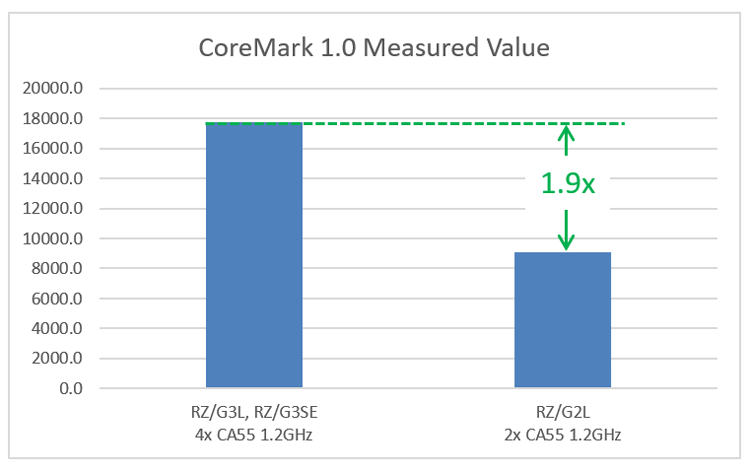
To achieve this, RZ/G3L and RZ/G3SE are designed with a multi-core architecture and integrate up to four Arm® Cortex®-A55 cores, which enables multiple tasks to be executed simultaneously, while maintaining responsive system performance.
In addition, both RZ/G3L and RZ/G3SE are available in dual-core versions, allowing developers to select the appropriate CPU performance based on product requirements. For example, a dual-core RZ/G3SE is appropriate for an entry-level model focused on IoT functionality; a quad-core RZ/G3SE or dual-core RZ/G3L works for a mid-range model with display capability; and a quad-core RZ/G3L is ideal for a more advanced HMI product. These flexible options support scalable product development, while maximizing the reuse of existing design assets.
The Challenge of Achieving Both High Functionality and Low Power Consumption
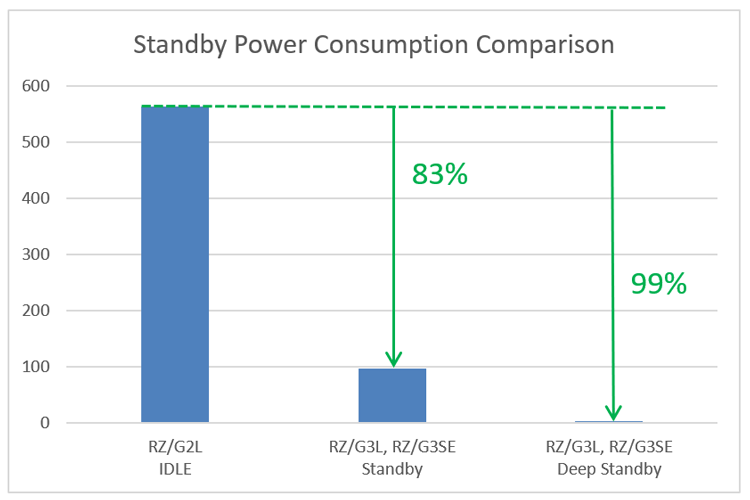
Given the global focus on energy efficiency, it is important to note that as processing performance increases, so does power consumption. Furthermore, many IoT and industrial devices spend significantly more time in a standby state than actively processing.
As a result, it is important to minimize standby power consumption while enabling fast system wake-up when needed. To address this, RZ/G3L and RZ/G3SE feature four independent power domains for selecting power modes according to use case. In addition, Double Data Rate (DDR) self refresh enables the devices to transition to a low-power state while retaining the Linux image. The result is an approximately one-second wake-up time with standby power consumption in the 1mW class, and a successful low-power system design that does not compromise the user experience.
A Single Platform from HMI to IoT Edge
As the convergence of HMI and IoT edge speeds up, easy product scalability and performance are important to developers. RZ/G3L and RZ/G3SE provide scalability due to their platform-based architecture, comfortable multitasking performance through a quad-core CPU, and low power consumption with fast wake-up capability. At the same time, they enable product development based on common hardware and software assets.
From entry-level products to mid-range models, these devices support efficient product expansion and contribute to the development of next-generation HMI and IoT edge equipment.