
Overview
Description
The Renesas capacitive sensor, CTSU2, can utilize an active shield without any external components. Active shielding is effective in improving water resistance as well as improving the noise immunity of self-capacitance buttons.
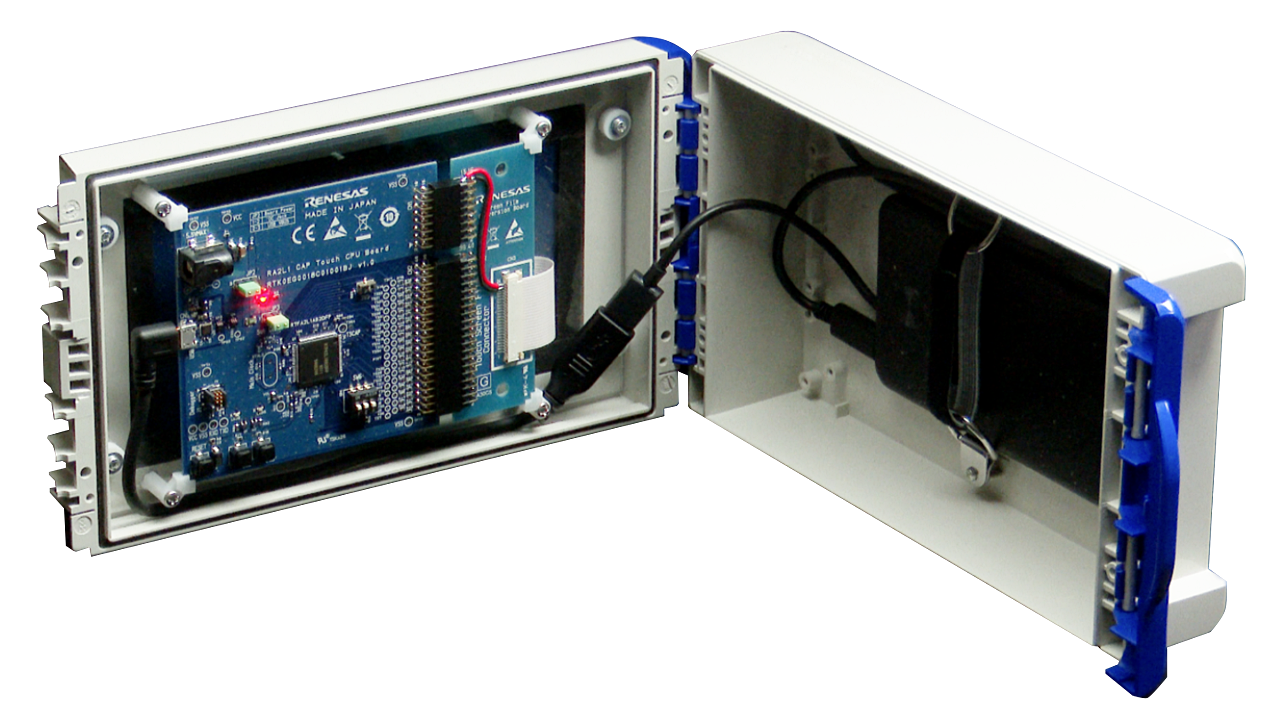
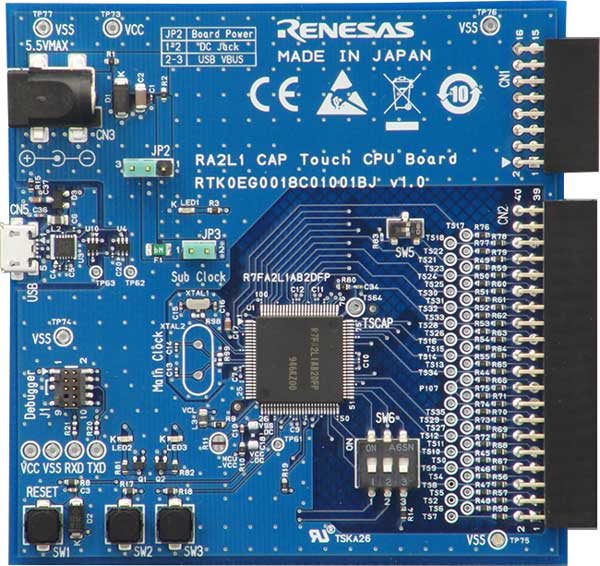
The Self-Capacitance Waterproof Button Solution reference design compares the water resistance of traditional GND shields to the active shield for the self-capacitance buttons.
Self-Capacitance Water-Resistant Button and Electrode Board
- Based on the high-sensitivity, high-noise-tolerance Renesas capacitive touch key solution
- Example of CTSU2 active shielding
- Self-capacitance touch buttons achieve both water resistance and noise immunity
- Complies with IEC 61000 4-3 Level 3 for radiated noise immunity
- Applicable to a variety of products requiring water resistance, including white goods, bathroom appliances, and outdoor equipment
| Desired Feature | Technology Issue |
|---|---|
| When you'd like to adopt a capacitive touch button to a device that will be used in a wet environment, such as a kitchen | It is possible to mis-detect with water drops in the conventional self-capacitance touch method |
| When you'd like to improve noise immunity | It is possible to mis-detect with water drops if using a GND shield |
| When you'd like to configure with a simple electrode pattern | It will be a complex electrode design if using a mutual-capacitance method, which has the water resistance |
This design can resolve these issues: It enables improving the water resistance with an active shield, as the self-capacitance method is a simpler electrode design, as well as keeping noise immunity.
As a reference design, Renesas publishes application notes, sample code, and hardware design files, allowing you to start development immediately.
* The active-shield function is supported on the MCU included CTSU2 IP.

Features
- 8 Self-Capacitance Touch Buttons (4 GND Shields, 4 Active Shields)
- 4 GND Shield Buttons: 4
- 4 Active Shield Buttons: 4
- 8 LED Indicators: 8
Applications
Documentation
|
|
|
|
|---|---|---|
| Type | Title | Date |
| PCB Design Files | Self-Capacitance Waterproof Demo Design Files
|
|
| Manual - Hardware | PDF 2.28 MB 日本語 | |
| Application Note |
PDF
7.71 MB
日本語
, 简体中文
Provides the design principles and layout examples of touch electrodes for microcontrollers embedded with a Capacitive Touch Sensing Unit (CTSU). This application note outlines recommended design practices and considerations for both self‑capacitance and mutual‑capacitance methods, covering electrode geometry, routing, and shielding structures. In addition, it describes the application examples for each sensing method.
|
|
| Application Note | PDF 4.99 MB 日本語 | |
| Application Note |
PDF
3.34 MB
日本語
AI-generated Summary:
Capacitive touch sensing integrates with Renesas RA microcontrollers using QE and FSP tools. The process includes creating a project with RA Smart Configurator, adding required modules, building a capacitive touch interface, tuning with QE for Capacitive Touch, and monitoring touch performance. Supported devices include RA6M2 and RA2L1 with CTSU/CTSU2 units. Development requires e2 studio IDE, GCC ARM compiler, QE for Capacitive Touch plug-in, and FSP middleware. The example demonstrates starting measurements with RM_TOUCH_ScanStart() and detecting touch via RM_TOUCH_DataGet().
|
|
| Application Note | RX140 Self-capacitance Waterproof Touch Button Demo Software Rev.1.00
AI-generated Summary:
The self-capacitance waterproof touch button demo software implements an active shield function to enhance noise immunity and water resistance in capacitive touch buttons. It addresses false detections caused by water droplets on electrodes by driving the shield pattern at the same potential as the electrode, canceling parasitic capacitance. The demo uses RX140 devices and compares conventional GND shield buttons with CTSU2 active shield buttons. It includes software control for LED indicators and detailed operational insights, including waveform behavior when water contacts the buttons.
|
|
| Application Note |
PDF
1.33 MB
日本語
AI-generated Summary:
The software implements self-capacitance waterproof touch buttons using the RL78/G23 MCU with CTSU2's active shield function to enhance noise immunity and water resistance. It addresses false detections caused by water droplets on GND shield buttons by driving the shield at the same potential as the electrode, canceling parasitic capacitance. The demo board includes both GND shield and active shield buttons for comparative evaluation, with LED indicators for touch detection. The document details hardware setup, software structure, and operational behavior, focusing on reducing false touch detection in wet environments.
|
|
7 items
|
||
Design & Development
Sample Code
Sample Code
Filters
|
||
|---|---|---|
| Type | Title | Date Date |
| Sample Code | RA2L1 Group Self-capacitance Waterproof Touch Button Demo Sample Software
Application:
Consumer Electronics, Industrial
Compiler:
GNU ARM Embedded
Function:
HMI
IDE:
e2 studio
The CTSU2, the enhanced version of the Renesas Capacitive Touch Sensing Unit (CTSU), supports an active shield as one of its anti-noise countermeasures. This document describes the self-capacitance waterproof touch button demo software, which implements the active shield function.
|
|
| Sample Code | RX140 Self-capacitance Waterproof Touch Button Demo Software Rev.1.00
[Software=RX Driver Package|v1.36],[Toolchains=CC-RX|v3.04.00]
ZIP
11.59 MB
日本語
Application:
Consumer Electronics
Compiler:
CC-RX
Function:
Evaluation Kit
IDE:
e2 studio
|
|
| Sample Code | RL78/G23 Self-capacitance Waterproof Touch Button Demo Sample Software Rev.1.00 - Sample Code
Application:
Consumer Electronics, Industrial
Compiler:
GNU ARM Embedded
Function:
HMI
IDE:
e2 studio
|
|
3 items
|
||
Related Boards & Kits
Boards & Kits
Capacitive Touch Evaluation System for RA2L1
The RA2L1 capacitive touch evaluation system makes it easy for users to evaluate touch solutions offered by Renesas. You can start evaluating immediately out of the box using the board and software included in each kit.
Configuration
- RA2L1 CPU board
- Touch application board
- Self-capacitance... Read More
Capacitive Touch Evaluation System for RL78/G23
The RL78/G23 capacitive touch evaluation system makes it easy for users to evaluate touch solutions offered by Renesas. You can start evaluating immediately out of the box using the board and software included in each kit.
Configuration
- RL78/G23 CPU board
- Touch application...
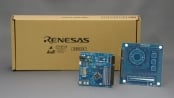
Capacitive Touch Evaluation System for RX140
The RX140 capacitive touch evaluation system makes it easy for users to evaluate touch solutions offered by Renesas. You can start evaluating immediately out of the box using the board and software included in each kit.
Configuration
- RX140 CPU board
- Touch application board
- Self-capacitance...
Videos & Training
The capacitive touch sensing unit "CTSU2" has enhanced noise immunity functions and supports "active shields." It is also effective in improving the water resistance of self-capacitance touch buttons. In this demo, a GND shield and an active shield have been placed to compare the water resistance of each shielding method.
Additional Videos
Support

Support Communities

Knowledge Base


