

Growing Market Opportunity for IO-Link Devices
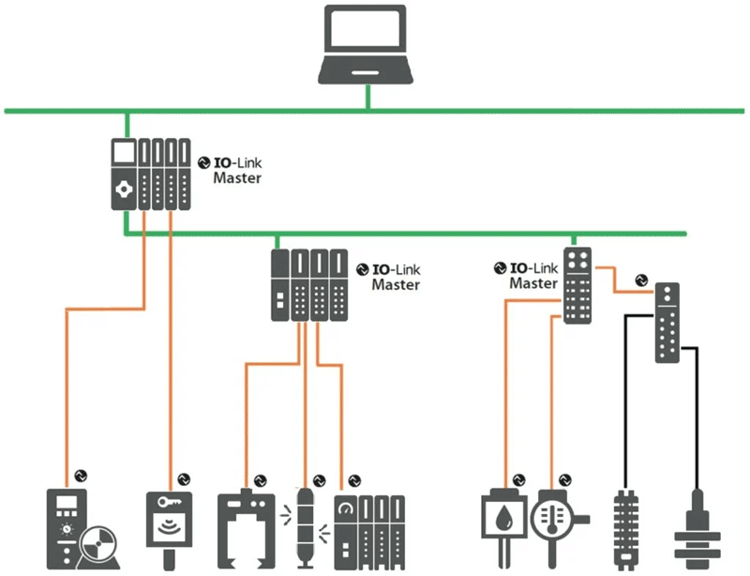
Industrial automation continues to evolve toward smarter, more connected systems, and IO-Link has become a key enabler of this transformation. By providing a standardized, vendor-independent communication interface between sensors, actuators, and control systems, IO-Link simplifies integration to higher-level field bus protocols, enhances diagnostics, and enables seamless access to valuable device data.

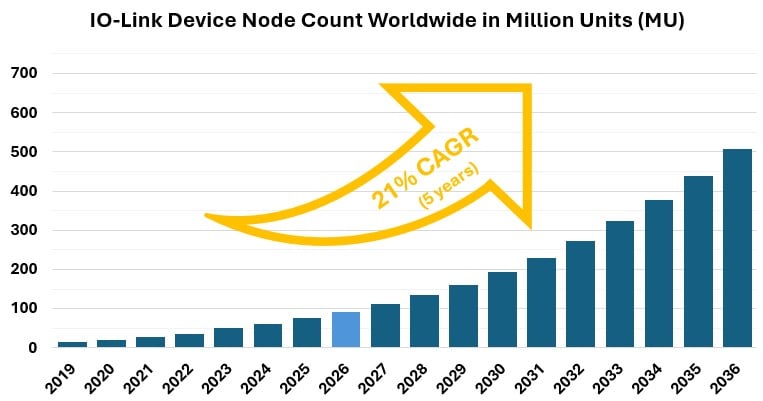
The market momentum is clear: Industry analysts forecast the global IO-Link market to grow at a compound annual growth rate (CAGR) of 21% over the next five years, driven by increasing demand for digitalized manufacturing, predictive maintenance, and Industry 4.0 applications.
For end customers, the appeal of IO-Link is straightforward: a simple and unified communication standard that reduces complexity while improving interoperability. At the same time, an increasing number of sensor and actuator manufacturers are entering the market, either by launching new IO-Link-enabled products or by converting existing legacy designs to support the standard. As adoption accelerates, device vendors are challenged to deliver competitive IO-Link products quickly and cost-effectively.
The Hidden Challenges of IO-Link Device Development
While IO-Link offers significant benefits for end customers, device development presents a different reality. Designing an IO-Link-enabled sensor or actuator often requires overcoming several technical and commercial hurdles, increasing complexity, especially for new-to-market or late-to-market developers.
Common challenges include:
- High IO-Link stack licensing costs
- A wide range of hardware implementation options for transceivers, microcontrollers, and so on
- Development effort to tailor and port stacks to specific microcontrollers
- High validation and conformance testing effort
Traditionally, developers go through multiple iterations of selecting compatible hardware components, including the microcontroller (MCU) and physical layer transceiver (PHY). They must acquire and integrate an IO-Link device stack from a third-party provider and validate the solution before application-specific software refinement can even begin.
As a result, engineering teams often spend significant time and resources assembling technologies from multiple vendors, instead of focusing on the actual sensor or actuator functionality that differentiates their products.
A New Approach
To simplify and accelerate this process, Renesas has created a modular IO-Link device platform that combines hardware and software from a single source.
The solution is built around the RH4Z2502 single-channel IO-Link transceiver and the RA2 Family of Arm® Cortex®-M microcontrollers. Together, these components provide a flexible foundation for a wide range of sensing, control, and interface applications.
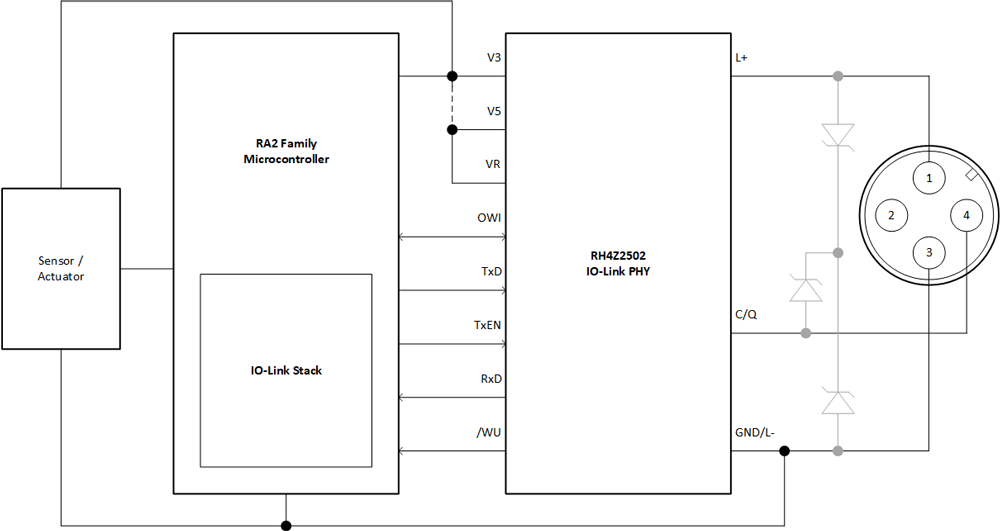
The platform includes a fully customizable IO-Link device stack library developed by TEConcept GmbH, which is delivered as a Visual Studio Code project and optimized for the Renesas RA2 Family of microcontrollers. Since the stack is integrated and tailored to the microcontroller, developers can focus primarily on implementing the application-specific functionality required for their sensor or actuator design.
This approach places control directly into the hands of developers, while significantly reducing development effort, integration risk, and direct licensing expenses.
How the IO-Link Device Stack Solution Solves Key Design Challenges
By removing most of the underlying communication infrastructure work, engineering teams can focus primarily on product differentiation to create maximum value for their customers.
Start with Compatible Hardware
The platform combines Renesas MCU and PHY hardware components that have been designed and proven to work together for a complete IO-Link solution.
Benefits include:
- Reduced integration risk
- Simplified MCU selection process for optimal functional fit
- Minimal effort required to migrate applications across the RA microcontroller family
Eliminate IO-Link Stack Development Effort
Instead of developing or porting an IO-Link stack from scratch, engineers only need to configure the provided stack for their application.
Benefits include:
- No separate stack development project
- No individual stack licensing fees
- Reduced engineering effort
- Optimized implementation
- Faster time-to-market
When to Choose the Renesas IO-Link Device Stack Platform
By combining a proven hardware architecture with an integrated software stack, the solution helps reduce development complexity while accelerating product deployment. The Renesas IO-Link platform is particularly well suited for:
- Companies entering the IO-Link market for the first time
- Manufacturers migrating existing sensor portfolios to IO-Link
- Development teams seeking to reduce software development effort
- Projects with aggressive time-to-market requirements
- Engineers looking for a scalable hardware platform that can be reused across multiple product generations
Get Started Today
Use the Renesas evaluation hardware and demonstration software as the fastest way to experience the complete solution firsthand.
Order the RH4Z2502-PMOD board together with the corresponding EK-RA2E1 evaluation kit, then use the provided stack library project to flash the demonstration software. From there, start developing your own IO-Link-enabled sensor or actuator products and experience the benefits.