Industrial edge AI systems often need to make fast decisions based on analog sensor inputs, such as temperature, vibration, or pressure, right where the data is collected. However, many endpoints, which include sensors, motor controllers, and other small devices on the edge of the network, cannot support large AI models, high-bandwidth data movement, or processor-centric response loops.
Knowledge distillation solves this with a practical deployment method where a high-compute "teacher model" is trained during development, its behavior is reduced, or distilled, to compact rules or decision functions, and those functions are implemented in a local "student" device. The distilled AI behavior can then be mapped and built into configurable mixed-signal hardware in the sensor signal path.
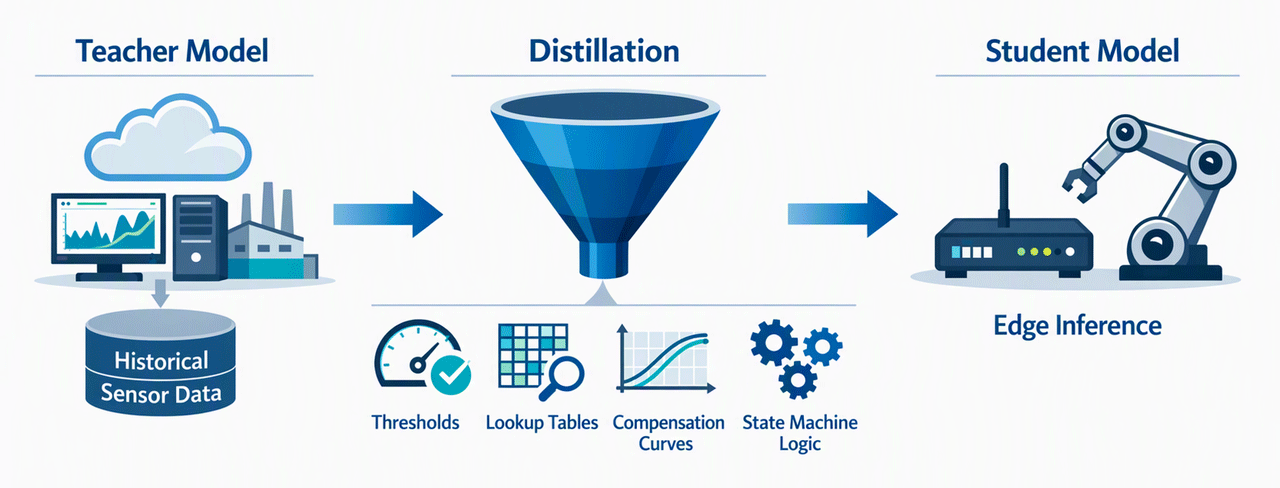
Figure 1. Knowledge distillation converts learning from a high-compute teacher model into compact implementation rules that can run locally in a student device at the industrial edge.
Figure 1 shows the teacher-student workflow: the teacher learns from development data, distillation converts that learning into compact rules, and the student applies those rules locally at the industrial edge.
The Teacher-Student Model in AI
In a teacher-student architecture, the teacher model is used during development to extract decision behavior from measured system data. Typical inputs may include sensor history, operating conditions, calibration data, environmental variation, fault signatures, and known outcomes. The teacher output is not necessarily deployed directly; but used to derive implementable decision logic for the endpoint running at the edge.
The student device implements the distilled behavior in the deployed system and depending on the application, may be represented as calibrated thresholds, gain or offset correction, lookup tables, linearization curves, timing windows, state-machine transitions, event counters, voting logic, or control-output rules.
Student-Device Functional Requirements
A student device for industrial edge AI must interface directly with real-world analog signals and execute distilled behavior with bounded latency. At the signal-chain level, this requires accurate acquisition, signal conditioning, conversion, local correction, event qualification, and deterministic output control.
Key implementation functions may include programmable gain, filtering, averaging, sensor linearization, lookup table correction, arithmetic operations, threshold comparison, hysteresis, counters, timers, state logic, fault outputs, and host-interface reporting. These functions allow the distilled behavior to be executed near the point of measurement, rather than entirely in system firmware.
The student device is therefore best viewed as a local implementation block for learned behavior, not simply as a sensor, ADC, or processor. Its value depends on how much of the measurement, correction, decision, and response loop can be executed locally and predictably.
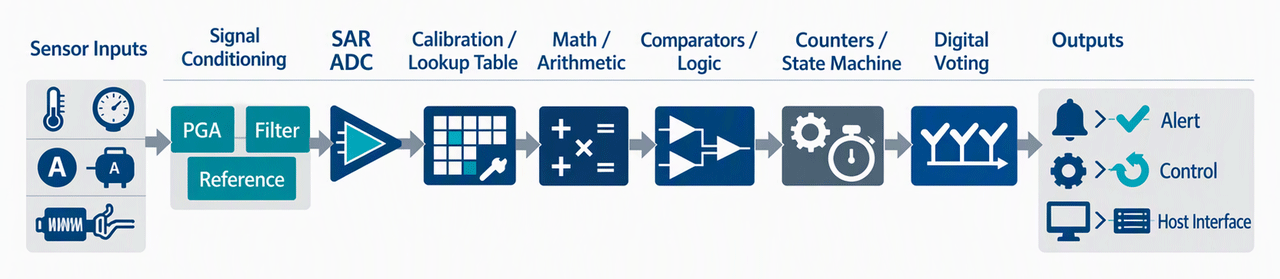
Figure 2. A practical student device must sense, condition, convert, interpret, and act locally.
Industrial Example: Predictive Monitoring
In a predictive-monitoring application, a teacher model may analyze temperature, pressure, vibration, current, duty cycle, and operating history collected from motors, pumps, actuators, or process sensors. The distilled result may be implemented as a set of endpoint rules, such as temperature-dependent gain adjustment, nonlinear sensor correction, dual-threshold fault qualification, timed event validation, or load-dependent threshold adaptation.
Implementing these rules locally helps reduce the need to stream raw data to a host processor or cloud service for every decision. The endpoint can qualify events at the sensor interface, generate local interrupts or control outputs, and forward only relevant status, fault, or measurement data upstream.
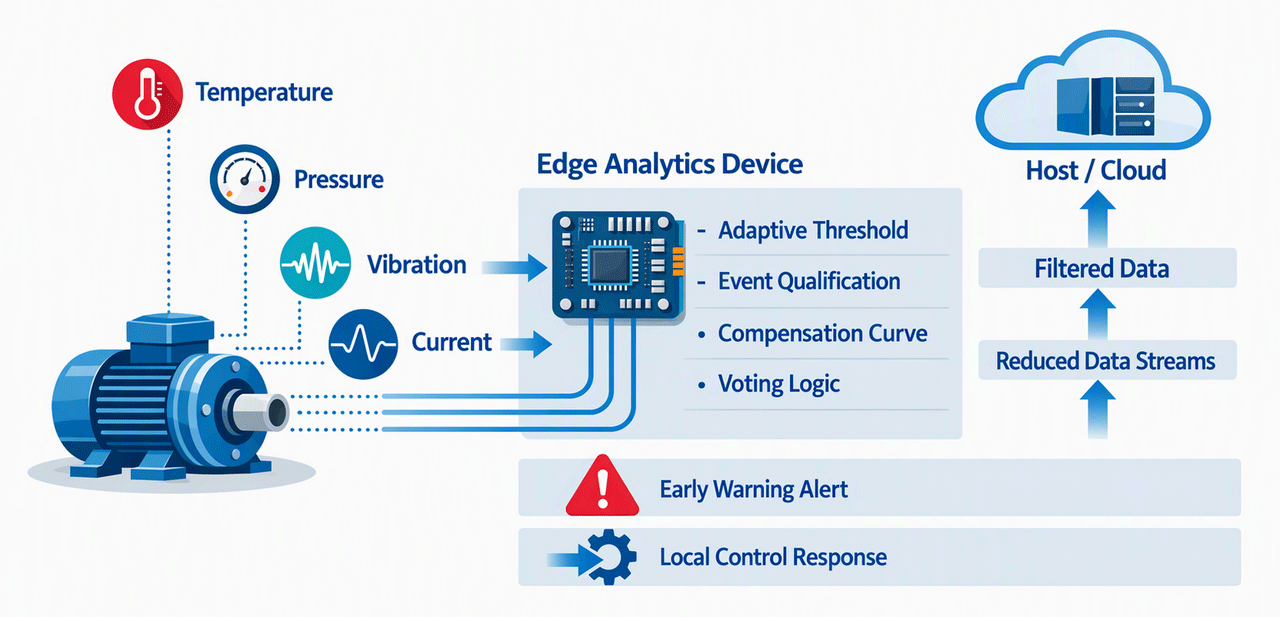
Figure 3. Distilled rules enable local predictive monitoring, early warning, and reduced data movement to the host or cloud.
Implementation Trade-Offs: MCU-Centric vs. Configurable ADC Architecture
A practical implementation must partition analog acquisition, correction, decision logic, timing, and fault response across the signal chain. A standalone ADC digitizes the input signal, but compensation curves, adaptive thresholds, event qualification, voting logic, and local control must be implemented in external circuitry or firmware.
An MCU can execute decision logic but typically requires external analog front-end functions before conversion. Sensor excitation, gain scaling, input filtering, precision conversion, reference generation, protection, and comparator functions may add components, firmware dependencies, timing variation, and validation effort.
An MCU with an integrated ADC reduces package count, but the ADC path may still be limited by input range, reference accuracy, resolution, sample sequencing, and analog front-end flexibility. Correction, timing-window detection, event confirmation, voting logic, and output control remain primarily firmware-managed.
A configurable ADC with integrated mixed-signal resources moves more implementation functions into the measurement path. Local correction, thresholding, hysteresis, timing, voting logic, and output control can be implemented as hardware-configured behavior, reducing processor load, external components, response latency, and firmware validation scope.
| Action | MCU with Integrated ADC | Configurable ADC with Functional Integration |
|---|---|---|
| Threshold Response | Samples the signal and compares values in firmware. Response timing depends on ADC sequencing, CPU availability, interrupt latency, and software execution. | Places comparison, hysteresis, digital qualification, and output action directly in the measurement path for faster and more deterministic response. |
| Sensor Correction | After conversion, the processor uses firmware-based lookup tables, gain correction, linearization, and temperature compensation. | Applies correction, lookup-table behavior, math operations, or compensation immediately after conversion and before the result is handed off to a processor. |
| Event Timing | Relies on firmware timers, interrupts, and CPU state tracking to determine whether a condition persists or occurs within a time window. | Uses local counters, timers, and configurable logic to qualify events without waking, interrupting, or loading the processor. |
| Fault Handling | Protection is delayed by inherent system latency and can be increased if the MCU is busy, asleep, resetting, or executing other tasks unless separate hardware supervision is added. | Can trigger local fault or control outputs after hardware logic confirms the condition, reducing dependence on MCU firmware and improving autonomous protection and operation. |
| System Integration | Combines the ADC and CPU physically, but measurement interpretation, decision-making, and control response remain largely firmware-driven. | Integrates conversion, correction, timing, decision logic, and local control directly into the sensor measurement path. |
The architectural decision should be based not only on where the sensor's analog signal is converted to digital data, but where the system cleans up the signal, checks that it is valid, and acts on it. For distilled edge-AI behavior, placing these functions closer to the sensor can help reduce costs while improving latency, determinism, power, and system robustness.
AnalogPAK™ as a Configurable Student-Device Implementation
AnalogPAK provides a configurable mixed-signal implementation path for distilled student-device behavior. By integrating acquisition, conditioning, conversion, correction, decision logic, timing, and local control, AnalogPAK can help reduce the number of functions that must be partitioned across discrete analog circuitry and MCU firmware.
Relevant AnalogPAK resources may include SAR ADC conversion, programmable gain, DACs, comparators, voltage references, memory tables, arithmetic resources, counters, timers, lookup tables, digital logic, and serial interfaces. These resources support common distilled behavior functions, such as compensated measurement, nonlinear transfer correction, adaptive thresholds, event-window qualification, autonomous fault output, and compact host reporting.
In this implementation model, the teacher model defines the desired decision behavior during development, while AnalogPAK implements the distilled result as configurable hardware. This enables the endpoint to execute selected AI-derived behavior without deploying a full neural-network model or continuously involving the host processor.
The primary design benefit is implementation efficiency, which means fewer external components, reduced firmware complexity, lower processor utilization, faster local response, and a smaller validation surface for time-critical protection and monitoring functions.
Design Example: Local Motor Condition Monitoring
Consider a motor-drive endpoint that monitors winding temperature and phase-current behavior to detect abnormal load or early fault conditions. During development, a teacher model analyzes logged sensor data across load, ambient temperature, duty cycle, and known fault cases to identify practical endpoint rules for correction, qualification, and response.
In the deployed system, AnalogPAK can acquire the sensor inputs, apply gain, or offset correction, use lookup table behavior for temperature compensation, compare corrected values against adaptive thresholds, and qualify the result with local counters or timers. A confirmed condition can generate a fault output, interrupt the host MCU, or update a status register over the serial interface.
This implementation keeps time-critical measurement and protection behavior close to the sensor while allowing the MCU to manage higher-level diagnostics, communications, and system policy. The result is a practical student-device partition, where AnalogPAK executes distilled local behavior, and the host processor handles supervisory functions.
Smarter Endpoints through Distillation
For industrial edge-AI endpoints, the objective is often not to run the largest model locally, but to implement the most useful distilled behavior near the sensor. Knowledge distillation provides a practical method for converting AI-derived behavior into correction, thresholding, timing, state-logic, and control-output rules that can execute in compact endpoint hardware.
AnalogPAK supports this implementation model by integrating acquisition, conditioning, conversion, correction, qualification, and local response in configurable mixed-signal hardware. This partition keeps deterministic behavior close to the sensor, while reducing data movement, firmware burden, processor utilization, external circuitry, and validation scope.