
Overview
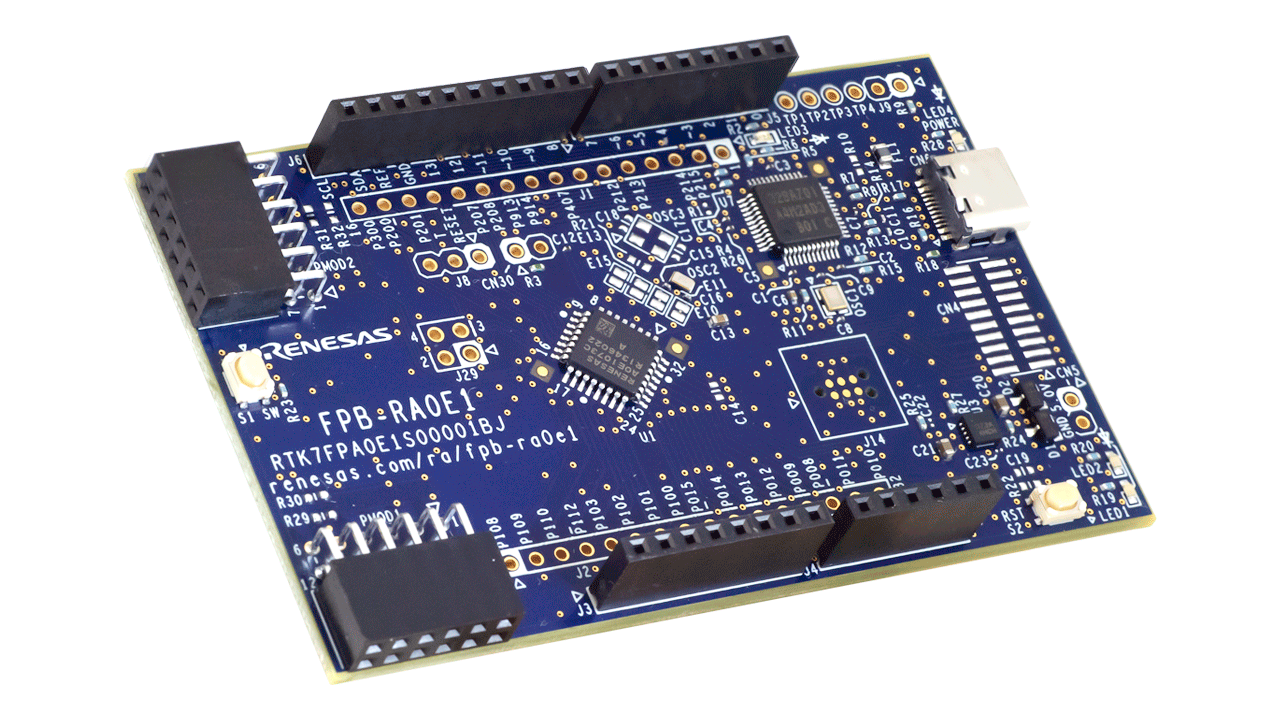
The RA0E1 Fast Prototyping Board is equipped with an RA0E1 MCU, making it an evaluation board specialized for prototype development for a variety of applications. It has a built-in SEGGER J-Link™ emulator circuit so you can write and debug programs without additional tools. In addition, it includes Arduino® UNO and Pmod™ interfaces as standard, along with through-hole access to all pins of the microcontroller, offering high expandability.
Sample software is available to demonstrate the functionality of the RA0E1 MCU and to facilitate connections between the RA0E1 Fast Prototyping Board and various wireless or sensor modules. The kit includes the FPB‑RA0E1 v1 board and either a USB 2.0 Type‑C™ cable (Type‑A male to Type‑C male) or a USB 2.0 Type‑C cable (Type‑C male to Type‑C male); the cable type varies by FPB lot number.
Features
- Equipped with an RA0E1 32-bit microcontroller (R7FA0E1073CFJ):
- 32MHz, Arm® Cortex®-M23 Core
- 64KB ROM, 12KB RAM, Data Flash: 1KB
- 32-pin LQFP (7mm x 7mm x 1.7mm, 0.8mm pitch)
- No additional tools are required for program writing/debugging with the built-in SEGGER J-Link™ emulator circuit
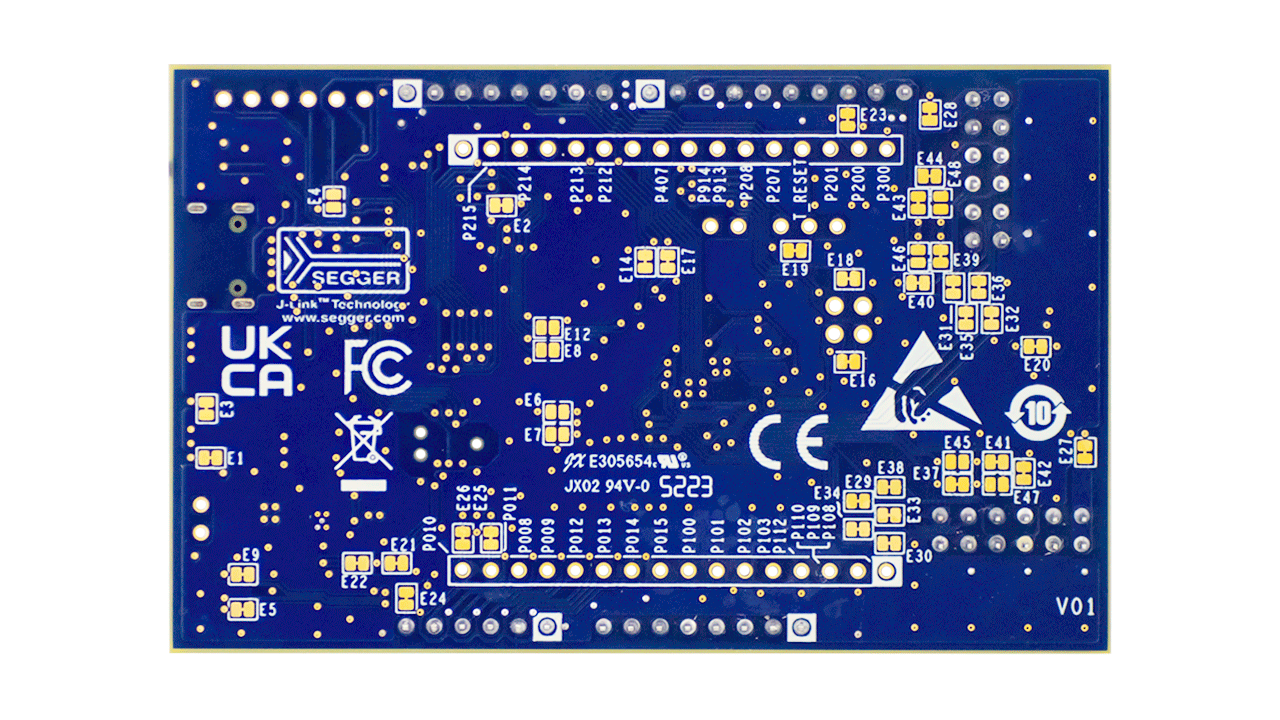
- Through-holes with access to all of the pins of the MCU
- Arduino UNO and Pmod interfaces
- Small size board: 53mm x 85mm
- Support for various RA0E1 software and tools

Sample & Buy
Fast Prototyping Board for the RA0E1 MCU Group
| Description: | Fast Prototyping Board for the RA0E1 MCU Group |
| SPQ: | 1 |
| Pb (Lead) Free: | No |
| Assembly Location: | CHINA |
Videos & Training
This video demonstrates the RA0E1 fast prototyping board, designed for the RA0E1 MCU. It includes a built-in SEGGER J-Link emulator circuit, enabling program writing and debugging without additional tools. The board also provides Arduino UNO and Pmod™ interfaces, along with through-hole access to all microcontroller pins for enhanced expandability.
Additional Videos
News & Blog Posts
Blog Post Apr 22, 2025 |
Blog Post Apr 9, 2024 |
Support
Support Communities
- I2C SCL and SDA pin configuration difference in schematic and e2 studio pin tab and e2 studio stack properties in FPB-RA0E1
Hi, i was tried to generate a simple I2C write and read code by referring IICA example code for fpb-raoe1 from example bundle. For that first i select the IICA master in stack tab-> connectivity->IICA_Master. i was trying to select SDA and SDL in the property window ...
Nov 20, 2024 - FPB-RA0E1 - SAU_I2C pin selection issue for FPB-RA0E1 device configuration
Hi, i was trying to generate EEPROM code, for FPB-RA0E1 device. The code is working for custom device but while generating project, if i select FPB-RA0E1, the SAU_I2C pin selection will make error. I will share the working code, configuration for i2c, summary page and pin tab ...
Dec 17, 2024 - TAU- Interval Timer time calculation for FPB-RA0E1
Hi, i wanted to use interval timer for 1 second fixed time and 1ms fixed time for another example. Which value am i need to change in configuration. in the tau_fbp_ra0e1_ep example period selected as 0x10000. and its getting around 15 to 16s time interval. Can i ...
Dec 10, 2024
Knowledge Base
- How to use different low power modes on FPB-RA0E1 board
Last updated on 25th May 2026 Summary of the video This video demonstrates how to setup and enter a low-power mode on EK-RA0E1. FSP supports LPM operations on RA0E1 with the r_lpm FSP module. It shows how the ICU external IRQ and LPM modules are initialized, how ...
- How to Use Real-Time Clock on FPB-RA0E1
Last updated on 1st June 2026 Summary of the video This video demonstrates how to update and read the RTC on RA0E1 Fast Prototyping Board using UART input. Flexible Software Package (FSP) supports RTC operation with the r_rtc_c FSP module and serial communication with the r_uarta FSP ...
- How to Use Watchdog Timer on FPB-RA0E1 Board
Last updated on 25th May 2026 Summary of the video This video demonstrates how to use the Independent Watchdog Timer (IWDT) on EK-RA0E1. FSP supports IWDT operations on RA0E1 with the r_iwdt FSP module. It shows normal operation where the IWDT is refreshed to prevent a reset, followed ...

Support Communities

