
Features
- High ESD protection on RS-485 I/O pins: ±10kV
- Class 3 HBM ESD level on all other pins: >3kV
- Large differential VOUT 2.8V into 54Ω better noise immunity, or drive up to 6 terminations
- High data rates: up to 40Mbps
- Specified for +125°C operation (FBZ), +85°C (IBZ)
- 11/13ns (maximum) Tx/Rx propagation delays; 1.5ns (maximum) skew
- 1/5 unit load allows up to 160 devices on the bus
- Full fail-safe (open, shorted, terminated/undriven) receiver
- High Rx IOL to drive opto-couplers for isolated applications
- Hot plug - Tx and Rx outputs remain three-state during power-up
- Low quiescent supply current: 4mA
- Low current shutdown mode: 1μA
- -7V to +12V common-mode input voltage range
- Three-state Rx and Tx outputs
- Operates from a single +5V supply (10% tolerance)
- Current limiting and thermal shutdown for driver overload protection
- Pb-free (RoHS compliant)
Description
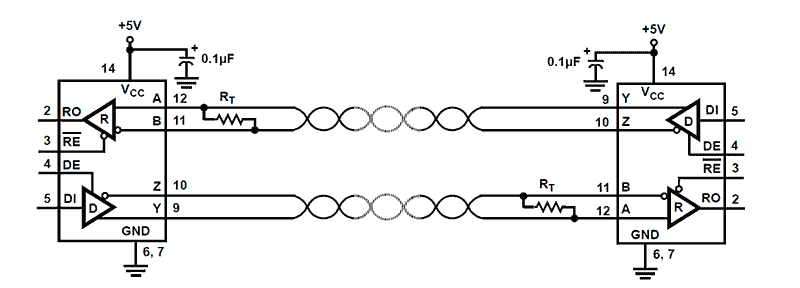
The ISL3160E is a ±10kV IEC61000 ESD protected, 5V powered, full-duplex transceiver that meets both the RS-485 and RS-422 standards for balanced communication. It also features a large differential output voltage and high data rate (up to 40Mbps) and is offered in the standard industrial (-40°C to +85°C) and extended industrial (-40°C to +125°C) temperature ranges. The low bus currents (+220μA/-150μA) present a 1/5 unit load to the RS-485 bus. This allows up to 160 transceivers on the network without violating the RS-485 specification’s load limit and without using repeaters. This transceiver requires a 5V ±10% tolerance supply, and delivers at least a 2. 1V differential output voltage over this supply range. This translates into better noise immunity (data integrity), longer reach, or the ability to drive up to six 120Ω terminations in “star” or other nonstandard bus topologies at the exceptional 40Mbps data rate. SCSI applications benefit from the ISL3160E’s low receiver and transmitter part-to-part skews. The ISL3160E is perfect for high speed parallel applications requiring simultaneous capture of large numbers of bits. The low bit-to-bit skew eases the timing constraints on the data latching signal. Receiver (Rx) inputs feature a “full fail-safe” design, which ensures a logic high Rx output if Rx inputs are floating, shorted, or terminated but undriven. Rx outputs feature high drive levels (typically >30mA at VOL = 1V) to ease the design of optically isolated interfaces. Hot plug circuitry ensures that the Tx and Rx outputs remain in a high impedance state while the power supply stabilizes. Driver (Tx) outputs are short-circuit protected, even for voltages exceeding the power supply voltage. Additionally, on-chip thermal shutdown circuitry disables the Tx outputs to prevent damage if power dissipation becomes excessive.
Parameters
| Attributes | Value |
|---|---|
| Temp. Range (°C) | -40 to +125°C |
| Devices Allowed on Bus | 160 |
Package Options
| Pkg. Type | Pkg. Dimensions (mm) | Lead Count (#) | Pitch (mm) |
|---|---|---|---|
| SOICN | 8.7 x 3.9 x 0.00 | 14 | 1.3 |
Application Block Diagrams
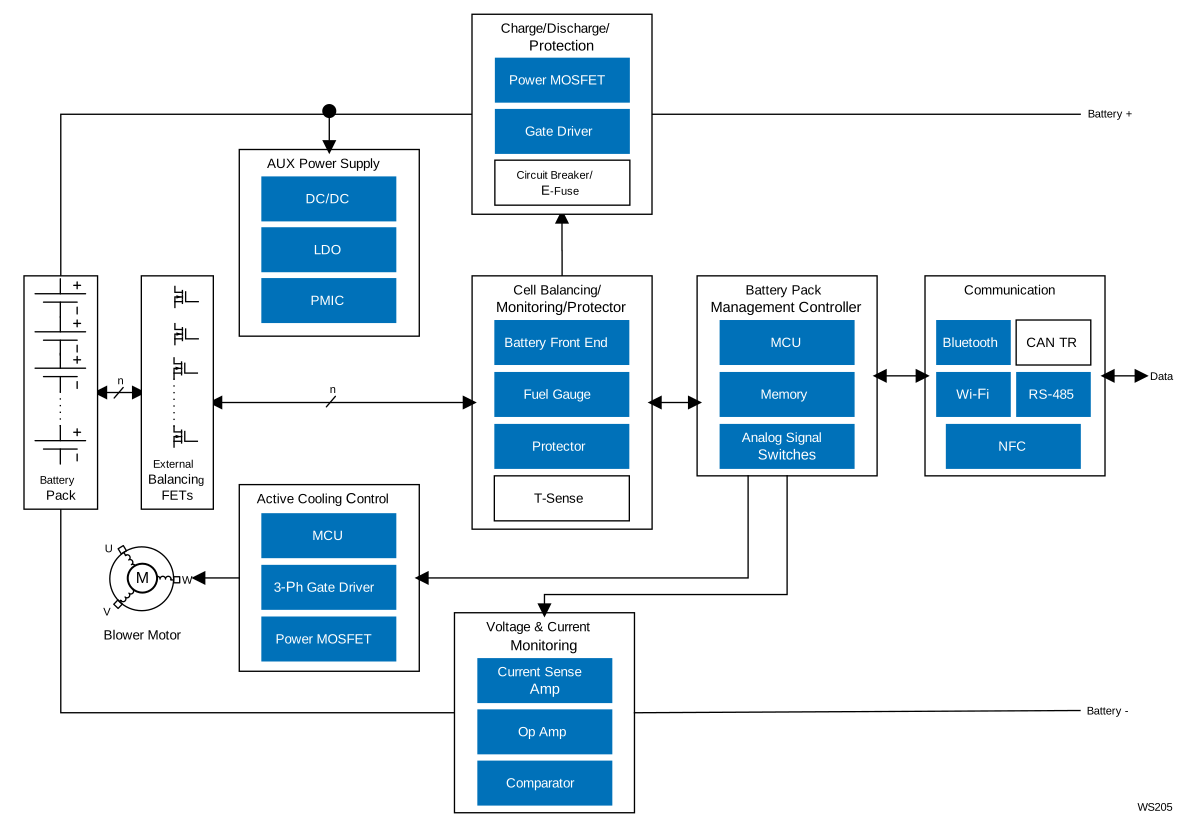 | Humanoid Battery Management System Integrated humanoid robot BMS enabling safe, real-time power management, protection, and battery-state control. |
Complete Your Design
Explore complementary products to elevate your design
| Part Number | Status | Samples | Stock | RoHS | Package | Budgetary Price (USD) | Lead Count (#) | Carrier Type | Moisture Sensitivity Level (MSL) | Pb (Lead) Free | Pb Free Category | Temp. Range (°C) | Country of Assembly | Country of Wafer Fabrication |
|---|---|---|---|---|---|---|---|---|---|---|---|---|---|---|
| ISL3160EFBZ | Active | Available | In Stock | RoHS:EN | SOIC | 1ku | $0.99 | 14# | Tube | 3 | Yes | Pb-Free 100% Matte Tin Plate w/Anneal-e3 | -40 to +125°C | CHINA, TAIWAN, MALAYSIA | USA |
| ISL3160EFBZ-T | Active | Available | Out of Stock | RoHS:EN | SOIC | 1ku | $0.99 | 14# | Reel | 3 | Yes | Pb-Free 100% Matte Tin Plate w/Anneal-e3 | -40 to +125°C | CHINA, TAIWAN, MALAYSIA | USA |
| ISL3160EFBZ-T7A | Obsolete | N/A | In Stock | RoHS:EN | SOIC | 14# | Reel | 3 | Yes | Pb-Free 100% Matte Tin Plate w/Anneal-e3 | -40 to +125°C | |||
| ISL3160EIBZ | Obsolete | N/A | In Stock | RoHS:EN | SOIC | 14# | Tube | 3 | Yes | Pb-Free 100% Matte Tin Plate w/Anneal-e3 | -40 to +85°C | |||
| ISL3160EIBZ-T | Obsolete | N/A | In Stock | RoHS:EN | SOIC | 14# | Reel | 3 | Yes | Pb-Free 100% Matte Tin Plate w/Anneal-e3 | -40 to +85°C | |||
| ISL3160EIBZ-T7A | Obsolete | N/A | In Stock | RoHS:EN | SOIC | 14# | Reel | 3 | Yes | Pb-Free 100% Matte Tin Plate w/Anneal-e3 | -40 to +85°C |
Complete Your Design
Explore complementary products to elevate your design
Filters
Applied Filters
- TrainingPDF 719 KB R15TB0008EU0100 Rev.1.00 Dec 18, 2023
- TrainingPDF 762 KB R15TB0007EU0100 Rev.1.00 Dec 04, 2023
- TrainingPDF 208 KB R15TB0004EU0100 Rev.1.00 Oct 26, 2023
- TrainingPDF 405 KB R15TB0003EU0100 Rev.1.00 Jun 26, 2023
- TrainingPDF 239 KB R15TB0002EU0100 Rev.1.00 Jun 21, 2023
- Application NotePDF 365 KB AN1978 Apr 12, 2023AI-generated Summary: The document details surge protection circuits for RS-485 transceivers, focusing on Level 4 (4kV) protection using gas discharge tubes (GDTs) for higher overvoltage and overcurrent tolerance. It compares protection schemes by component count, board area, and cost, highlighting that higher-level protection increases complexity and expense. The BOMs for Level 3 and Level 4 circuits list components such as transceivers, bidirectional TVS diodes, transient blocking units, thyristors or GDTs, and resistors. The GDT switching characteristic explains how it diverts transient currents to ground by transitioning from high impedance to a crowbar current path. Simpler protection can be achieved with overvoltage protected transceivers.
- Application NotePDF 207 KB an1985 Aug 19, 2022AI-generated Summary: Transient protection for RS-485 transceivers involves careful TVS diode design to prevent damage from high surge currents. Internal ESD structures in the ISL3152E share transient current with external TVS diodes, risking damage without current-limiting resistors. Using thick-film resistors under 200 ohms between TVS and transceiver limits surge current while minimizing bus voltage attenuation. Recommended PCB layout includes low-inductance ground and Vcc planes, 0603 resistors for wave or reflow soldering, and proper component placement to reduce inductance and enhance protection.
- Application NotePDF 474 KB AN1979 Aug 16, 2022AI-generated Summary: The document explains surge protection using Renesas’ Overvoltage Protected (OVP) transceivers with various protection schemes. It details the use of TVS diodes and thyristors to protect data lines against surge currents while maintaining low capacitance for high data rates. Different configurations address various common-mode voltage ranges and surge levels, ensuring compliance with IEC61000-4-5 standards. The paper includes calculations for peak protection voltages and discusses device characteristics and combinations for robust surge protection in industrial applications.
- Technical BriefPDF 188 KB R70TB0002EU0100 Rev.1.00 May 17, 2022
- Application NotePDF 180 KB R15AN0007EU0100 Rev.1.00 Jul 20, 2021AI-generated Summary: Failure Modes and Effects Analysis (FMEA) evaluates the impact of various pin failure conditions on device functionality and damage. It covers scenarios such as short-circuits to VCC, GND, adjacent pins, and open pins. The analysis classifies failure effects into four categories based on damage and functional impact. Detailed tables describe each pin’s response to failure modes, including current flow, device operation status, and effects on data transmission. The document aids in understanding pin-level reliability and failure impact for robust system design.
- Product Change NoticePDF 266 KB Jun 04, 2020
Recommended Documents (1)
Datasheets (1)
No Results Found.
Make sure all keywords are spelled correctly.
Try fewer, different, or more general terms to vary your search.
If you have filters applied, consider deselecting some to broaden your results.
- Search our extensive knowledgebase, designed to help customers with their FAQs.
- Get help from our expert Renesas technical staff and community on our support forums.
- Application NotePDF 365 KB AN1978 Apr 12, 2023AI-generated Summary: The document details surge protection circuits for RS-485 transceivers, focusing on Level 4 (4kV) protection using gas discharge tubes (GDTs) for higher overvoltage and overcurrent tolerance. It compares protection schemes by component count, board area, and cost, highlighting that higher-level protection increases complexity and expense. The BOMs for Level 3 and Level 4 circuits list components such as transceivers, bidirectional TVS diodes, transient blocking units, thyristors or GDTs, and resistors. The GDT switching characteristic explains how it diverts transient currents to ground by transitioning from high impedance to a crowbar current path. Simpler protection can be achieved with overvoltage protected transceivers.
- Application NotePDF 207 KB an1985 Aug 19, 2022AI-generated Summary: Transient protection for RS-485 transceivers involves careful TVS diode design to prevent damage from high surge currents. Internal ESD structures in the ISL3152E share transient current with external TVS diodes, risking damage without current-limiting resistors. Using thick-film resistors under 200 ohms between TVS and transceiver limits surge current while minimizing bus voltage attenuation. Recommended PCB layout includes low-inductance ground and Vcc planes, 0603 resistors for wave or reflow soldering, and proper component placement to reduce inductance and enhance protection.
- Application NotePDF 474 KB AN1979 Aug 16, 2022AI-generated Summary: The document explains surge protection using Renesas’ Overvoltage Protected (OVP) transceivers with various protection schemes. It details the use of TVS diodes and thyristors to protect data lines against surge currents while maintaining low capacitance for high data rates. Different configurations address various common-mode voltage ranges and surge levels, ensuring compliance with IEC61000-4-5 standards. The paper includes calculations for peak protection voltages and discusses device characteristics and combinations for robust surge protection in industrial applications.
- Application NotePDF 180 KB R15AN0007EU0100 Rev.1.00 Jul 20, 2021AI-generated Summary: Failure Modes and Effects Analysis (FMEA) evaluates the impact of various pin failure conditions on device functionality and damage. It covers scenarios such as short-circuits to VCC, GND, adjacent pins, and open pins. The analysis classifies failure effects into four categories based on damage and functional impact. Detailed tables describe each pin’s response to failure modes, including current flow, device operation status, and effects on data transmission. The document aids in understanding pin-level reliability and failure impact for robust system design.
- Application NotePDF 178 KB r15an0002eu-rs-485-transient-protection Oct 28, 2019View More (14)
Application Notes & White Papers (14)
- Product Change NoticePDF 266 KB Jun 04, 2020
Product Notices (PCN, EOL, etc) (3)
No Results Found.
Make sure all keywords are spelled correctly.
Try fewer, different, or more general terms to vary your search.
If you have filters applied, consider deselecting some to broaden your results.
- Search our extensive knowledgebase, designed to help customers with their FAQs.
- Get help from our expert Renesas technical staff and community on our support forums.
No Results Found.
Make sure all keywords are spelled correctly.
Try fewer, different, or more general terms to vary your search.
If you have filters applied, consider deselecting some to broaden your results.
- Search our extensive knowledgebase, designed to help customers with their FAQs.
- Get help from our expert Renesas technical staff and community on our support forums.
No Results Found.
Make sure all keywords are spelled correctly.
Try fewer, different, or more general terms to vary your search.
If you have filters applied, consider deselecting some to broaden your results.
- Search our extensive knowledgebase, designed to help customers with their FAQs.
- Get help from our expert Renesas technical staff and community on our support forums.
No Results Found.
Make sure all keywords are spelled correctly.
Try fewer, different, or more general terms to vary your search.
If you have filters applied, consider deselecting some to broaden your results.
- Search our extensive knowledgebase, designed to help customers with their FAQs.
- Get help from our expert Renesas technical staff and community on our support forums.
No Results Found.
Make sure all keywords are spelled correctly.
Try fewer, different, or more general terms to vary your search.
If you have filters applied, consider deselecting some to broaden your results.
- Search our extensive knowledgebase, designed to help customers with their FAQs.
- Get help from our expert Renesas technical staff and community on our support forums.
No Results Found.
Make sure all keywords are spelled correctly.
Try fewer, different, or more general terms to vary your search.
If you have filters applied, consider deselecting some to broaden your results.
- Search our extensive knowledgebase, designed to help customers with their FAQs.
- Get help from our expert Renesas technical staff and community on our support forums.
- TrainingPDF 719 KB R15TB0008EU0100 Rev.1.00 Dec 18, 2023
- TrainingPDF 762 KB R15TB0007EU0100 Rev.1.00 Dec 04, 2023
- TrainingPDF 208 KB R15TB0004EU0100 Rev.1.00 Oct 26, 2023View More (10)
Marketing Collateral (10)
- Technical Brief
- Technical BriefPDF 188 KB R70TB0002EU0100 Rev.1.00 May 17, 2022
- DocumentPDF 254 KB tb505 Sep 15, 2010
Other (3)
No Results Found.
Make sure all keywords are spelled correctly.
Try fewer, different, or more general terms to vary your search.
If you have filters applied, consider deselecting some to broaden your results.
- Search our extensive knowledgebase, designed to help customers with their FAQs.
- Get help from our expert Renesas technical staff and community on our support forums.

Support Communities


