
Enabling Smarter Sensors
Sensing devices play an increasingly important role in many areas of modern life — at our workplace, in industry, at home, as well as our personal mobile devices. In consumer applications, sensor-based electronic control provides us with additional safety, health information, power savings, and overall convenience. And for more complex systems in industry and commercial applications, the trend is toward more intelligent sensors that deliver more precise and "intelligent" data to improve product quality, increase operational savings, and reduce energy consumption.
However, each sensor has its unique electrical characteristics and require painstaking tuning of circuitry to convert weak or varied signals into a value that is usable for a microcontroller (MCU). The challenge then is to have a flexible platform that will allow a user to adapt to varied interface requirements, simplify the tuning process, and have the ability to add intelligence based on the information received.
Renesas' Smart Analog portfolio allows interfacing to hundreds of sensor types with a single, configurable analog front end (AFE) platform – resulting in more intelligent sensors with a smaller footprint, while significantly reducing development time.
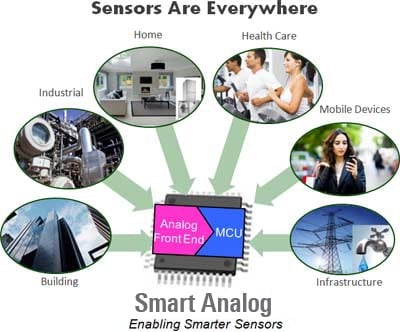
Smart Analog IC
The Smart Analog IC is a monolithic programmable analog IC integrating an analog front end circuit for processing small sensor signals.
| Products | Description | Featured Document |
|---|---|---|
| Smart Analog IC101 | Flexibly change analog front end settings in response to environmental changes | RAA730101 16-bit Delta-sigma A/D converter IC with programmable gain instrumentation amplifier (PDF | English, 日本語) |
| Smart Analog IC300 | For low voltage configurable amplifier | RAA730300 Monolithic Programmable Analog IC (PDF | English, 日本語) |
| Smart Analog IC301 | For low voltage general-purpose instrumentation amplifier | RAA730301 Monolithic Programmable Analog IC (PDF | English, 日本語) |
| Smart Analog IC500 | For configurable amplifier | RAA730500 Monolithic Programmable Analog IC (PDF | English, 日本語) |
| Smart Analog IC501 | For general-purpose instrumentation amplifier | RAA730501 モノリシック・プログラマブル・アナログIC データシート (PDF) |
| Smart Analog IC502 | For high-speed instrumentation amplifier for motor control | RAA730502 Monolithic Programmable Analog IC (PDF | English, 日本語) |
Smart Analog MCU
The RL78/G1E microcontroller is based on the RL78/G1A and has built-in analog front-end (AFE) for sensor applications. The AFE circuit contains configurable amplifiers capable of various amplifier configurations, a gain adjustment amplifier, filters, D/A converters, a temperature sensor, which are suitable for processing small sensor signals.
| Products | Description | Featured Document |
|---|---|---|
| RL78/G1E | Analog Front End + MCU, 8/12-bit ADC | |
| RL78/I1E | Analog Front End + MCU, 24-bit Delta-Sigma | RL78/I1E Data Sheet (PDF) |
Smart Analog Development Tools
- Smart Analog Easy Starter
With a Smart Analog Easy Starter, you can observe waveforms by actually designing the analog front end circuitry of a Smart Analog device, downloading analog circuit data, and running the system. - API Builder SAIC101 Coding Assistance Tool
API Builder SAIC101 is for editing the API for controlling the Smart Analog IC101, generating various sample code that uses the edited API, and assisting integration work. - SA-Designer
SA-Designer lets you design actual analog front-end circuits employing Smart Analog products and then generates the circuit data as C source code.
| Device | Development & Design Tools | |
|---|---|---|
| Analog IC | Smart Analog IC101 | Smart Analog Easy Starter (v2.1) API Builder SAIC101 (v1.1) SA-Designer |
| Smart Analog IC300 | Smart Analog Easy Starter (v2.0) SA-Designer | |
| Smart Analog IC301 | ||
| Smart Analog IC500 | ||
| Smart Analog IC501 | ||
| Smart Analog IC502 | ||
| MCU | Smart Analog MCU RL78/G1E R5F10FMx | |
| Smart Analog MCU RL78/G1E R5F10FLx |
Supported Partner Solutions
| Device | Microcontroller | Starter Kit/Evaluation Board | Remarks | |
|---|---|---|---|---|
| Analog IC | Smart Analog IC101 | --- | Smart Analog IC101 RSK Option Board TSA-OP-IC101 *1 | Manufactured by Tessera Technology |
| Smart Analog IC300 | RL78/G1A | Smart Analog IC Evaluation Board TSA-IC300 | Manufactured by Tessera Technology | |
| Smart Analog IC301 | Smart Analog IC Evaluation Board TSA-IC301 | Manufactured by Tessera Technology | ||
| Smart Analog IC500 | Smart Analog IC Evaluation Board TSA-IC500 | Manufactured by Tessera Technology | ||
| MCU | Smart Analog MCU RL78/G1E R5F10FMx | RL78/G1E | Smart Analog Stick (RL78/G1E Stick Starter kit) RL78/G1E-STICK | Manufactured by Tessera Technology |
Notes:
- The Smart Analog IC101 RSK Option Board TSA-OP-IC101 is an optional evaluation board that includes the Smart Analog IC101 and a sensor element. A Renesas Starter Kit (for example, the Renesas Starter Kit for RL78/L13) must be purchased separately.
- The Smart Analog Easy Starter 101 currently supports Renesas Starter Kit for RL78/L13 only. For details, see Smart Analog IC101: Smart Analog Easy Starter 101 Tutorial (RL78/L13).
- If you are using in combination with any other Renesas Starter Kit, please refer to this application note:
Smart Analog IC101: How to Use Smart Analog IC101's API and Sample Code for Other MCUs
Analog Front End Brings Sensor and Microcontroller Together
The analog front end (AFE) is an essential system building block to a sensor circuit that amplifies and/or filters sensor signals that are often weak and may have complex electrical configurations to support different MCUs. In addition, the AFE that performs this vital bridging function is often difficult to simulate and must be adjusted because of specific component behavior, board layout, and nearby noise sources.

Smart Analog Technology
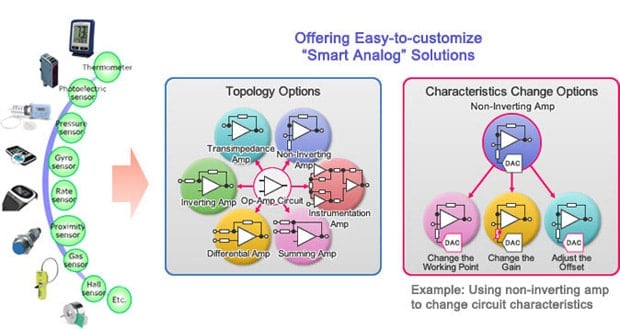
Smart Analog technology implements a range of AFE topologies designed to be easily configured to support countless types of sensors with a single device. Smart Analog key highlights:
- Flexibility – A set of configurable amplifier circuits can easily be tailored using an intelligent and intuitive software GUI.
- Eliminate trial-and-error soldering – Adjust for sensor, board, noise and other characteristics without hardware-level experimentation.
- Field programmable – Circuit characteristics can be modified for sensor drift after equipment is installed reducing service and maintenance costs.
- Simplified tuning – Easily tune circuits to meet the system requirements for a wide range of industrial, commercial and medical applications.
Reduced Development Time
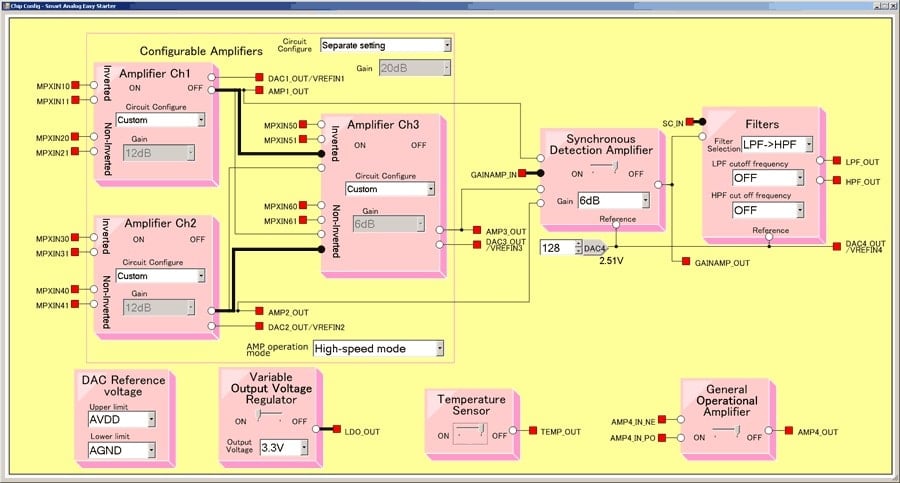
Even if you are new to the analog design field, engineers will be able to get their development projects up and running quickly and easily.
- A powerful GUI-based sensor configuration software tool enables quick configuration of the analog front-end, allowing the designer to easily change gain values or do offset tuning.
- The ability to do sensor calibration and debugging "on the fly" can reduce the overall design lead time between 3 to 8 months depending on the complexity of the design.
Low-power, Small Footprint Hardware Platform
Smart Analog technology replaces discrete components that typically measure and regulate sensor data
- Reduce the number of components compared to conventional analog front end implementations by a factor of ten!
- Up to 20% lower power consumption
- Flexible low power modes
- Power-on/off function of each block
- Reduce the PCB footprint by 25%
Providing Intelligence To Every Sensor
Receive the benefit of the MCUs intelligence used to automate trimming and automatically correct long-term drift
Previously, trimming had to be performed manually during the manufacture of the sensor equipment to absorb variations in sensor characteristics. But with Smart Analog, the configuration and characteristics of the analog circuits are controlled automatically by the MCU. Smart Analog is also field programmable, allowing long-term sensor drift to be automatically corrected and repaired. This prolongs the life of your system and raises its added value.
Practical Example of Field Programmability (Light Sensor)
Due to time, weathering or other factors, the sensor may become dirty and its characteristics drift over time, causing a drop in sensitivity.
If the output gain of the sensor remains the same as when the sensor was first installed, the MCU stops detecting the sensor output sooner once it falls below the detection threshold. With the Smart Analog, it is able to detect the drop in sensor output.
Smart Analog is able to raise the output gain automatically so that the MCU maintains its detection performance. This means that if the luminance is within the detection range, it will be detected normally.
Support

Support Communities

