The first wave of the artificial intelligence infrastructure buildout was a race for capacity: AI model training fueled the earliest growth stages, supported by more powerful xPUs including GPUs and AI ASICs that enabled the rapid expansion of hyperscale data centers.
That initial investment cycle transformed AI into a global computing platform. Today's AI infrastructure has entered a new phase where workloads shift from training models on extremely large datasets to AI inference, which emphasizes continuous, real-time application processing. As model inference becomes an increasingly dominant workload, infrastructure requirements are evolving beyond raw compute capacity.
The emergence of agentic AI and physical AI, which extends autonomous systems capable of reasoning, planning, and executing complex tasks into the real world, is spawning new business use cases across multiple markets and applications. In automotive, for example, AI is enabling software-defined vehicles, while AI-enhanced humanoid robotic deployments could approach one billion by the middle of the century.
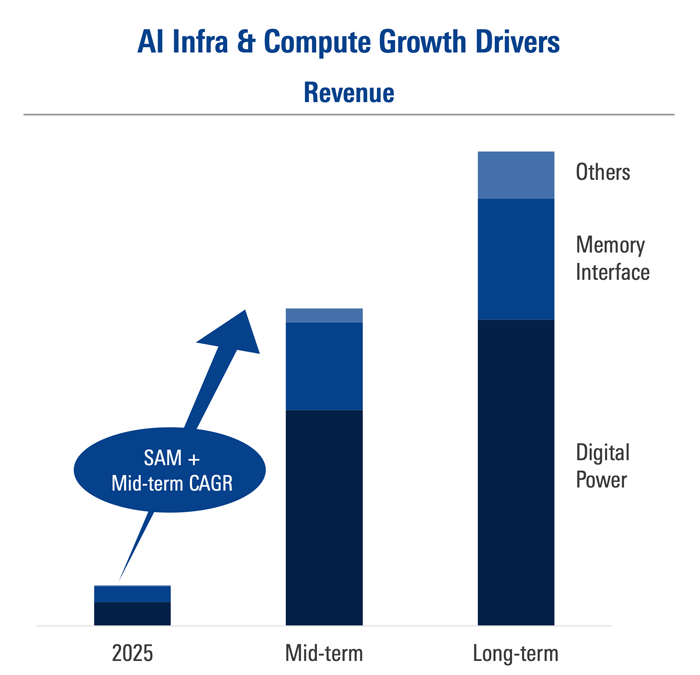
As a result, xPUs are expected to share the stage with a host of enabling technologies that will define the future of data center design and performance. In this environment, CPUs and xPUs, but also power, memory interfaces, and control systems, will drive AI market expansion and create a broader and more durable infrastructure opportunity than many had initially anticipated. Amplified by inference workloads, AI's burgeoning power demands are triggering a fundamental redesign of infrastructure architectures. Renesas is uniquely positioned to capitalize on this opportunity. As I shared in an AI infrastructure and compute update at our recent Renesas Capital Market Day investor event, this is due to our extensive portfolio of digital power, power semiconductor, memory interface, control, and analog solutions.
Where Inference Meets Opportunity
As inference workloads become the dominant driver of AI deployment, they open a broader market than even the first phase of AI expansion.
Instead of depending on a single processor category, infrastructure growth increasingly benefits the technologies that connect, power, and manage every compute element. More companies are expanding into infrastructure and services, bringing both complementary technologies and new competition.
Renesas is addressing this opportunity by organizing around three complementary pillars:
- Digital Power: Addresses the growing electrical demands of AI systems.
- Memory Interface: Optimizes compute utilization to improve data movement between processors and memory.
- Control: Manages complex power and control planes throughout the server.
Together, these technologies allow Renesas to serve opportunities across all xPUs regardless of which processor architecture is in play.
Power Is AI's Defining Engineering Challenge
If xPUs defined the first chapter of AI infrastructure, power architecture is shaping the next. Next-generation AI racks could potentially consume more than one megawatt of power—enough to supply more than a thousand homes. That requires new approaches to energy distribution, conversion, efficiency, and thermal management throughout the data center.
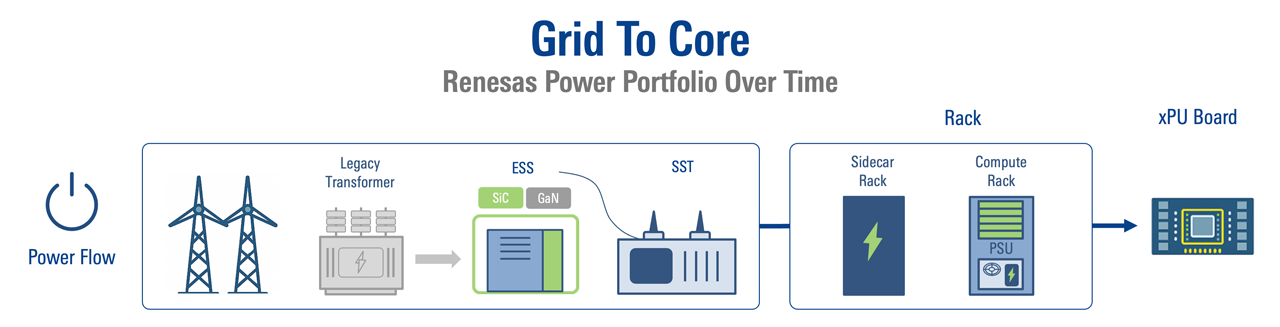
A visible example is the transition to 800VDC power distribution. As traditional power architectures approach their practical limits, the industry is adopting higher-voltage systems and more advanced power delivery technologies. Higher voltage reduces current, minimizes conduction losses, and increases system density and efficiency as rack power climbs. But in placing more xPUs closer together, thermal management now becomes as critical as electrical performance.
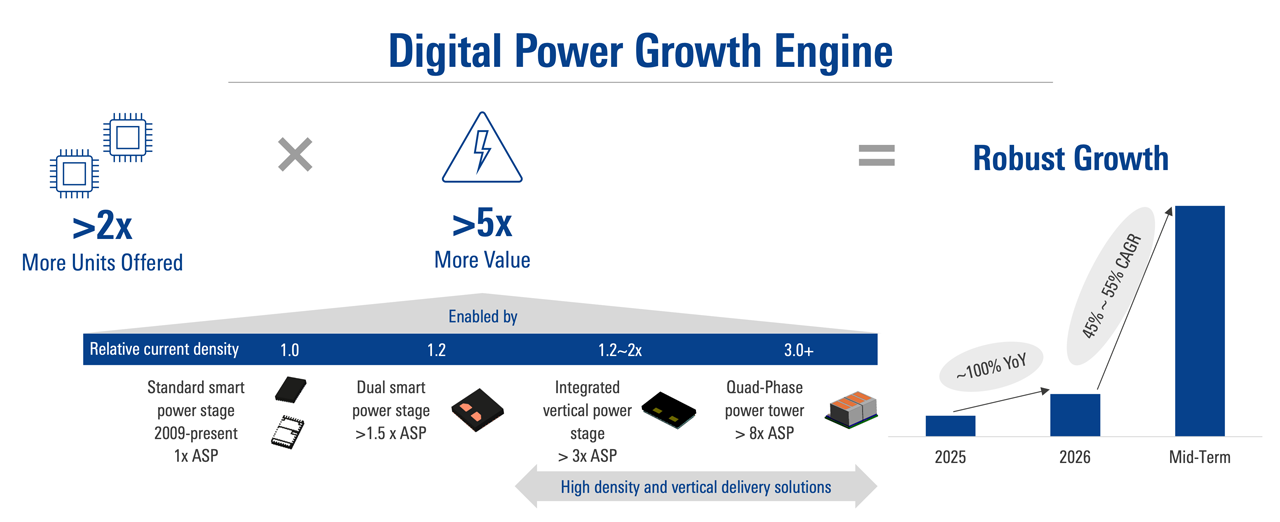
These changes are refocusing demand for enabling technologies, and Renesas is responding with a digital power portfolio that serves key stages of the power delivery chain—from rack-level power conversion to processor-level voltage regulation.
One of the most significant opportunities lies in vertical power delivery. Renesas' vertical power solutions deliver higher current closer to the processor using modular, high-density, multi-phase solutions and power stages. Gallium nitride (GaN) switches support efficient high-voltage conversion from emerging 800V architectures. And our advanced MOSFET technologies, low-voltage GaN options, and associated drivers are used throughout lower-voltage (isolated and non-isolated) conversion stages and managed by Renesas' smart, MCU-based digital controllers.
At these voltage levels, power conversion efficiency, density, and thermal management move from incidental considerations to the frontline of system-level design requirements.
Data Management Is Critical to AI Performance
In addition to efficient and intelligent power management, data centers tasked with processing AI inference models require more memory bandwidth and memory capacity. The ability to transfer data quickly between processors and memory is essential for sustaining system performance, particularly as read-intensive inference workloads continue to scale.
As a longtime leader in memory interface technologies, Renesas' portfolio includes key components within advanced DDR memory modules that help customers improve bandwidth, reliability, scalability, and compute efficiency.
AI Data Centers Require Intelligent Controls
As AI infrastructure becomes more complex, operators also need intelligent controls throughout the data center capable of managing power systems, monitoring performance, and coordinating system-level functions. By ensuring reliability, efficiency, and manageability, control functions play a critical role in modern data centers from the rack level to individual subsystems.
To address these customer requirements, Renesas is expanding MCU-based solutions with the flexibility and software-defined capabilities required by both power management and control-plane applications.
A System-Level View of Infrastructure
What makes the AI opportunity especially compelling for Renesas is the convergence of power, memory, and control.
Today's data center architects value design partners that understand hyperscale data center challenges from the system down to the component level and are capable of optimizing performance across the entire infrastructure stack. By collaborating early in the development cycle with our system modeling, power emulation, and software tools, we help customers improve design outcomes by identifying issues before hardware is built.
Renesas' systems orientation extends into production where we combine internal manufacturing capacity with foundry partnerships. A hybrid model allows us to respond flexibly to changing AI demand and support rapid scaling without relying on a single manufacturing source – all while reducing supply-chain risk.
Powering the Next AI Wave
AI infrastructure is entering a period of sustained expansion, and the next generation of data centers will require advanced power delivery, memory bandwidth, and intelligent control. These deeply interconnected requirements will shape the future of computing as they evolve from supporting technologies into essential AI building blocks.
The shift favors companies with a broad, platform-first mindset and a heritage of customer co-development. By any measure, Renesas meets that definition.