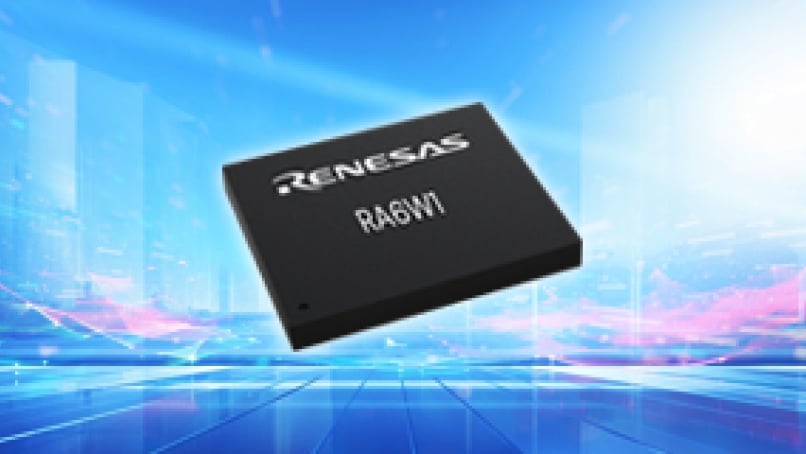
Renesas recently announced that our Connectivity team is now part of the Embedded Processing group. The move supports our commitment to elevating the customer experience by combining the strengths of our connectivity and embedded computing portfolios into one cohesive yet flexible design platform.
At its core, the decision is about simplicity. Smart home, IoT, and industrial IoT designers are under pressure to optimize designs using less power, less board space, fewer components – even smaller teams. A multi-vendor approach yields a patchwork of MCUs, Wi-Fi chipsets, and Bluetooth® modules that tax engineering resources and introduce compatibility and interoperability risks – not to mention the complexity of managing disparate software environments, documentation, validation, and certification flows.

By aligning connectivity with embedded processing under one organization, Renesas delivers complete, coherent platforms that combine compute, wireless, security, tools, and long-term product support. That shift is exemplified in our latest offering, the RA6W1 and RA6W2 wireless MCUs.
Three Technology Legacies, One Connected Platform
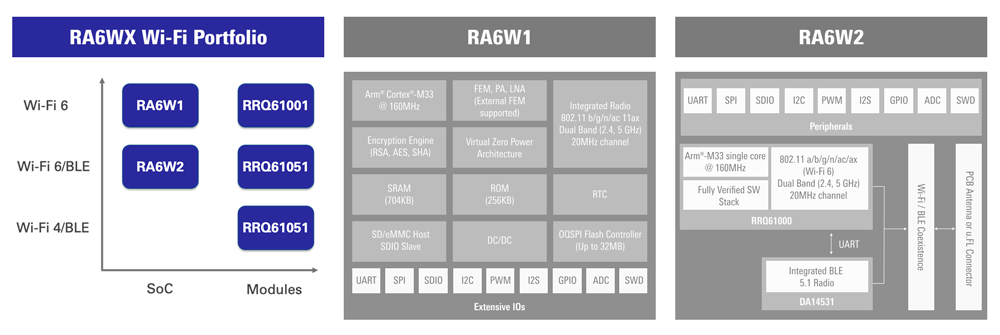
The RA6W1 dual-band Wi-Fi 6 MCU and RA6W2 Wi-Fi 6 + Bluetooth Low Energy (LE) combo MCU are a representative outcome of Renesas' acquisition strategy in that they unite three lineages:
- Renesas' proven RA MCU architecture, built on Arm® Cortex® cores, offers a rich set of peripherals within the Flexible Software Package (FSP) ecosystem.
- Dialog Semiconductor brings expertise in ultra-low power Bluetooth LE.
- Celeno lends its heritage in high-performance, advanced Wi-Fi.
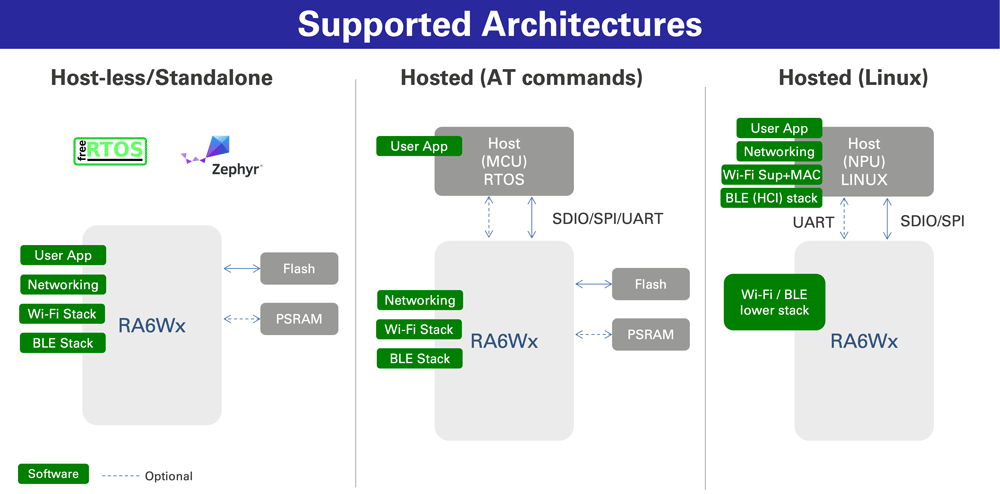
In the new RA6W1 and RA6W2 MCUs, those pieces have coalesced into a family of devices that deliver dual-band Wi-Fi 6, optional integrated Bluetooth LE, robust security, and an MCU that can run the application – all in one device. Designers can build cost-effective, standalone IoT endpoints without an external host MCU, or they can treat the RA6W1/RA6W2 as a connectivity "companion" attached to a higher-end host processor. Either way, they stay within the RA ecosystem, with common tools, software, and support. That consistency is a direct byproduct of folding connectivity into embedded processing. Branding the devices as RA6W1 and RA6W2 also signals to existing RA customers that these new MCUs plug into the same FSP, the same e² studio environment, and the same development workflows they already know. This is part of our broader effort to bring connectivity, processing, and software together on a single platform to simplify development. In the future, customers will be able to integrate and manage these elements holistically under Renesas 365. Renesas 365 is an open cloud platform that connects key development stages from selecting devices to building, validating, and managing them in a single environment.
Making Life Easier for Real-World Designers
We expect our customers will enjoy the benefits of this organizational alignment as they introduce their products across a host of applications.
For example, smart thermostats and smart locks must be connected constantly to enable remote control and monitoring yet are often limited by power budgets. With the RA6W1 and RA6W2, designers get Wi-Fi 6 features like Target Wake Time (TWT) and "sleepy connected" modes that keep the device connected to the network while consuming as little as 200nA in sleep state and well under 50µA in DTIM10, a popular Wi-Fi power-saving mode.
Another example is baby-monitoring wearables, where a small sensor on a child communicates via Bluetooth LE to a nearby base unit, which then relays data over Wi-Fi to a caregiver's smartphone. Here, integrating Wi-Fi and Bluetooth LE in a consistent platform simplifies both the edge node and the gateway: short-range pairing and onboarding via Bluetooth and higher-bandwidth backhaul using Wi-Fi, all supported by a single software stack and security framework.
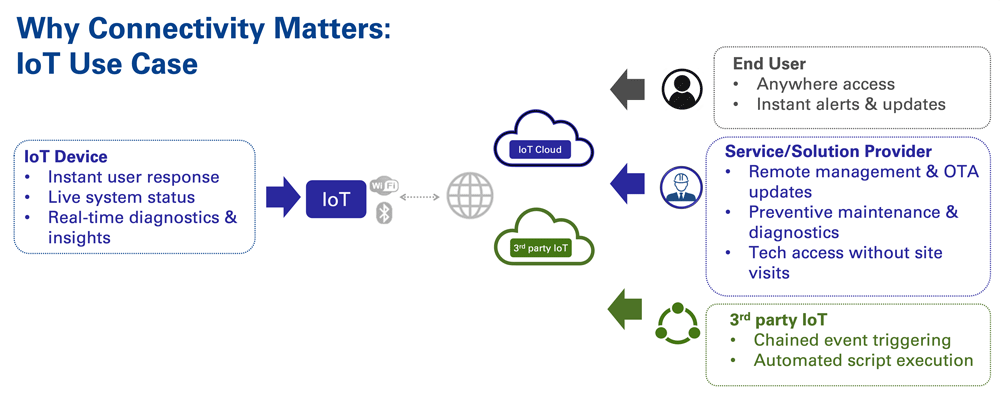
In the industrial world, motor-control companies can use the RA6W1/RA6W2 to pull operational data from field-deployed controllers into the cloud for predictive maintenance and over-the-air (OTA) firmware updates. Instead of redesigning boards around an assortment of third-party radios, they can keep the motor control expertise they've built on RA MCUs and add connectivity using the same ecosystem.
Dual-Band Intelligence and Wi-Fi/Bluetooth LE Coexistence
Both RA6W1 and RA6W2 MCUs support 2.4GHz and 5GHz Wi-Fi 6, with dynamic band selection based on real-time conditions. In practice, this means 2.4GHz can be used for longer-range, lower-bandwidth links, while 5GHz provides higher throughput, a more consistent signal, and lower latency in RF-congested environments like homes and crowded factory floors. The devices continuously monitor channel conditions and can steer traffic accordingly, helping maintain stable, high-speed connections even as RF environments change. That intelligence becomes particularly valuable in dense IoT deployments, where dozens or hundreds of nodes are competing for airtime.
At the same time, Wi-Fi and Bluetooth LE share the 2.4GHz band, which can create coexistence challenges. By integrating both radios with the MCU, Renesas can implement coexistence algorithms and perform rigorous RF testing at the platform level, rather than leaving customers to debug interference in discrete designs. For resource-constrained teams, access to a pre-tuned, pre-validated connectivity subsystem is a major advantage.
From Chips to Modules: Meeting Customers Where They Are
Recognizing that many design firms and manufacturers lack in-house RF design teams, Renesas offers the RA6W1 and RA6W2 in multiple forms:
- Wi-Fi-only and Wi-Fi/Bluetooth LE combo devices for customers who want to do chip-down designs and optimize every aspect of the hardware.
- Fully integrated modules with built-in antennas, protocol stacks, and pre-tested RF for customers whose expertise lies outside connectivity.
The pre-certified modules can save significant time and reduce cost and risk by eliminating the need to tune antennas and chase corner-cases in the lab, while designers with more advanced requirements can still pair the RA6W1/RA6W2 with higher-end host MCUs or MPUs using the RA device primarily as a connectivity engine. Supported RF certifications span all major regions, including the U.S. (FCC), Canada (IC), Brazil (ANATEL), Europe (CE/RED), UK (UKCA), Japan (Telec), South Korea (KCC), China (SRRC), and Taiwan (NCC), supporting broad global compliance and quicker time to market.
Together, We're Building a Broader Integration Roadmap
The RA6W1 and RA6W2 MCUs point to the future of Renesas' embedded processing strategy. Integration now extends beyond wireless by bringing advanced security, edge AI capabilities, and cloud connectivity into the MCU. Renesas is more than a microcontroller supplier or a connectivity vendor; we're a one-stop shop for low-power, connected, and embedded platforms backed by long product lifecycles, robust security, and an extensive library of "Winning Combinations" reference designs.
Ultimately, the repositioning of connectivity into the Embedded Processing group makes it easier to deliver tightly integrated, connectivity-ready solutions for designers tasked with bringing secure, always-connected devices to market faster, with fewer moving parts and less risk.