


In the rapidly evolving world of the Internet of Things (IoT), the choice of Wi-Fi frequency band is more than a technical detail; it is a strategic decision that directly impacts network performance, reliability, latency, range, and power consumption. With Wi-Fi now operating across the 2.4GHz, 5GHz, and the newly introduced 6GHz bands (via Wi-Fi 6E), understanding the strengths and trade-offs of each is essential for designing robust IoT systems.
The Shift from Single-Band to Dual-Band Connectivity
Many early IoT devices were built around Wi-Fi 4, relying solely on the 2.4GHz band. While this band offers broad coverage and better penetration through walls, it suffers from congestion and interference due to limited channel availability. Today, dual-band support, enabling operation on both 2.4GHz and 5GHz, is a foundational design principle for modern IoT ecosystems.
Dual-band connectivity enables devices to intelligently select the optimal band based on range, bandwidth, and power constraints, ensuring resilient coverage, efficient spectrum utilization, and coexistence across diverse deployment scenarios. By leveraging the complementary strengths of both frequency bands, IoT networks can achieve the balance of reach, reliability, and responsiveness required to sustain large-scale, mission-critical connectivity in the evolving digital landscape.
Real-World Benefits of 5GHz Operation
To demonstrate the practical advantages of 5GHz, a smart building Wi-Fi environment was simulated. Multiple networks operated simultaneously, revealing stark differences between the two bands:
- 2.4GHz band: Limited to three primary channels, leading to congestion and interference.
- 5GHz band: Offers eleven or more channels, significantly reducing interference and enabling higher data rates.
This cleaner spectrum translates into tangible user benefits: faster throughput, lower latency, lower power consumption, and a more reliable connection, especially in environments with many connected devices.
Performance Testing: Throughput, Latency, and Power Consumption
A series of tests was conducted in a typical congested environment using an access point connected to the Device Under Test (DUT) placed at a fixed distance. Measurements were taken for both 2.4GHz and 5GHz bands.
Measurement Set-up
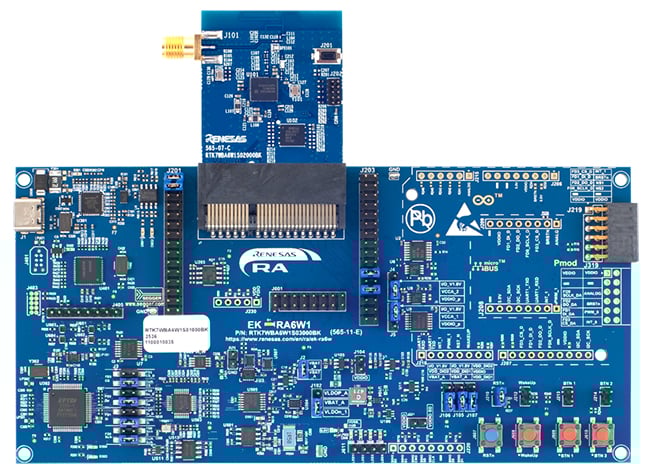
The EK-RA6W1 evaluation kit (DUT) was connected over Wi-Fi to an Android phone configured as a Soft AP, enabling wireless data exchange between the two devices.
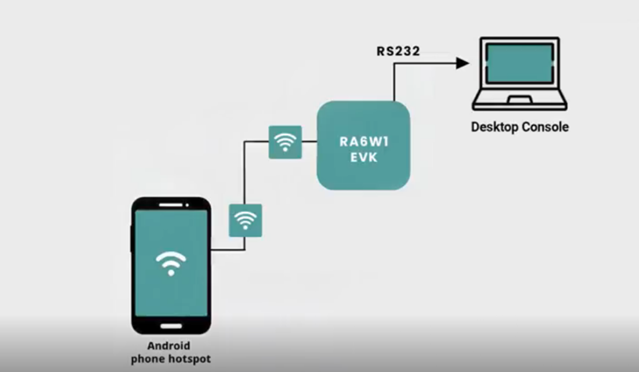
The tests were conducted in an open office space with multiple active Wi-Fi networks and electronic devices operating in the same frequency bands. The goal was to analyze the device's performance under real-world conditions.
Spectrum of the Environment as Measured
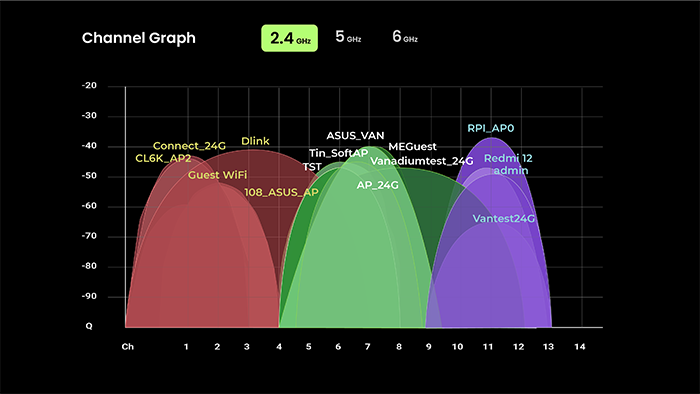
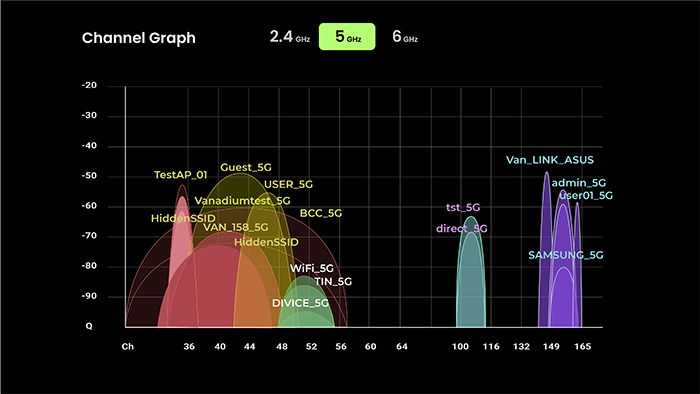
A Wi-Fi analyzer application was used to examine the frequency spectrum present in the described environment.
As depicted in Figure 3, the 2.4GHz spectrum appeared heavily congested due to overlapping networks, which may cause higher latency and degraded performance.
In contrast, Figure 4 demonstrates that the 5GHz spectrum was more evenly distributed across channels, reducing interference and improving connectivity.
Throughput
Although both the 2.4GHz and 5GHz bands were tested using the same 20MHz channel bandwidth, the 5GHz band consistently delivered significantly higher throughput. This performance boost is largely attributed to the cleaner, less congested spectrum available in the 5GHz band.
- Reduced retransmissions: In the 2.4GHz band, limited channel availability and high device density often lead to interference and packet collisions.
- More available channels: The 5GHz band offers a wider selection of non-overlapping channels.
- Lower interference: With less overlap from other technologies like Bluetooth, Zigbee, and microwave ovens, the 5GHz band experiences less environmental noise.
- Efficient spectrum utilization: Devices operating in 5GHz can take advantage of advanced Wi-Fi 6 features such as Multi-User Multiple Input Multiple Output (MU-MIMO) and Orthogonal Frequency Division Multiple Access (OFDMA).
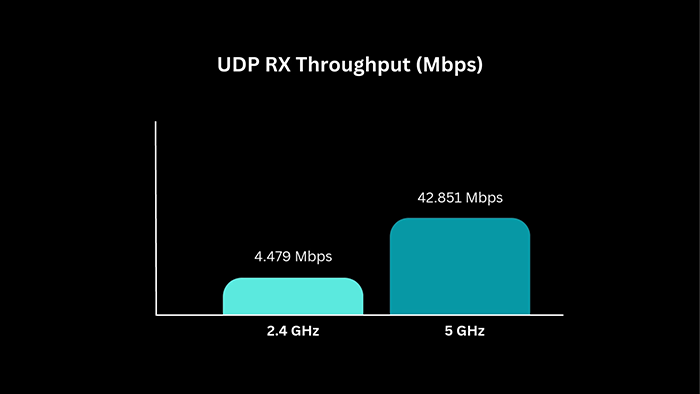
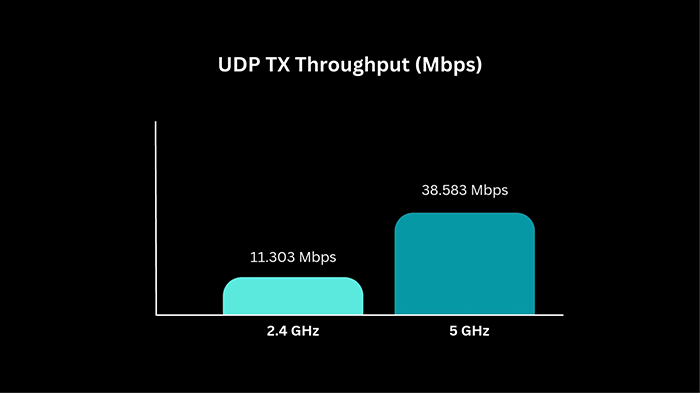
In real-world terms, this means faster downloads, smoother streaming, and more responsive IoT applications, especially in environments with many connected devices. This is clearly visible from the measurements depicted for UDP in Figures 5 and 6.
Latency
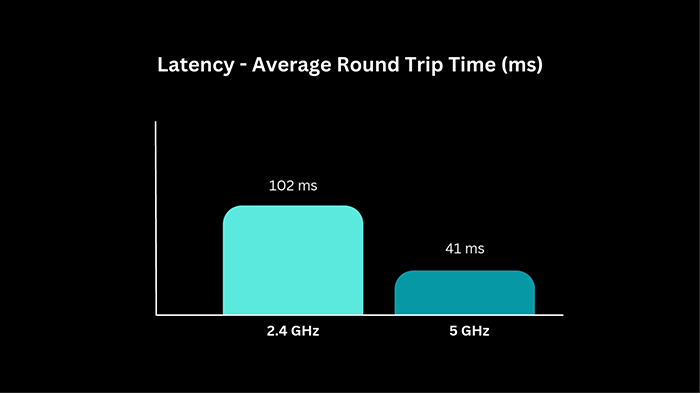
In performance testing, the 5GHz band demonstrated a 2.5x reduction in ping round-trip time compared to 2.4GHz. This significant improvement in latency is driven by several key factors: faster transmission of management frames that reduced airtime usage, lower interference, which leads to fewer retransmissions and smoother communication, smaller coverage cells that decreased client contention, and advanced MAC/PHY features such as OFDMA and MU-MIMO, which allow multiple devices to transmit simultaneously and more efficiently.
Power Consumption
IoT devices are designed to conserve energy while maintaining cloud connectivity. To stay connected, these devices continuously monitor network beacons and send periodic keep-alive signals that confirm their presence and readiness to communicate. The 5GHz band offers a distinct advantage in this context with faster transmission rates for beacons and other management frames, a reduced interference allows devices to complete active sessions faster and enjoy longer low-power sleep periods. This results in approximately 20% lower power consumption, as depicted in Figure 6, the current consumption for 2.4GHz is 40mA average compared to the 5GHz measurement of 34mA average.

Dual-Band Support: Balancing Performance and Coverage
While the 5GHz band excels in data throughput performance, signal integrity, and reduced power consumption, its shorter wavelength restricts range and wall penetration. By contrast, the 2.4GHz band, with its superior propagation characteristics, is ideal for long-range applications like smart meters and environmental sensors, with restrictions on throughput performance and high-power consumption.
Supporting both bands provides the flexibility needed to meet the diverse requirements of modern IoT deployments, balancing throughput, coverage, and energy efficiency.
Renesas RA6W1: A Dual-Band Solution for Modern IoT
Renesas has expanded its microcontroller portfolio for advanced IoT architectures with the RA6W1, an ultra-low power, dual-band Wi-Fi 6 MCU designed for continuous connectivity.
The RA6W1 integrates Wi-Fi 6 capabilities, delivering:
- 2.4GHz band for extended coverage and robust connectivity in high-interference environments.
- 5GHz band for high data throughput, reduced latency, and optimized power efficiency.
This MCU leverages Wi-Fi 6 enhancements such as OFDMA for efficient channel utilization and Target Wake Time (TWT) for energy savings in battery-powered devices. Combined with advanced RF performance and dual-band flexibility, RA6W1 ensures deterministic, low-latency communication across diverse IoT applications — from smart home ecosystems to industrial automation and mission-critical systems.
For detailed specifications and design resources, visit the RA6W1 product page and explore Renesas' comprehensive portfolio of dual-band Wi-Fi 6 solutions engineered for scalable, resilient, and future-ready IoT deployments.
