Head-up display (HUD) systems are turning the windshield into an intelligent information layer, putting navigation, alerts, and vehicle data directly in the driver's line of sight. As these systems evolve and the technology improves, augmented reality (AR) HUDs are moving beyond basic information to connect real-time guidance and safety cues visually with the road ahead.
In an AR HUD-equipped vehicle, the graphics are projected across a large portion of the windshield, providing graphical content overlaid to look as if boundary boxes, directional arrows, and other information, such as speed and navigation directions, are projected onto objects and the road in front of the vehicle.
By putting all of this information in front of the driver, there is no need to look away from the road to see turn-by-turn guidance, speed, radio stations, and so on; however, since a larger portion of the windshield has this graphical content projected onto it, safety concerns are arising about how it might distract the driver, obstruct the ability to see the road clearly, or worse, display the wrong information in the wrong place at the wrong time.
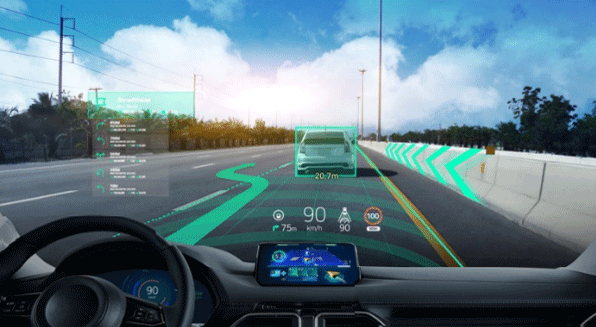
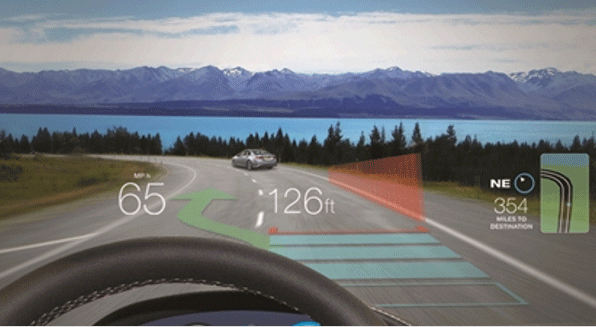
Example of AR-HUDs
Consequently, automotive OEMs are responding with more stringent functional-safety requirements for HUD and AR-HUD systems. In fact, some government agencies are implementing rules and regulations defining safety requirements for such systems, such as United Nations Economic Commission for Europe (UNECE) Regulation 105.2. UNECE rules and other emerging standards are placing increased scrutiny on how information is presented in the driver's field of view, with a growing focus on visibility, distraction, and the safe integration of AR content.
Many HUD systems are implementing ISO 26262 ASIL B functional safety to help detect and mitigate failures that could cause critical information to be displayed incorrectly or not at all, and thereby comply with such regulations. These failures include graphical content flickering, flashing, or obstructing the view of the driver, which are now being addressed by implementing diagnostic monitoring capabilities into the HUD systems to mitigate such issues from occurring.
Renesas recognized the issues facing automotive HUD systems and developed the RAA278831 video display and diagnostics IC as a cost-effective means to implement advanced video diagnostics and functional safety into the HUD display module.
The RAA278831 is an ISO 26262 ASIL B video processor that gives system designers the ability to monitor both the video signal and the content within that video. Using multiple different diagnostic and measurement engines, the RAA278831 can detect video content that is flashing/flickering or obscuring the drivers' ability to see the road clearly (such as the HUD projecting a solid color across the whole windshield).
When a problem is detected, an alert can be sent to the graphics processor or corrective actions can be taken by the RAA278831 itself. Its internal on-screen display (OSD) capability can show warning messages and critical vehicle information when the input video source is lost, or the graphical content is corrupted or causing distraction to the driver.
As HUDs become a more integral part of the driving experience, functional safety is fundamental to their evolution. Building intelligence into the display pipeline helps ensure that increasingly sophisticated visual experiences can advance without compromising the driver's ability to see, interpret, and respond to the road ahead.
By adding this layer of diagnostics functionality to the HUD projection module itself, OEMs can greatly increase the safety and reliability of the HUD system without adding significant cost or complexity to the software stack within the vehicle.
For more information, visit RAA278831 - ASIL B Video Display and Diagnostics OpenLDI Bridge IC for Automotive HUD Systems.