Renesas Electronics Corporation - June is Pride Month, a month to raise awareness of the rights and the culture of the LGBTQ+ community
This Software / Tool Has Been Discontinued

Please contact technical support with any questions.

Description

This product is a real-time operating system (real-time OS) that is an implementation of the μITRON4.0 specification. μITRON is the predominant real-time OS for embedded systems in Japan. Its low resource requirements, outstanding real-time performance, and broad range of service calls make it very suitable for embedded systems requiring true real-time and multi-tasking capabilities.

In addition, its high degree of compatibility with the compiler package from Renesas Electronics and the configurator which automatically generates startup files will help you greatly reduce development times and get your products to market more quickly.

Successors:M3T-MR30/4 Real-time OS for M16C Series and R8C Family
 

Features

  • Conformance with the µITRON4.0 Specification
    The design conforms with the µITRON4.0 Specification, which prescribes a representative OS architecture for embedded control.
  • ROM-based implementation
    The kernel is provided in library format. You can link only the functions you need at the time of system generation and minimize application software size.
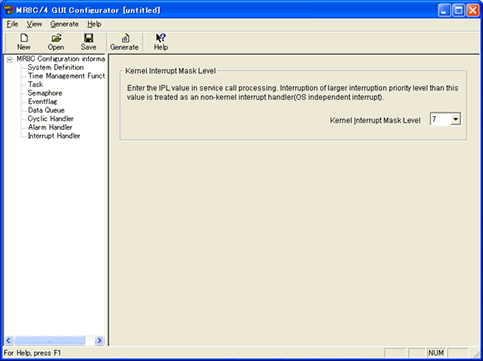
  • Equipped with the configurator
    The configurator is equipped which makes the setup of OS construction parameters easier. Using the combination of GUI configurator and cfg8c configurator based command line lets you automatically generate start-up programs that rely on development products by just creating a simple definition file (configuration file), and so on. You can easily and reliably process parts specially suited to the product. [Learn More]
  • Interlinking with the High-performance Embedded Workshop IDE
    OS-embedded applications can be developed using common operations of the Renesas MCU toolchain.
  • Supported compiler: C/C++ Compiler Package for M16C Series and R8C Family [M3T-NC30WA]
  • Learn More

Release Information

Latest Ver.: V1.01.00
Released: Sep 16, 2011
Details of upgrade (See Tool News)
Operating Environment
Agreement Details

Target Devices

Type Title Date
Upgrade - OS
Log in to Download ZIP 197 KB 日本語
Upgrade - OS
Log in to Download ZIP 14.17 MB 日本語
Upgrade - OS
Log in to Download ZIP 14.17 MB 日本語
Upgrade - OS
Log in to Download ZIP 14.30 MB 日本語
4 items
Type Title Date
Release Note PDF 237 KB 日本語
Tool News - Note PDF 204 KB 日本語
Manual - Development Tools PDF 1.07 MB 日本語
Tool News - Release PDF 202 KB 日本語
Application Note PDF 695 KB
AI-generated Summary: Interrupts enable embedded systems to handle time-critical tasks by signaling the processor to pause current operations and address urgent events. There are hardware and software interrupts, with hardware interrupts further divided into special and peripheral I/O types. The R8C family uses two interrupt vector tables: fixed and relocatable, which store interrupt service routines and their properties. Interrupt priority levels allow nested interrupts, and interrupts can be maskable or non-maskable, with NMIs reserved for critical system events.
Application Note PDF 126 KB
AI-generated Summary: The system timer in MR8C/4 tracks elapsed time in an RTOS by generating periodic interrupts, incrementing a tick counter. The timer's resolution depends on application needs, hardware limitations, and counter storage. MR8C/4 uses a 6-byte counter allowing up to 8925 years of tick counting at 1ms resolution. Hardware timer inaccuracies require adjustments to ensure minimum delay durations. Users configure the system timer by selecting hardware timers, setting interrupt priorities, and defining interrupt vectors. The system timer manages time-based functions and is optional if no time management is used.
Application Note PDF 938 KB
AI-generated Summary: MR8C/4 provides two types of time event handlers: cyclic handlers for repetitive events at fixed intervals, and alarm handlers for one-shot events at specified times. These handlers operate independently from tasks, executing in non-task contexts with priority between interrupts and dispatchers. Time event handlers must be statically created in configuration files and require the CPU to be unlocked for activation. Accuracy depends on system timer resolution, with R8C devices supporting up to 1 ms resolution. Cyclic handlers can be used to trigger tasks periodically without reprogramming timers.
Application Note PDF 750 KB 日本語
AI-generated Summary: Real-time OS aware debugging supports various real-time operating systems including HI7200/MP, ThreadX, uC/OS-II, and TOPPERS variants. It operates within High-performance Embedded Workshop on Windows platforms and integrates with SuperH Family RISC engine simulators/debuggers. The document details environment setup, program downloading, OS definition selection, task state monitoring, execution history, and timing display functions.
Guide PDF 371 KB 日本語
Application Note PDF 897 KB 日本語 , 简体中文
AI-generated Summary: This guide explains how to create a workspace for MR8C/4 RTOS on R8C Family MCUs. It covers software preparation, including installing the M3T-NC30WA compiler package version 5.45 or higher, opening and configuring the workspace, and downloading programs using the E8a Emulator. The document provides step-by-step instructions with visual aids to facilitate user understanding and efficient setup.
Application Note PDF 469 KB 简体中文
AI-generated Summary: Debugging with MR8C/4 using MR Window in High-performance Embedded Workshop streamlines application development by providing a graphical interface to monitor RTOS resources and error codes. The process involves identifying errors, interpreting MR Window data, and creating system down routines to locate faults. Practical exercises and sample programs enhance users' debugging skills, supported by detailed guidance on setup, techniques, and troubleshooting.
Application Note PDF 801 KB
AI-generated Summary: Real-Time Operating Systems (RTOS) enable multitasking in embedded systems by providing timely and logically correct responses to events. RTOS combines real-time requirements with operating system features such as multitasking, synchronization, interrupt handling, and resource management. This document explains RTOS concepts, architecture, and selection criteria, focusing on their application in the R8C microcontroller family and highlighting their deterministic timing and efficient resource use.
Application Note PDF 583 KB 简体中文
AI-generated Summary: This document explains how to calculate the user stack and system stack sizes for the R8C Family MCUs. It details the importance of allocating appropriate stack memory to prevent wastage and stack overflows. The user stack is assigned per task, representing worst-case memory usage during runtime, while the system stack is used during service call execution. Both stacks reside in internal RAM, and the document provides methods and examples for computing their sizes using configurator files and utilities.
Application Note PDF 760 KB
AI-generated Summary: MR8C/4 is a preemptive priority-based RTOS designed for embedded applications using the R8C family MCU. Implementing MR8C/4 requires careful task partitioning, prioritization, and interrupt management to ensure real-time responsiveness. The RTOS increases memory usage due to additional code and task stacks, so memory allocation must be optimized. Proper implementation also helps reduce power consumption by enabling efficient CPU usage and minimizing memory waste.
Application Note PDF 152 KB 日本語
AI-generated Summary: The MR8C/4 excludes service calls with timeout features to minimize memory usage. This document explains a workaround to implement timeout functionality by forcibly releasing tasks from the WAITING state using a timer. It details the removal of timeout-enabled service calls like tslp_tsk, twai_sem, and others, and illustrates how to apply the workaround method, particularly for the wai_sem service call, using a sample program.
Application Note PDF 325 KB 日本語
AI-generated Summary: The document explains how to replace the Mailbox module, excluded in MR8C/4, with the Data Queue module for inter-task communication in R8C family MCUs. It compares the functionalities of Mailbox and Data Queue, highlighting that Mailbox manages message queues and wait queues for synchronization, while Data Queue handles one-word data elements with send and receive wait queues. Step-by-step guidance for converting Mailbox usage to Data Queue is provided.
Tool News - Release PDF 195 KB 日本語
17 items

Successor

M3T-MR30/4 Real-time OS for M16C Series and R8C Family

Specifications

Target MCUR8C Family
Max. number of tasks255
Number of priority levels255
Max. number of eventflags255
Width of an eventflag16 bits
Max. number of semaphores255
Type of semaphoresCounter type
Max. number of data queue255
Data queue size16 bits
Max. number of cyclic handler255
Max. number of alarm handler255
Number of service call43
Kernel languageAssembly language, C language
Performance
(Time takes for a target task to be executed after the wup_tas is issued.)
19 microseconds (20MHz)
Kernel code sizeApproximately 1.5K to 6.5K bytes
Kernel RAM usage per taskData: 11 bytes
Stack 8 bytes

Components of Evaluation License Package

Kernel librarymr8c.lib
Kernel library source filesNot included.
(* Included with Mass-production License  Package)
Configuratorcfg8c
Utilitiesmr8ctbl
Default configuration filedefault.cfg
C interface libraryc8cmr.lib
C language include fileitron.h, kernel.h, kernel_api.h, kernel_sysint.h
Sample start-up program[For NC30] crt0mr.a30
[For AS30] start.a30
Sample Section definition file[For NC30] c_sec.inc
[For AS30] asm_sec.inc
System RAM area definition database filesys_ram.inc
Table database filemrtable.tpl
Service call file for issuing service callisssys.mrc
Include database filemr8c.inc
MR8C/4 version fileversion
Sample programdemo.c, smp.cfg

Components of Mass-production License Package

(1) With source code

  • Components of Evaluation License Package
  • Mass production rights (For details, see the License Agreement.)
  • MR8C/4 kernel libraries (mr8c.lib) source files

(2) No source code

  • Components of Evaluation License Package
  • Mass production rights (For details, see the License Agreement.)

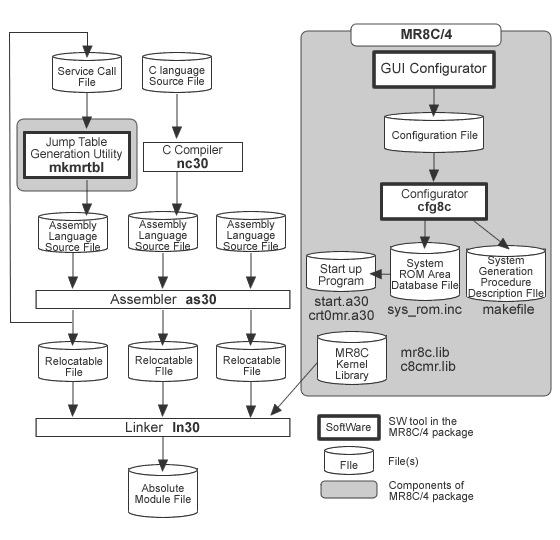
Processing Flow
Image
mr8c4-flow-e
Support Communities

Support Communities

Get quick technical support online from Renesas Engineering Community technical staff.
Browse Articles

Knowledge Base

Browse our knowledge base for helpful articles, FAQs, and other useful resources.
Submit a Ticket

Submit a Ticket

Need to ask a technical question or share confidential information?