
| CAD Model: | View CAD Model |
| Pkg. Type: | WAFER |
| Pkg. Code: | DICEF |
| Lead Count (#): | |
| Pkg. Dimensions (mm): | 0.0 x 0.0 x 0.0 |
| Pitch (mm): |
| Moisture Sensitivity Level (MSL) | 1 |
| Pb (Lead) Free | Yes |
| ECCN (US) | EAR99 |
| HTS (US) | 8542.39.0090 |
| Lead Count (#) | 0 |
| Carrier Type | Wafer |
| Moisture Sensitivity Level (MSL) | 1 |
| Pkg. Dimensions (mm) | 0.0 x 0.0 x 0.0 |
| Qty. per Reel (#) | 0 |
| Qty. per Carrier (#) | 0 |
| Pb (Lead) Free | Yes |
| Pb Free Category | e3 Sn |
| Temp. Range (°C) | -40 to +125°C |
| Country of Wafer Fabrication | GERMANY |
| Adj. Analog Gain | 1.5 - 1.5, 3 - 3, 6 - 6, 12 - 12, 24 - 24, 48 - 48, 96 - 96, 192 - 192 |
| Automotive Qual. | No |
| Function | Resistive SSC |
| Input Type | Single-bridge |
| Interface | I2C, SPI |
| MOQ | 8500 |
| Pkg. Type | WAFER |
| Qualification Level | Standard |
| Requires Terms and Conditions | Does not require acceptance of Terms and Conditions |
| Resolution (bits) | 14 |
| Sample Rate Max (KHz) | 2 |
| Supply Voltage (V) | 2.7 - 5.5 |
| Tape & Reel | No |
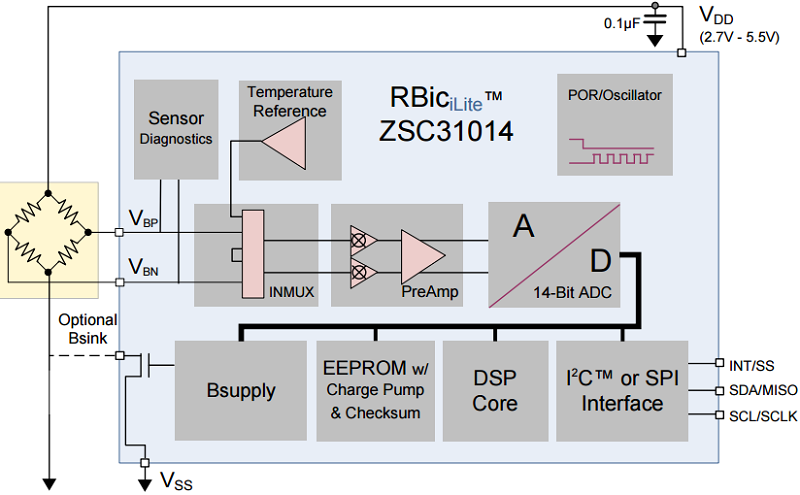
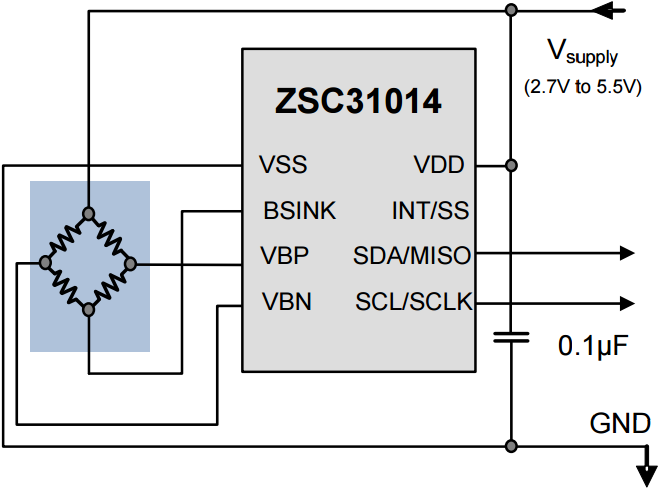
The ZSC31014 is a feature-rich RBiciLite™ CMOS integrated circuit that provides high-accuracy amplification and analog-to-digital conversion of differential input signals. Designed for cost-sensitive applications, it performs offset, span, and first- and second-order temperature compensation of the measured signal. Developed for resistive bridge sensor correction, the ZSC31014 can also provide a compensated temperature output using an internal or external temperature sensor.
Digital compensation of signal offset, sensitivity, temperature drift, and non-linearity is performed by an internal digital signal processor running a correction algorithm. Calibration coefficients are stored in a highly reliable nonvolatile EEPROM. Measured and compensated bridge values are available through configurable I²C or SPI digital outputs.
Programming the ZSC31014 is simplified through the I²C interface and the PC-controlled calibration software included with the ZSC31014KIT evaluation kit. Digital mating of the sensor and signal conditioner is fast and precise, eliminating the overhead typically associated with trimming external components and performing multipass calibration routines. Integrated diagnostic functions and a low-power standby mode make the ZSC31014 well-suited for a wide range of battery-operated applications, particularly systems that use a microcontroller for sensor networking.