
Overview
Description
The FPB-R9A02G021 Fast Prototyping Board provides an entry point for evaluation, prototyping, and development with the R9A02G021 MCU. Since this board incorporates a SEGGER J-Link™ emulator circuit, you can use it for designing your own applications without further investments in tools. This product includes through-holes for pin headers that allow access to all MCU signal pins, allowing easy prototyping with a breadboard.
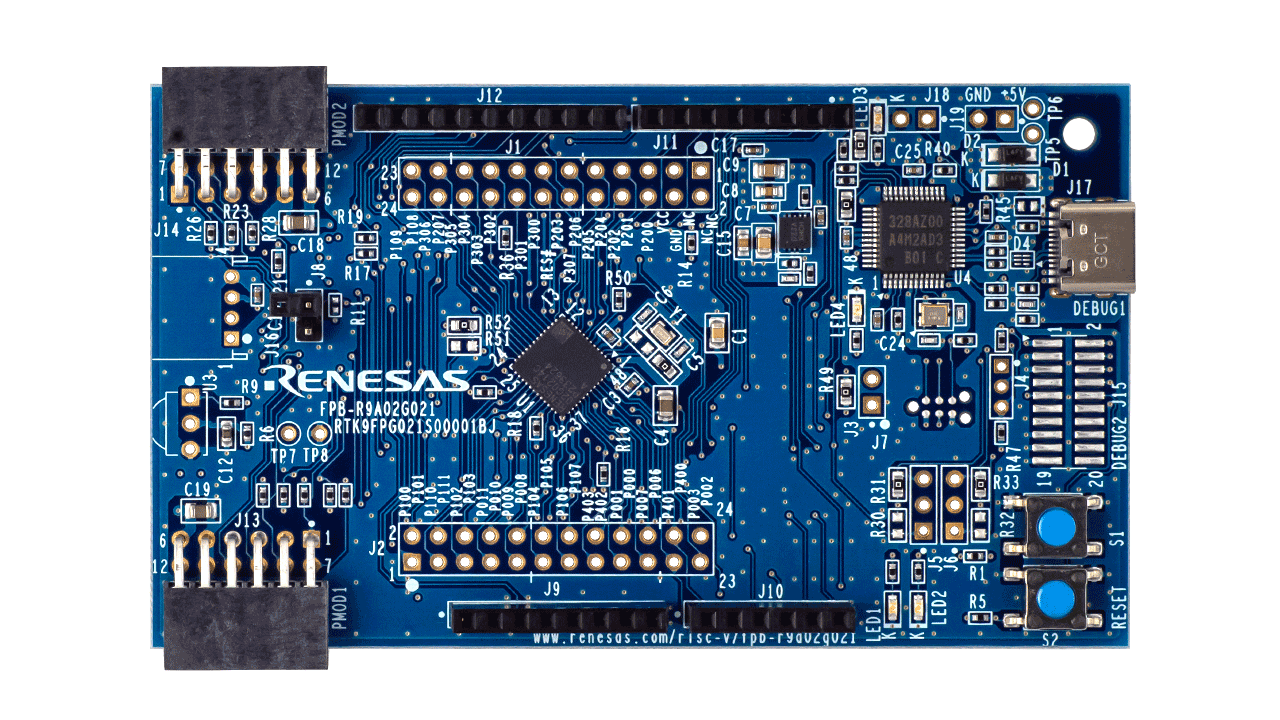
Features
- Evaluation MCU: R9A02G0214CNE (48‑pin HWQFN, 128 KB flash, 16 KB RAM, 4 KB data flash)
- Size: 55mm x 95mm
- SEGGER J-Link™ OB
- USB Type-C connector
- 2-pin external power-supply headers (DNF)
- 1 reset button, 1 user button
- Green power led, two user LEDs, and a yellow debug LED
- Pmod™ connector angle type, 12 pins x 2.
- Arduino® connector 6 pins x 1, 8 pins x 2, 10 pins x 1 (compatible with Arduino® UNO R3)
- Grove® connector angle type, 4 pins x 1 (DNF)
- MCU breakout pins on header: 24 pins x 2 (DNF)
Applications
Documentation
|
|
|
|
|---|---|---|
| Type | Title | Date |
| Quick Start Guide | PDF 417 KB 日本語 | |
| Application Note |
PDF
961 KB
The Renesas board support package module (r_bsp) forms the foundation of any project that uses Software Integration System. This document describes r_bsp conventions and explains how to use it, configure it, and create a BSP for your own board.
|
|
| Manual - Development Tools | PDF 1.66 MB 日本語 | |
| PCB Design Files | FPB-R9A02G021 v1 - Design Package
|
|
| Application Note |
PDF
781 KB
AI-generated Summary:
The flash programming software module enables users to implement self-programming of embedded flash memory in RISC-V MCUs, specifically the R9A02G021 device. It provides API functions for programming, erasing, blank checking, and protecting flash memory regions, including access window and startup program protection features. The module supports LLVM for RISC-V and details hardware/software requirements, API usage, and integration methods. It facilitates reprogramming code flash memory by running code from RAM and includes blocking and non-blocking operation modes.
|
|
| Flyer | PDF 542 KB | |
| Application Note |
PDF
512 KB
AI-generated Summary:
The 32-bit interval timer operates in 8-bit counter mode to control LED indications by monitoring compare match detection flags during timer interrupts. The timer interrupt intervals adjust dynamically based on the number of switch presses detected via an edge-triggered external interrupt pin (IRQ4). The system uses four timer channels and manages LEDs connected to specific ports. Detailed operation includes setting timer intervals, handling interrupts for each channel, and modifying frequency division ratios to vary interrupt timing. The document provides hardware configuration, software setup, flowcharts, and sample code to implement these functions effectively.
|
|
| Application Note |
PDF
359 KB
AI-generated Summary:
The RISC-V A/D converter operates in scan mode to convert analog signals from pins ANI2, ANI3, ANI4, and ANI5 into 12-bit digital values stored in on-chip RAM. It uses sequential conversion triggered by software without wait, with a conversion time of 5.375 µs. The converter runs at 48 MHz on a 3.3 V supply and supports voltage references from Vcc to Vss. Sample code and hardware configuration details enable practical implementation and testing on RISC-V microcontrollers, specifically the R9A02G021 device and the RISC-V-48p Fast Prototyping Board. Development uses e2studio with LLVM compiler and Smart Configurator tools.
|
|
| Application Note |
PDF
328 KB
AI-generated Summary:
The document explains how to use the software trigger wait mode of the RISC-V A/D converter to convert analog voltages from the P400/ANI2 pin into 12-bit digital values stored in internal RAM. It details initialization steps, including using select mode, one-shot conversion mode, and software triggers, with conversion results handled via interrupts while the CPU sleeps. Hardware configuration and pin usage are outlined, along with operation conditions such as clock frequency and voltage. Sample code and flowcharts support implementation.
|
|
| Application Note |
PDF
247 KB
AI-generated Summary:
Flash read protection disables read access to specified code flash areas while allowing CPU instruction fetch. Setting protection involves configuring start and end addresses in flash read protection registers, which are option-setting memory within code flash. Reading from protected areas returns 00H. Protection can be released by erasing the code flash. Debugging is disabled in protected areas unless protection is disabled. Programs can be placed in protected areas via linker script section settings, and functions within these areas can be called normally.
|
|
| Application Note |
PDF
468 KB
AI-generated Summary:
The document details the register settings and procedures for switching the RISC-V microcontroller's operation states among high-speed, middle-speed, and low-speed modes using a button-triggered external interrupt (IRQ4). It explains the initial configurations for I/O ports, clock generation, and interrupt handling, with LED indicators showing the current flash operation mode. The operation cycles through the modes sequentially upon each button press. The document also specifies hardware and software requirements, including MCU, board, clock frequencies, voltage ranges, and development tools used for testing.
|
|
| Application Note |
PDF
549 KB
AI-generated Summary:
The document explains how to use the fixed-cycle interrupt and alarm interrupt functions of a realtime clock (RTC) on a RISC-V microcontroller. It details setting the RTC time, configuring interrupts to toggle output ports and control LEDs, and displaying the clock on an LCD via I2C communication. The fixed-cycle interrupt toggles an output every 0.5 seconds, while the alarm interrupt triggers an LED five seconds after the set alarm time. Initialization steps for the RTC, I/O ports, serial interface, and LCD module are provided along with sample code and flowcharts for implementation.
|
|
| Application Note |
PDF
505 KB
AI-generated Summary:
Remote control signals in AEHA format are received using a remote control signal receiver (REMC) integrated with RISC-V microcontrollers. The system turns on specific LEDs based on received channel signals. If no signal is detected for 10 seconds, the MCU enters Software Standby mode and switches to Snooze mode upon signal detection to resume reception. The document details signal timing, data structure, peripheral usage, and state transitions between normal, standby, and snooze modes, enabling efficient power management during remote control signal reception.
|
|
| Application Note |
PDF
537 KB
AI-generated Summary:
Frequency detection compares the high-speed on-chip oscillator clock (HOCO) and the low-speed on-chip oscillator clock (32.768 kHz) to detect abnormal clock frequencies. It measures pulse intervals using timer array unit 0 (TAU0), with HOCO as the count clock and the low-speed clock as the timer input. If the measured pulse interval falls outside a defined range, an LED blinks to indicate abnormal frequency; otherwise, the LED remains off. The count clock frequency can be switched dynamically via an external interrupt, with LED indicators reflecting the current clock state. The process involves initializing TAU0, measuring pulse intervals, entering Sleep mode, and handling interrupts to evaluate frequency status and switch clock settings as needed.
|
|
| Application Note |
PDF
451 KB
AI-generated Summary:
UART communication operates through the UARTA serial interface, transmitting and receiving ASCII characters. The system analyzes incoming data and sends corresponding responses or error notifications. It uses UARTA0 with TxDA0 and RxDA0 pins, 8-bit data length, LSB first, even parity, and a 9600 bps transfer rate. Interrupts handle reception completion, transmission completion, and errors. The sample code echoes received characters or sends error codes for parity, framing, or overrun errors, enabling robust UART communication on RISC-V devices.
|
|
| Application Note |
PDF
247 KB
AI-generated Summary:
The document explains methods to protect third-party software IP on RISC-V MCUs using memory protection and startup control functions. It details flash read protection to prevent unauthorized reading or copying of software stored in designated memory areas. Unique ID and User ID mechanisms restrict software execution to authorized devices by linking software licenses to specific MCU IDs. These security features help prevent unauthorized use, duplication, and analysis of valuable software IP. The document also covers practical setup procedures for these protections.
|
|
| Application Note |
PDF
450 KB
AI-generated Summary:
The PWM output function uses timer array unit 0 (TAU0) channels 2 and 3 in simultaneous operation to control LED brightness by adjusting the PWM duty cycle. Channel 2 acts as the master timer generating interrupts every 2 ms, counting up to 250 interrupts (500 ms) to update the duty cycle from 10% to 90% in 20% increments, then resets. The PWM output is delivered via pin P107/TO03, and LED2 output inverts every 500 ms. The document details initialization, timer settings, and operation flow for implementing PWM output.
|
|
| Application Note | PDF 417 KB | |
| Application Note |
PDF
401 KB
AI-generated Summary:
The TRNG software driver enables generation of true random numbers on RISC-V MCUs by controlling the hardware random number generator. It provides functions to start random number generation and retrieve 32-bit random values stored in RAM. The driver supports generating single or multiple random numbers, returns status codes indicating success or busy state, and includes usage examples and error handling details. The document also covers function specifications, processing flowcharts, and notes on interrupts and debugging.
|
|
| Application Note |
PDF
360 KB
AI-generated Summary:
The document explains the operation and setup of three voltage detection circuits (LVD0, LVD1, and LVD2) integrated into the RISC-V microcontroller. LVD0 monitors supply voltage against a set threshold to generate internal resets during voltage fluctuations, ensuring stable operation. LVD1 and LVD2 provide reset or interrupt signals based on voltage detection, with configurable detection voltages and modes. The note details register settings, activation procedures, and timing requirements to maintain microcontroller stability during power supply changes, emphasizing proper reset handling during voltage rise and fall.
|
|
| Schematic | PDF 348 KB | |
| Other | PDF 89 KB | |
22 items
|
||
Design & Development
Software & Tools
Software & Tools
| Software title
|
Software type
|
Company
|
|---|---|---|
| Renesas Flash Programmer (Programming GUI) Flash memory programming software [Support MCU/MPU and devices: RA, RE, RX, RL78, RH850, RISC-V MCU, Renesas Synergy, DA1453x, DA1459x, DA1469x, DA1470x, DA148xx, Power Management, Renesas USB Power Delivery Family, ICs for Motor Driver/Actuator Driver, V850, 78K0R, 78K0]
|
Programmer (Unit/SW) | Renesas |
| PG-FP6 Flash memory programmer [Programming software: Dedicated GUI-based software, the "FP6 Terminal"] [Support MCU/MPU and devices: RA, RE, RX, RL78, RH850, RISC-V MCU, Renesas Synergy, Power Management, Renesas USB Power Delivery Family, ICs for Motor Driver/Actuator Driver, SuperH RISC engine, V850, 78K, R8C]
|
Programmer (Unit/SW) | Renesas |
| RISC-V Smart Configurator RISC-V Smart Configurator is an automatic driver generation tool for internal peripheral I/O modules through GUI settings.
|
Solution Toolkit | Renesas |
| e² studio - information for RISC-V MCU Eclipse-based Renesas integrated development environment (IDE).
|
IDE and Coding Tool | Renesas |
| E2 emulator [RTE0T00020KCE00000R] On-chip debugging emulator. Also available as a flash memory programmer. [Support MCU/MPU: RA, RE, RH850, R-Car D1, RL78, RX, RISC-V MCU]
|
Emulator | Renesas |
| E2 emulator Lite [RTE0T0002LKCE00000R] On-chip debugging emulator. Also available as a flash memory programmer. [Support MCU/MPU: RA, RE, RL78, RX, RISC-V MCU]
|
Emulator | Renesas |
| SEGGER Embedded Studio for RISC-V SEGGER Embedded Studio for Renesas R9A02G21 RISC-V MCUs
|
IDE and Coding Tool | Segger Microcontroller GmbH |
| IAR Embedded Workbench for RISC-V IAR Embedded Workbench for RISC-V MCUs
|
IDE and Coding Tool | IAR Systems |
|
8 items
|
||
Sample Code
Sample Code
Filters
|
||
|---|---|---|
| Type | Title | Date Date |
| Sample Code | RISC-V MCU Family Board Support Package Module Using Software Integration System Rev.1.23 - Sample Code
[Toolchains=LLVM|19.1.7.202501]
ZIP
1.96 MB
Application:
Consumer Electronics, Industrial
Function:
BSP, Initial Setting, System
|
|
| Sample Code | RISC-V MCU Renesas Flash Driver Application Note - Sample Code
Application:
Consumer Electronics, Industrial
Function:
Memory
|
|
| Sample Code | RISC-V 32-Bit Interval Timer (8-bit counter mode) Application Note - Sample Code
Application:
Consumer Electronics, Industrial
Function:
Timer
|
|
| Sample Code | RISC-V A/D Converter (Scan mode) Application Note - Sample Code
Application:
Consumer Electronics, Industrial
Function:
Analog
|
|
| Sample Code | RISC-V A/D Converter (Software trigger wait mode) Application Note - Sample Code
Application:
Consumer Electronics, Industrial
Function:
Analog
|
|
| Sample Code | RISC-V Operation State Switching Application Note - Sample Code
Application:
Consumer Electronics, Industrial
Function:
Application Example, System
|
|
| Sample Code | RISC-V Realtime Clock Application Note - Sample Code
Application:
Consumer Electronics, Industrial
Function:
Clock
|
|
| Sample Code | RISC-V Remote Control Signal Reception (AEHA Format, SNOOZE Mode) Application Note - Sample Code
Application:
Consumer Electronics, Industrial
Function:
Communication Interface
|
|
| Sample Code | RISC-V Safety Function (Frequency Detection) Application Note - Sample Code
Application:
Consumer Electronics, Industrial
Function:
Clock
|
|
| Sample Code | RISC-V Serial Interface UARTA Application Note - Sample Code
Application:
Consumer Electronics, Industrial
Function:
Communication Interface
|
|
| Sample Code | RISC-V Timer Array Unit (PWM output) Application Note - Sample Code
Application:
Consumer Electronics, Industrial
Function:
Timer
|
|
| Sample Code | RISC-V Timer Array Unit (Pulse Interval Measurement: Width) Application Note - Sample Code
Application:
Consumer Electronics, Industrial
Function:
Timer
|
|
| Sample Code | RISC-V True Random Number Generator (TRNG) Software Driver Application Note - Sample Code
Application:
Consumer Electronics, Industrial
Function:
Security
|
|
13 items
|
||
Product Options
| Part Number | Status | Stock | Budgetary Price (USD) | Sampleable |
|---|---|---|---|---|
| RTK9FPG021S00001BJ | Active | In Stock | 1u | $15.29 | Available |
Videos & Training
Watch this lab overview of the features, low-power operation, design resources, and fast prototyping board for the general-purpose RISC-V MCU with Renesas core.
News & Blog Posts
Blog Post Mar 26, 2024 |
News Nov 30, 2023 |
Blog Post Nov 30, 2023 |
Partners

IAR Systems
Complete development toolchain providing one toolbox in one view, giving you one uninterrupted workflow. As a well-established frontrunner in the embedded industry, you can rely on IAR Embedded Workbench to compile, analyze and debug your code in the most efficient way.

Segger Microcontroller GmbH
Embedded Studio for RISC-V is the development environment for devices based on the open RISC-V architecture. Whether you use an available device or designed your own chips, Embedded Studio offers a complete solution to develop and debug your application.
Support
Support Communities
- FPB-R9A02G021 debug-program
Just starting using FPB-R9A02G021, when connecting the board to the PC the yellow debug led is continous flashing so is not connected to the PC. When tryiying to debug an error is output, do you mind to clarify-help. Regards, MiquelGDB Server for Renesas targets. Version 10.2.0 ...
May 3, 2025 - RISC-V FPB-R9A02G021 Fast Prototyping Board - cJTAG
I have bought RISC-V based MCU -- FPB-R9A02G021 Fast Prototyping Board. Facing issue with cJTAG when trying to build the target. May I know the debug connection required on the board? I don't find the specific Forum for RISC-V based MCUs and so I am posting my ...
Jul 17, 2024 - Getting started with FPB-R9A02G021 + e2studio on macOS
Hello, I'm stuck right now and can not get a working development environment. I'm not new to MCU alltogether but I'm new in the Renasas ecosystem Host device: MacBook Pro with M1 Pro (Apple Silicon) I downloaded: e2studio_installer-2025-04_macosx_host.txz - e2studio standalone app ...
May 14, 2025

Support Communities


