While features such as adaptive cruise control and blind spot monitoring are prime examples of popular advanced driver assistance system (ADAS) capabilities, the next generation of ADAS is no longer defined by individual features alone. Instead, it is increasingly shaped by how efficiently end-to-end ADAS software stacks can be integrated, validated, and deployed on scalable automotive compute platforms to transform the entire driving experience.
This is especially important in China, where OEMs are quickly moving from core safety and New Car Assessment Program (NCAP) requirements toward software-rich L2++ experiences, such as highway navigate on autopilot (NOA), urban NOA, hands-off driving, integrated parking, and other enhancements to natural vehicle behaviors.
To accomplish this, global OEMs and Tier 1 suppliers need platform strategies that scale across regions, segments, and autonomy levels, while maximizing software reuse, minimizing integration risk, and enabling faster, more continuous feature evolution.
To address this need, Renesas and Nullmax are developing an L2++ end-to-end urban NOA in-vehicle showcase that brings real-world ADAS use cases to life at the vehicle level. Combining the Renesas R-Car high-performance SoC, R-Car Open Access (RoX) platform, and the Nullmax end-to-end AI stack can turn platform capability into tangible evidence of readiness for customer programs.
Why End-to-End ADAS Stack Enablement Matters
Modern ADAS/AD systems are moving from modular, feature-by-feature integration toward AI-defined stacks where perception, planning, and control operate more closely together. This shift creates new demands on the underlying compute platform to process enormous amounts of diverse data and support high-performance AI inference, deterministic real-time control, continuous sensor ingestion, high-throughput data movement, safety-related monitoring, and flexible software execution environments.
Increasingly, modern ADAS/AD systems are evolving toward end-to-end AI architectures, inspired by large language, vision-language, and vision-language-action models. These approaches are moving beyond modular pipelines by combining perception, planning, and control blocks within unified models, creating new demands on compute, memory bandwidth, and system-level data orchestration.
Renesas focuses on helping partners deploy scalable, production-oriented, end-to-end ADAS/AD stacks on a common and mature platform foundation. That foundation must support the EU General Safety Regulation (GSR) framework and NCAP 5-Star driven safety needs, while providing a path from L2 to L2+/L2++ ADAS and towards L3/L4 mobility.
R-Car X5 Series: Scalable Compute from Silicon to System
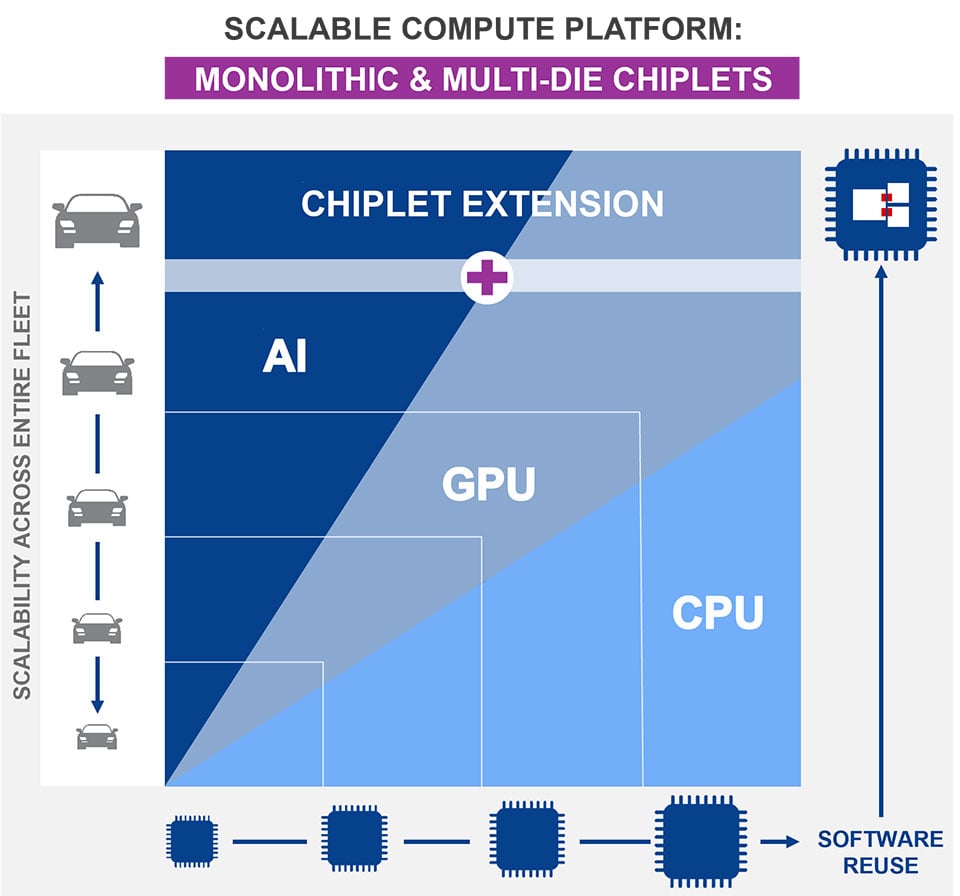
The R-Car X5 series is designed to address one of the most important challenges in ADAS/AD development—scaling performance without rebuilding the platform strategy for every vehicle program. Instead of focusing on a single performance point, the R-Car X5 (SoC) series provides a compute portfolio that can scale from entry-level ADAS to high-performance computing-oriented high-end segments with footprint compatibility.
Across the series, performance scales from 250k to 1400k DMIPS, and from 50 to 1000+ dense AI TOPS. This allows OEMs and partners to align compute capability with vehicle segment, feature content, and cost targets, while preserving platform reuse across programs.
The R Car X5 architecture integrates the heterogeneous compute resources required for full-stack ADAS and automated driving workloads, including ISP, general-purpose CPUs, real-time CPUs, NPUs/DSPs, GPUs, and dedicated accelerators. These elements must operate in a tightly coordinated manner to sustain continuous sensor processing, AI inference, planning, visualization, and real-time vehicle control with consistent, predictable latency.
High-resolution vision, radar, and LiDAR data, combined with the new AI paradigm in automotive that relies on memory and compute-intensive models, such as LLMs, VLMs, and VLA-oriented end-to-end architectures, must be processed and coordinated across the system with predictable latency to ensure stable closed-loop behavior.
This makes memory bandwidth another critical system-level enabler. Support for LPDDR5x up to the 9600MT/s speed grade helps the R-Car X5 series address these bandwidth demands and enables high-throughput video and AI pipelines across ISP, memory, CPU, NPU/DSP, GPU, and real-time processing resources.
The R-Car X5 architecture also provides a path for performance expansion through chiplet technology. This allows OEMs and ecosystem partners to scale the overall compute and memory resources within the same platform as system complexity grows, without redefining the overall architecture. The R-Car X5H is used as the reference showcase platform, while the broader X5 series supports scalable deployment across multiple vehicle segments and autonomy targets.
R-Car Open Access (RoX): The Software & Tools Layer
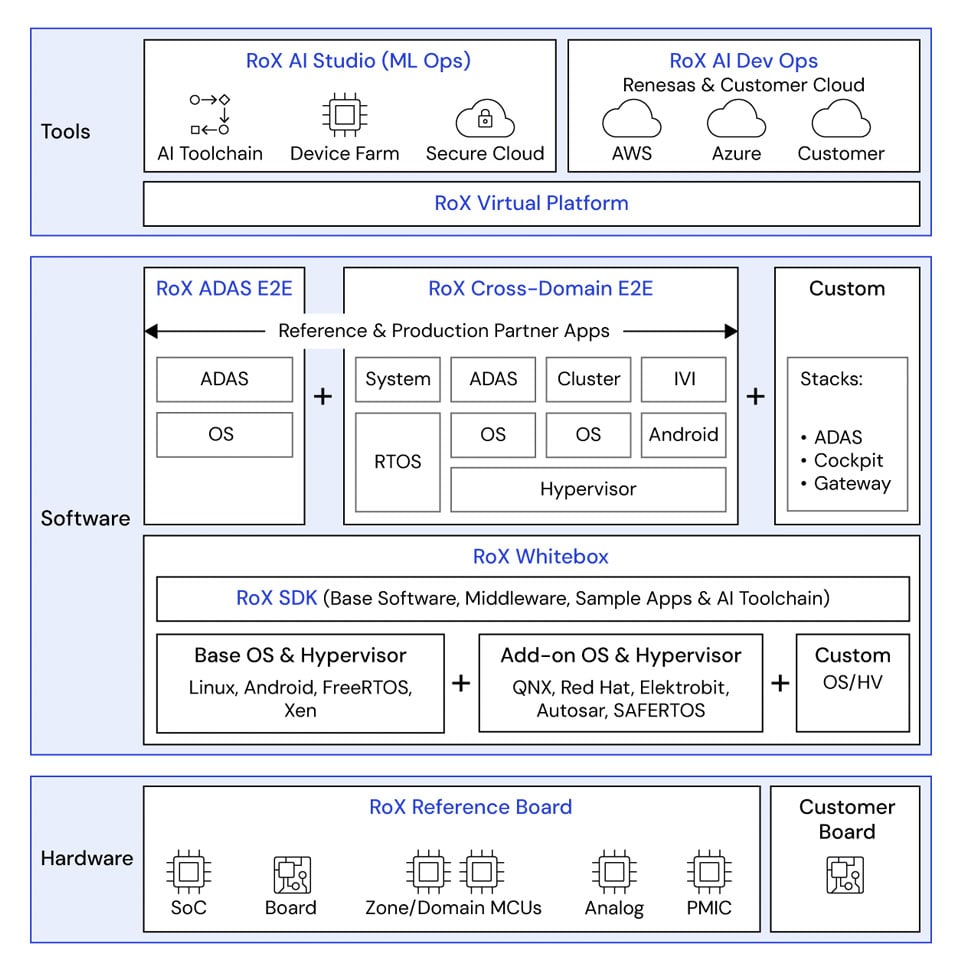
Scalable silicon is only part of the solution. ADAS/AD programs also need software platforms, tools, and virtual development environments that help partners efficiently develop, integrate, test/validate, bring up, and continuously optimize complex stacks. RoX Whitebox Software Development Kit (SDK) is the Renesas software enablement layer that bridges the R-Car X5 hardware foundation with partners' ADAS/AD software, while enabling partners to integrate their own middleware or frameworks. The RoX Whitebox SDK is used with a Linux execution environment for this in-vehicle showcase with Nullmax.
The RoX Whitebox SDK can support a range of open-source and licensed operating systems and hypervisors for both development and commercial ADAS/AD system deployments. Ecosystem partners use the RoX Whitebox SDK to reduce integration effort and create a more reusable path across R-Car X5 performance tiers. OEMs and Tier 1 suppliers can evaluate their target ADAS stacks on R-Car X5 platforms for production-oriented programs, while reducing time to market. The Renesas RoX Platform enables OEMs, Tier 1s, and ecosystem partners with the tools, expertise, and long-term support required to confidently deploy, scale, and differentiate their system solutions on R‑Car platforms—from early development through mass production.
L2++ End-to-End Navigate-on-Autopilot Demo with Nullmax
Before an ADAS/AD stack moves into a customer program, the full data and control pipeline must be validated, regardless of how responsibilities are split across ecosystem partners. In a complex L2++ architecture, sensor data flows through capture, ISP processing, memory buffering, synchronization, and AI-driven processing, together with planning, control, and visualization.
Each stage directly impacts system latency, memory bandwidth, determinism, and overall closed-loop stability. As ADAS stacks increasingly shift toward LLM/VLM/VLA-oriented end-to-end AI architectures, where perception and driving policy are more tightly coupled, validating the full data and control pipeline becomes even more critical to ensure deterministic and stable closed-loop behavior in real-world scenarios.
This is where the combination of the R-Car X5 SoCs and RoX SDK can create exceptional value. The R-Car X5 SoCs provide a heterogeneous compute and high-bandwidth memory foundation, while the RoX SDK enables partners to bring up, integrate, and validate end-to-end software pipelines across flexible execution environments. Early validation of the full pipeline can reduce integration risk ahead of OEM engagement and provide strong evidence that the platform is ready for production-oriented customer programs.
A concrete example of this approach is the 1L11V5R-based L2++ end-to-end NOA in-vehicle proof-of-concept demo with Nullmax. This demonstrates a closed-loop AI-driven ADAS stack deployed on R-Car X5H, integrating camera, radar, LiDAR, and GNSS/IMU data, and supporting both highway and urban/city NOA for hands-off driving scenarios up to 130km/h.
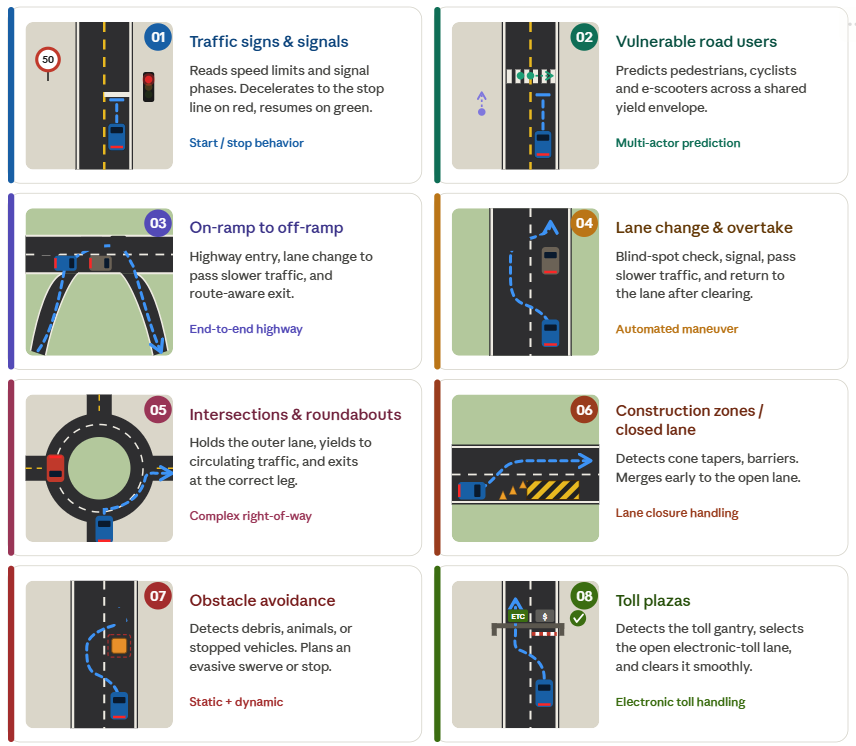
The demo uses the Nullmax MaxDrive Plus stack with a one-stage end-to-end AI architecture, aligned with the industry shift towards LLM, VLM, and VLA-inspired driving models, on R-Car X5H to handle advanced highway and urban/city driving use cases. It also covers complex real-world use cases, such as:
- Speed limit, traffic sign, and traffic light handling with start/stop behavior
- Interaction with vulnerable road users (VRUs)
- On-ramp to off-ramp navigation
- Automated lane changes and overtaking
- Complex intersections and roundabouts
- Construction zones and closed lanes
- Obstacle avoidance
More than just a feature demonstration, it serves as an in-vehicle validated example of how R-Car X5 and RoX SDK can support complex, end-to-end partner ADAS stacks under real driving conditions.
From Proof-of-Concept to Production-Oriented Programs
Moving from proof-of-concept to production ADAS/AD deployment requires solving key challenges in integrating complex end-to-end AI stacks, managing data and resource-intensive workloads, and ensuring deterministic closed-loop system behavior across multiple partners.
The combined R-Car X5 and RoX SDK platform directly addresses these challenges.
R-Car X5 provides scalable heterogeneous compute and high-bandwidth memory to handle modern AI workloads, while RoX SDK enables efficient bring-up, integration, and validation of end-to-end ADAS pipelines. This reduces integration complexity and enables early system validation at the vehicle level.
For OEMs, this translates into reduced development risk, faster integration cycles, and accelerated time to market, especially in fast-evolving L2++ segments. It also supports a more consistent platform strategy across vehicle programs. For software partners, RoX SDK provides a reusable environment to deploy and scale differentiated AI-driven ADAS stacks across R-Car X5 performance tiers.
As ADAS/AD continues to evolve toward end-to-end, data-intensive AI architectures (including LLM/VLM/VLA-inspired models), the ability to combine scalable compute, high-bandwidth memory, and validated architectures on real hardware and software becomes critical.
The R-Car X5 family and RoX SDK platform address these requirements, enabling partners to move efficiently from integration to in-vehicle validation and toward production deployment with confidence and speed.
For more information, visit R-Car Automotive System-on-Chips (SoCs).