Software-defined vehicles (SDV) are upending traditional automotive design. While vehicle development is still highly iterative, the industry is in the throes of a historic transformation where manufacturers are compressing once-sequential hardware-to-software design cycles into more efficient software-first design flows.
This so-called shift-left approach is exemplified by Renesas' adoption of digital tools and AI models as part of a broader digitalization and software strategy aimed at accelerating design and innovation, while simultaneously optimizing R&D efficiency. In the automotive sector, the evolution is driven by practical considerations given that a typical vehicle now embeds more than 100 million lines of code. Heavier software dependence requires continuous updating and deployment, multi-supplier integration, design validation at scale, and reflects an ecosystem where OEMs insource more software and chipmakers ship platforms, not parts. Renesas anticipated these changes with the scalable R-Car hardware and software development platform. R-Car supports the transition of E/E designs to more central processing architectures, including advanced driver assistance systems (ADAS) and autonomous vehicle design. Last year, we added R-Car Open Access (RoX), an extended platform for SDVs that provides a pre-integrated, out-of-the-box environment with hardware, operating systems, software stacks, and tools to accelerate next-generation vehicle development.

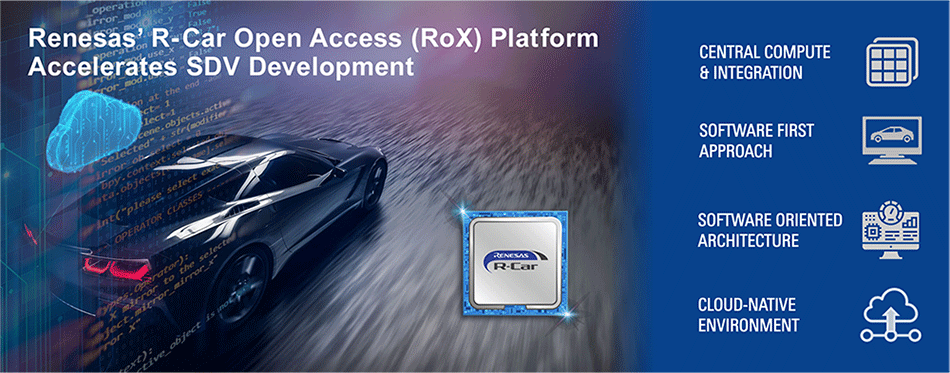

R-Car leverages a heterogeneous architecture that features Arm® CPUs with multiple hardware accelerators. RoX includes a common set of toolchains that allows software reuse across electronic control units (ECUs) for ADAS, in-vehicle information (IVI) systems, and centralized data gateways. By enabling cloud-native development and customized design simulation, the RoX platform expands SDV lifecycle support through continuous updates that align with a modern value chain where OEMs and service providers increasingly co-own software.
Introducing RoX AI Studio: Cloud-Native MLOps on R-Car
Many of our automotive customers have embraced R-Car and the Renesas RoX platform as a means to accelerate SDV development and manage the complexity of in-vehicle embedded processing systems. In doing so, we found a persistent "lab-to-road" gap between how designers employ AI training in the cloud and how they deploy new features in automotive SoCs.
RoX AI Studio, a new extension of the original RoX platform, closes that gap. The machine learning operations (MLOps) tool lets teams remotely evaluate AI models using a managed cloud control plane that connects engineers with hardware-in-the-loop (HIL) device farms so they can profile real-world performance without waiting for scarce lab boards. Continuous integration and deployment (CI/CD) keeps the full toolchain current, so improvements arrive automatically with no local installs required. The result is faster iteration, fewer surprises, and a direct line from model training to road-ready, HIL model validation.

What Is MLOps – and How Does RoX AI Studio Enable It for SDVs?
To define MLOps, it's important to understand what preceded it. MLOps builds on a concept called DevOps – short for development operations – in which tools and best practices are combined to shorten software design lifecycles. This is achieved by breaking down silos between development and IT operations teams to help them collaborate more effectively.
DevOps governs deterministic integrate/test/deploy processes for conventional software code and services. MLOps adds AI data and models, where development lifecycles are iterative, experiments branch, and choices must be tracked, compared, and promoted. By anchoring model validation on R-Car silicon, RoX AI Studio becomes the bridge between model-in-training and model-in-production, turning the art and science of AI model development into repeatable and scalable engineering operations with targeted KPIs.
RoX AI Studio operationalizes automotive MLOps for SDVs in several ways:
- Model Intake and Registry: Renesas provides a curated model zoo that includes many popular AI models. Users can also use a bring your own model (BYOM) approach to ingest their own custom or proprietary models and receive a quick performance evaluation on R-Car silicon.
- Automated Updates: Orchestration workflows in our MLOps tool simplify the user experience by abstracting model processing for silicon deployment, while CI/CD toolchains automate the release and deployment of the latest version of the AI toolchain for R-Car SoCs.
- HIL Evaluation: MLOps in the cloud connects to a physical lab hosting an array of R-Car silicon devices that run inference experiments on demand. This allows remote validation of AI models without requiring physical co-location with the hardware.
- Results and Artifacts: Collects metrics and logs from inference experiments and aggregates them as metric comparison tables and plots.
- Scaled Experimentation: Runs multiple models/variants in parallel to compare accuracy vs. latency under real-world operating constraints.
- Flexible Deployment: Will allow designers to begin on the Renesas cloud for speed and then mirror the same stack later in a private cloud when silicon is more widely available for individual projects.
RoX AI Studio Is Advancing Automotive's "Shift Left" Strategy
Automotive timelines are compressing. Manufacturers are moving from three to four-year platform development cycles to one to two-year cycles augmented by ongoing over-the-air (OTA) updates to provide on-road product feature enhancements. That means design teams adopting the shift-left philosophy need to test hardware and software earlier using target (remote or virtual) devices.
That's a challenge for OEMs, many of which have invested heavily in AI model training and are striving to continuously improve their networks by deploying feature updates to their vehicles in the field. At the same time, shorter development cycles mean they must test many device options simultaneously – at scale and across multiple vectors – without over-investing in the wrong development path.
When OEMs and Tier 1 suppliers use RoX AI Studio, they can quickly validate their devices by testing at scale and within the context of their specific MLOps network strategy. RoX AI Studio makes this practical by creating a simplified developer experience for managing cloud-to-lab infrastructure and automated workflows for pre-trained model deployment and evaluation on R-Car SoC targets. It runs experiments in parallel, as opposed to serially, and provides access to device farms that allow global teams to start development before boards arrive and continue at scale.
For automotive OEMs, this means earlier starts and fewer late surprises, reusable software investments that move from cloud to vehicle, and a clean path to private-cloud deployment and virtual platforms that yield better results and shorten time to market.
Platform Thinking for the Software-Defined Era
Car makers designing SDVs are committed to developing hardware and software in parallel, and the market is converging on cloud-native machine learning tools – but with no universal MLOps winner yet.
Renesas RoX AI Studio provides a standardized SDV design foundation and operationalizes AI development on that foundation by moving beyond DevOps to support a "one-stop studio" model. Together, the RoX platform and RoX AI Studio are enabling a shift-left culture change: validate earlier, iterate faster, deploy confidently.
Renesas RoX AI Studio is currently available to select customers with a broad introduction planned in 2026. Sign up for a hands-on demo of RoX AI Studio today.