
Overview
Description
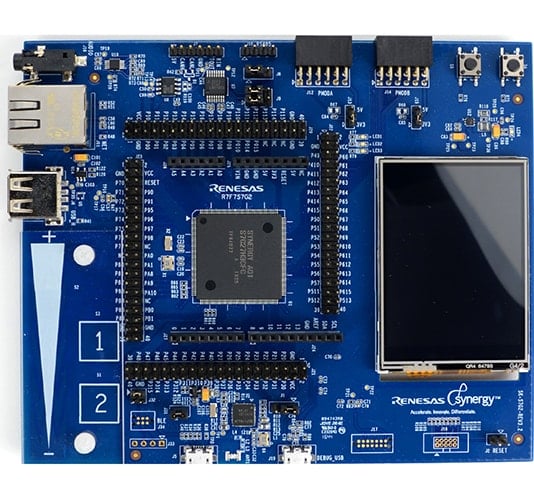
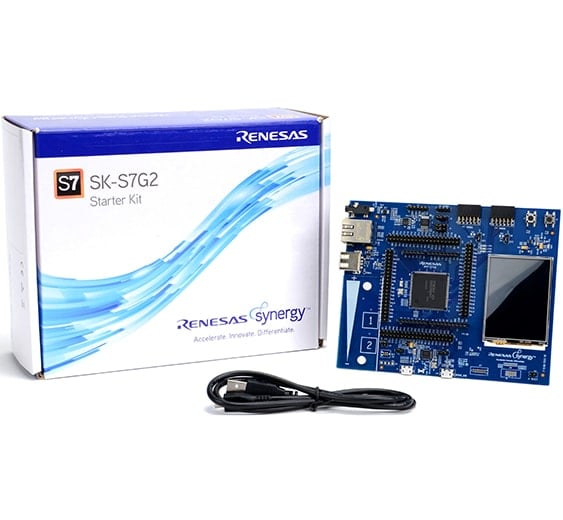
Experience the power of the Synergy™ Platform and key features of the flagship Synergy S7G2 microcontroller (MCU) Group within minutes.
Features
- Access all pins and on-board peripherals of the Synergy S7G2 MCU
- Accelerate code development with the tightly integrated and qualified Synergy Software Package (SSP)
- View, step through, and debug code with the e2 studio IDE from Renesas or IAR Embedded Workbench® for Renesas Synergy
- Flexible connectivity options with USB, Ethernet with IEEE 1588 Precision Time Protocol (PTP) support, CAN, and RS-232/RS-485
- Arduino™ Shield Uno compatible socket and Pmod™ connectors for expansion with third-party, off-the-shelf, and custom multi-function boards
- Wireless radio expansion capabilities with a Bluetooth® Low Energy (LE) module
- Human machine interface (HMI) functionality with a capacitive touch sensing unit (CTSU), graphics LCD controller with 2.4-inch QVGA (240 x 320) TFT LCD with capacitive touch screen, and GUIX Studio™ for developing user interface screens
- Measure real-time power consumption of the current over program execution
- Security and encryption functions enable secure data communications and storage, with support for industry-standard algorithms such as AES, DSA, 3DES, RSA, SHA, and GHASH
- Safety features include hardware diagnostics, memory protection, and watchdog timeout
- Debugging and programming with J-Link® OB on-board
Applications
Documentation
Featured Documentation
Log in required to subscribe
|
|
|
|
|---|---|---|
| Type | Title | Date |
| Quick Start Guide | PDF 943 KB 日本語 | |
| Application Note |
PDF
2.27 MB
日本語
AI-generated Summary:
Create a simple two-screen GUI application using GUIX Studio for SK-S7G2 and PK-S5D9 Synergy MCU kits. Configure hardware functions such as LCD, SPI, and I2C, manage threads, message passing, interrupts, LCD driver, and touchscreen. Develop and debug the project in e2 studio using the Renesas Synergy Software Package, which integrates ThreadX RTOS and X-Ware stacks. The package includes source files like guiapp_event_handlers.c and lcd_setup.c. The guide covers project creation, configuration, GUI design, custom controls, and running the application with touchscreen interaction.
|
|
| Application Note |
PDF
61 KB
AI-generated Summary:
The document provides a comprehensive look-up table for Synergy MCU Kits, listing current and new orderable part numbers to assist customers in ordering through distributors. It emphasizes precautions for handling microprocessing and microcontroller units, including electrostatic discharge prevention, power-on processing, signal input during power-off, unused pin handling, clock signal stability, and voltage waveform considerations. It also covers prohibitions on accessing reserved addresses, product differences, and safety and legal disclaimers. The document includes URLs for support, software, and additional resources related to the Synergy Platform. It highlights quality grades and usage restrictions for Renesas products, emphasizing user responsibility for safety and compliance.
|
|
| Application Note |
PDF
1.32 MB
日本語
AI-generated Summary:
The UART HAL module supports full-duplex UART communication with multiple channels, interrupt-driven data transfer, runtime baud-rate changes, and hardware flow control using CTS/RTS signals. It integrates with the DTC transfer module and allows aborting ongoing transfers. The module provides APIs for opening, reading, writing, setting baud rate, and closing the UART device. Interrupts manage data flow with RXI, TXI, TEI, and ERI handling reception, transmission, completion, and errors respectively. Hardware flow control supports both CTS and RTS signals via user callbacks, requiring GPIO initialization beforehand.
|
|
| Application Note |
PDF
708 KB
AI-generated Summary:
The NetX Duo NAT Module supports key RFCs for IP Network Address Translation and offers APIs to create, delete, enable, and disable NAT instances. It supports static inbound entries and callback notifications when the NAT table is full. The module operates by translating IP addresses and ports between private and public networks, managing TCP/UDP sessions and ICMP messages. It enables communication between internal hosts and external networks by dynamically or statically assigning IP addresses and ports.
|
|
| Application Note |
PDF
851 KB
日本語
AI-generated Summary:
The Console Framework module provides a menu-based command-line interface with features like submenus, navigation, help menus, and case-insensitive input. It supports Ethernet, UART, and USB implementations, automatically configuring necessary modules. The module offers APIs for opening, closing, reading, writing, prompting, parsing commands, and argument handling. It operates as a ThreadX-aware CLI using mutexes and event flags for synchronization. Menus and commands require user-defined structures, enabling multi-level navigation and command callbacks.
|
|
| Application Note |
PDF
1.04 MB
日本語
AI-generated Summary:
The document explains how to use the Audio Player application on supported Renesas Synergy boards, including S7G2 and PK-S5D9. It details connecting the board, importing the project into e² studio, and running the application. Supported audio files are mono, signed, 16-bit, 44.1 kHz PCM WAVE files. The UI includes splash, USB, and main screens, with volume control via buttons or GUI. It notes a current limitation in smooth audio switching, recommending stopping playback before changing tracks.
|
|
| Application Note | PDF 1.66 MB 日本語 | |
| Application Note | PDF 277 KB | |
| Application Note | PDF 284 KB 日本語 | |
| Application Note |
PDF
347 KB
AI-generated Summary:
The NetX DHCP Client module manages IP address acquisition, registration, and lease renewal using UDP and ARP protocols. It creates a UDP socket and a packet pool for DHCP messages, with a minimum payload size to accommodate headers. The client can request specific IP addresses and handles server responses including network mask, gateway, DNS, and NTP servers. It tracks lease time, renews IP leases, and handles lease expiration. The client clears non-specific broadcast packets to avoid queue overflow. Developers can supply custom packet pools and enable ARP probes to ensure IP uniqueness. DHCP client states include INIT, SELECTING, REQUESTING, BOUND, RENEWING, and REBINDING.
|
|
| Application Note |
PDF
346 KB
AI-generated Summary:
The NetX and NetX Duo Auto IP module assigns IPv4 addresses in the 169.254.x.x range by selecting a random address and verifying its uniqueness via ARP probes and announcements. If conflicts arise, it retries with a new address. The module integrates with DHCP clients to ensure valid IP assignment, switching between DHCP and Auto IP as needed. Configuration involves setting network interfaces, interrupt priorities, and adding the module to application threads via the SSP configurator. Error codes and operational notes guide proper usage and troubleshooting.
|
|
| Application Note |
PDF
581 KB
AI-generated Summary:
The document details the NetX BSD Support Module API functions for socket operations such as bind, connect, send, receive, and close. It explains how the module automatically creates IP instances and manages memory for BSD thread stacks and packet pools. Applications create socket addresses for IPv4 or IPv6, set socket options, and handle TCP/UDP connections. TCP servers listen and accept multiple connections using master and secondary sockets. An option exists to eliminate the internal BSD thread by using a timer-based process to save memory.
|
|
| Application Note |
PDF
342 KB
AI-generated Summary:
The NetX HTTP Client module provides high-level APIs to create and delete HTTP client instances and to send GET and PUT requests to HTTP servers. It supports IPv4 and IPv6 connections, complies with relevant RFCs, and manages TCP sockets and packet pools for efficient data transmission. The module handles server responses with standard HTTP status codes and offers configurable options such as connecting to non-default ports. Error codes and operational details are documented for robust application development.
|
|
| Application Note |
PDF
407 KB
AI-generated Summary:
The NetX HTTP Server module enables TCP services by creating an IP instance and HTTP Server instance that listens on port 80. It requires a packet pool optimized for HTTP packet transmission. The module supports IPv4 and IPv6 connections, with optional ICMPv6 checksum settings. It integrates with the Filex embedded file system. HTTP responses include standard status codes like 200, 401, and 404. Authentication supports basic and MD5 digest methods, with callbacks managing authentication requirements and responses.
|
|
| Application Note |
PDF
389 KB
AI-generated Summary:
The WDT HAL module manages the Watchdog Timer (WDT) in Synergy MCUs, supporting device reset or NMI generation upon underflow or improper refresh. It operates using a peripheral clock with configurable clock division and timeout cycles. The WDT can start via registers or auto-start using parameters stored in Option Function Select Register 0 (OFS0). APIs enable opening, refreshing, status reading, and configuration. The WDT continues running in Sleep mode and supports interrupt or reset signals. OFS0 settings control start mode, timeout, clock division, window positions, and low power behavior.
|
|
| Application Note | PDF 350 KB | |
| Application Note |
PDF
556 KB
AI-generated Summary:
The NetX Duo FTP Server Module supports both IPv4 and IPv6 networks and integrates with the FileX file system. It uses TCP port 21 for client requests and complies with RFC 959 and RFC 2428. The module provides APIs to create, start, stop, and delete FTP services. FTP operations require TCP ports 20 and 21 and handle ASCII NULL-terminated file names without size limits. Server responses use 3-digit codes to indicate status, and FTP commands cover directory and file management. The module supports standard FTP communication sequences for reading and writing files.
|
|
| Application Note |
PDF
429 KB
AI-generated Summary:
The Audio Record ADC Framework Module samples audio analog data using the ADC Periodic Framework and stores it in a user buffer for application processing. It supports 8-bit or 12-bit PCM data and does not support I2S recording. Configuration includes buffer length, data width, sampling rate, and iterations. The module integrates into applications via SSP Configurator, automatically adding necessary lower-level drivers. Configuration settings, including interrupt priority, are managed through the SSP Configurator with some properties locked to prevent conflicts.
|
|
| Application Note | PDF 224 KB | |
| Application Note |
PDF
2.14 MB
日本語
AI-generated Summary:
The document details the setup and configuration of the PE-HMI1 and DK-S7G2 boards for running the Weather Panel application, including specific DIP switch settings and J-Link programming interface connections. It highlights the application’s use of complex HMI designs with GUIX Studio, multi-threading with ThreadX RTOS, and Synergy messaging for inter-thread communication. The Weather Panel leverages Synergy S7G2 or S5D9 MCUs based on ARM Cortex-M4, utilizing various peripherals and drivers to streamline embedded application development.
|
|
| Application Note |
PDF
248 KB
日本語
AI-generated Summary:
The RTC HAL module manages real-time clock functions including configuration, time and alarm setting, and event notifications. It offers APIs for opening, closing, starting, stopping, and configuring the RTC, supporting interrupts for alarms, periodic events, and carry events. The module uses two clock sources: a low-power on-chip oscillator and a more accurate external sub-clock oscillator. It requires opening before use and supports user-defined callbacks for interrupts. Limitations include no support for binary-count mode or clock-error correction. Configuration is simplified via the SSP configurator with locked and modifiable properties.
|
|
| Application Note |
PDF
644 KB
日本語
AI-generated Summary:
This section explains how to connect the target board using the SEGGER J-Link debugger and power it up. It details setting DIP switches for specific DK-S7G2 board versions and connecting an Ethernet cable between the board and PC. It guides configuring a static IP address on the PC Ethernet port, using 192.168.0.200 as an example, and running the command prompt as administrator to verify IP settings with the ipconfig command. Finally, it advises selecting a unique IP address for the board, such as 192.168.0.2.
|
|
| Application Note |
PDF
586 KB
AI-generated Summary:
This document explains how to connect and configure a target board for use with the NetX Web Server on the Renesas Synergy Platform. It details setting up the SEGGER J-Link debugger, enabling Ethernet ports via DIP switches on specific DK-S7G2 board versions, and connecting the board to a PC using an Ethernet cable. It also guides configuring a static IP address on the PC and selecting a unique IP address for the board. Instructions for running the command prompt as an administrator and using the ipconfig command to verify network settings are included.
|
|
| Application Note | PDF 2.00 MB | |
| Application Note |
PDF
475 KB
AI-generated Summary:
The USBX Host Class HID module manages communication with HID devices like keyboards, mice, and remote controls. It supports starting and stopping periodic reports, sending and receiving reports directly, and reading device-specific data such as keyboard keys, mouse buttons, and positions. The module requires proper USB host controller definition and interrupt priority configuration. It integrates into applications via thread stacks, with configuration simplified through the SSP configurator, highlighting necessary settings like interrupt priorities and client support options.
|
|
| Application Note |
PDF
436 KB
日本語
AI-generated Summary:
The ADC Periodic Framework module manages periodic ADC sampling using a hardware timer to trigger scans in one-shot mode. It buffers data from multiple channels and notifies the user after a specified number of sample iterations via a callback. The buffer operates as a circular buffer, requiring appropriate sizing to prevent data overwrite. The module supports configuration through the SSP configurator, with limitations such as no group-scan mode or DMA support and restrictions on sensor channel combinations.
|
|
| Application Note |
PDF
194 KB
AI-generated Summary:
The SCI SPI HAL module enables SPI communication on Synergy MCUs, supporting 8-bit data transfers in master mode only. It provides APIs for opening, closing, reading, writing, and full-duplex operations, with callback support for transfer events. Configuration involves setting clock, IO ports, interrupts, and operational parameters via the SSP configurator. The module uses GPIO for chip select and integrates with the Data Transfer Controller for efficient data handling without CPU intervention.
|
|
| Application Note | PDF 921 KB | |
| Application Note |
PDF
250 KB
AI-generated Summary:
The USBX Host Class Hub Module manages USB hubs, supporting stand-alone or compound devices, self-powered or bus-powered modes, and cascading of up to five hubs. It requires defining USB host controllers and device classes for operation. The module uses USB controller interrupts and transfer module interrupts, with priority settings configurable in the Synergy Configuration tool. Integration involves adding the module to a thread stack via the SSP configurator, which automatically includes necessary lower-level modules. The module itself has no user APIs or configurable properties; configuration occurs through associated modules.
|
|
| Application Note | PDF 1.04 MB | |
| Application Note |
PDF
346 KB
AI-generated Summary:
The Low Power Modes V2 HAL module provides APIs to initialize, configure, and enter various low power states such as sleep, software standby, snooze, and deep software standby. Sleep mode maintains SRAM and processor states with minimal wake time. Software standby stops most peripherals and oscillators to reduce power. Snooze mode allows some peripherals to operate during standby. Deep standby wakes via reset or specific triggers. Proper interrupt configuration and timing settings are essential for correct operation, especially when using ThreadX RTOS.
|
|
| Application Note | PDF 456 KB | |
| Application Note | PDF 926 KB | |
| Application Note | PDF 305 KB | |
| Application Note |
PDF
585 KB
日本語
AI-generated Summary:
The CGC HAL module provides APIs to configure and control various clock sources and outputs in Renesas Synergy microcontrollers. It supports selecting system clocks, adjusting clock frequencies, checking clock stability, and detecting oscillator stops with callback options. The module manages internal clock domains and external clock outputs, allowing runtime changes to clock settings including divisors and PLL parameters. It returns detailed status codes for operation results and errors.
|
|
| Application Note |
PDF
310 KB
AI-generated Summary:
The IWDT HAL module configures the Independent Watchdog Timer (IWDT) interface, managing device resets or NMI generation upon underflow or invalid refresh. It supports various timeout periods, clock division ratios, and window positions, configurable via OFS registers. The module operates with a clock frequency derived from PCLKB and can trigger DMAC/DTC transfers on underflow events. The IWDT timeout can reach nearly 35 seconds with maximum settings. Error codes and API version retrieval are also detailed.
|
|
| Application Note |
PDF
224 KB
AI-generated Summary:
The Thread Monitor Framework module registers threads with counter variables monitored against set minimum and maximum values. It checks these counters periodically at half the watchdog timeout period, resetting the microcontroller if values fall outside the range. The module automatically refreshes the watchdog timer within a valid window, ensuring system reliability. It requires high thread priority and debugging support when using SEGGER J-Link. Integration involves adding the module via the SSP configurator, which manages dependencies like watchdog timers.
|
|
| Application Note |
PDF
427 KB
AI-generated Summary:
The document details the NetX and NetX Duo DNS Client module APIs, including functions for creating, deleting, and managing DNS client instances, server lists, and DNS cache. It covers IPv4 and IPv6 address lookups, DNS query handling, and error status codes. The DNS client sends queries to servers sequentially, retransmitting with increasing timeouts until a response or timeout occurs. Specific APIs support DNS record types like A, PTR, AAAA, and services for domain name, mail exchange, and service lookups.
|
|
| Application Note | PDF 499 KB | |
| Application Note | PDF 261 KB | |
| Application Note |
PDF
1.79 MB
AI-generated Summary:
The Cellular Framework module supports connectivity with CAT1, CAT3, and CAT M1 cellular modems using BSD Socket and NetX stack interfaces. It provides a common set of APIs for interfacing with different cellular hardware, enabling easy migration between modules. Supported modems include NimbeLink CAT3 and CAT1 variants and Quectel CATM1-BG96. The module offers APIs for initialization, information retrieval, statistics, and data transmission, facilitating cellular communication integration on the Renesas Synergy platform.
|
|
| Application Note | PDF 306 KB | |
| Application Note |
PDF
1.46 MB
AI-generated Summary:
The document details the NetX Duo SNMP Agent APIs, providing a comprehensive list of functions for creating, deleting, and managing SNMP Agent instances. It covers key operations such as authentication, message handling, and trap sending across SNMP versions 1, 2, and 3. The guide explains configuration settings, security key management, and operational notes essential for integrating the SNMP Agent into applications.
|
|
| Application Note |
PDF
769 KB
AI-generated Summary:
The NetX Duo MQTT client module supports both normal and secure modes for communication with an MQTT broker. It uses a publisher-subscriber model where clients publish or subscribe to topics via the broker. Secure mode employs TLS for encrypted communication. The module supports QoS levels 0 and 1, with message delivery guarantees for QoS 1. It manages message queues, supports callbacks for message reception and disconnect notifications, and provides APIs for connecting, publishing, subscribing, and disconnecting.
|
|
| Application Note |
PDF
439 KB
AI-generated Summary:
The document explains how to create and migrate custom Board Support Packages (BSPs) for Renesas Synergy SSP versions 1.1.z and 1.2.0. It details the use of the Custom BSP Creator and Custom Pack Creator tools to generate, modify, and package BSPs. Custom BSPs mainly require changes in the board folder, including essential files like bsp.h and bsp_init.c. The process involves creating a base BSP, making a template pack for modifications, editing in e2 studio, and finalizing a standard pack for distribution. An example using the DK-S7G2 board illustrates these steps.
|
|
| Application Note |
PDF
675 KB
AI-generated Summary:
The NetX Duo TLS Module supports multiple TLS protocol versions (1.0, 1.1, 1.2) and related standards including X.509 certificates, AES cipher suites, RSA cryptography, HMAC, and SHA algorithms. It provides APIs for managing TLS sessions, certificates, encryption metadata, and packet handling. Key functions include creating, starting, sending, receiving, and ending TLS sessions, as well as certificate management and protocol version control. The module integrates with hardware crypto accelerators and supports client certificate verification.
|
|
| Application Note | PDF 427 KB | |
| Application Note |
PDF
1.70 MB
AI-generated Summary:
The Wi-Fi Framework module provides APIs to manage Wi-Fi functionalities such as initialization, data transmission, scanning for networks, and provisioning settings. It supports multiple Wi-Fi modes (AP or client) and returns detailed information like chipset data, signal strength, and connection statistics. The framework integrates with ThreadX RTOS and various drivers, enabling flexible network stack implementations including BSD Socket and NetX Port.
|
|
| Application Note |
PDF
276 KB
AI-generated Summary:
The Communications Framework on NX module provides APIs for managing USB communication, including opening, closing, reading, writing, locking, and unlocking the driver. It supports Ethernet connections compatible with UART and USB APIs, enabling easy switching between communication types. The module requires configuration through the SSP configurator, where users set properties like IP address, subnet mask, and interrupt priority. The configurator highlights required settings and locks conflicting properties to simplify setup and reduce errors.
|
|
| Application Note |
PDF
82 KB
AI-generated Summary:
Disabling FileX error checking improves performance by up to 30% and reduces code size. FileX supports configurable parameters such as maximum filename lengths, sector cache sizes, and update rates. The Fault Tolerant Module ensures file system integrity by journaling updates to prevent corruption during power loss or media ejection. exFAT support requires a Microsoft license. Various options optimize performance, memory usage, and compatibility with single-threaded environments.
|
|
| Application Note |
PDF
538 KB
AI-generated Summary:
The DK-S7G2 kit powers on via a 5 V barrel connector, indicated by LED3 status lights. Connecting the USB J-Link OB to the PC enables programming through a batch file using SEGGER J-Link, with a recommended firmware update. The demonstration application loads automatically, initializing LEDs and Ethernet indicators. The LCD displays a splash screen with date and time. Users can access a Thermostat Demonstration, adjust settings such as time, date, and sound, and navigate the Thermostat Control Menu for further controls.
|
|
| Application Note |
PDF
622 KB
AI-generated Summary:
The NetX Duo DHCP Client Module supports both IPv4 and IPv6 DHCP clients compliant with relevant RFCs. It provides high-level APIs to create, start, stop, and manage DHCP client instances, request specific IP addresses, and handle DHCP messages. The module integrates with the Renesas Synergy Platform and ThreadX RTOS, offering functions to manage packet pools, network interfaces, and client state. Detailed API functions include creating DHCP instances, sending requests, retrieving server addresses, and managing client lease time.
|
|
| Application Note | PDF 411 KB | |
| Application Note |
PDF
1.99 MB
AI-generated Summary:
The Renesas Synergy S7G2 BACnet Demo Kit includes two demo suitcases designed for BACnet MS/TP and BACnet IP demonstrations. Suitcase #1 contains temperature sensors, potentiometers, toggle switches, light indicators, and interfaces such as RS485 and Ethernet. Suitcase #2 includes a fixed function thermostat, BAC router, power supply, and necessary cables for MSTP connection. The kit supports USB and Ethernet connectivity and provides components for hands-on BACnet protocol demonstrations.
|
|
| Application Note |
PDF
543 KB
日本語
AI-generated Summary:
The document details the Renesas Synergy SCE HAL module APIs for cryptographic operations including AES, ARC4, DSA, HASH, and RSA. It provides function names, example API calls, and descriptions for opening, closing, encrypting, decrypting, signing, verifying, and version retrieval. AES supports chaining and padding modes, ARC4 handles key setting and data processing, DSA offers digital signing and verification with various key sizes, HASH supports SHA1 and SHA256 hashing, and RSA supports encryption, decryption, signing, and verification with 1024 or 2048-bit keys.
|
|
| Application Note |
PDF
338 KB
AI-generated Summary:
The External IRQ Framework module provides APIs to handle external interrupts in the Renesas Synergy platform, including functions to open, wait for, and close interrupt channels. It integrates with ThreadX and uses semaphores or the Event Link Controller for signaling. Configuration involves setting hardware options like trigger levels and digital filtering. The module requires proper setup via the SSP configurator, which highlights necessary settings and locks conflicting properties. Typical usage includes opening the module, waiting for interrupts, processing events, and closing the module.
|
|
| Application Note |
PDF
199 KB
日本語
AI-generated Summary:
This guide details the migration from the S5D9 MCU Group to the S5D5 MCU Group, highlighting hardware and specification differences. It explains notation conventions and compares features such as communication modes, USB support, serial sound interface channels, Ethernet PTP controller, ADC capabilities, JPEG codec, graphics controller, and memory capacities. The S5D9 offers enhanced features like USB 2.0 High-Speed, larger SRAM and flash memory, and additional peripherals not available in the S5D5.
|
|
| Application Note |
PDF
208 KB
AI-generated Summary:
The External IRQ HAL module provides APIs to control external interrupts triggered by signal edges or levels, with optional digital noise filtering. It supports user callbacks triggered on IRQ events and integration with DMAC/DTC via the Event Link Controller. Configuration involves selecting IRQ pins, setting trigger conditions, enabling interrupts, and adjusting priorities through the SSP configurator. Proper ISR handling is essential to maintain system responsiveness. The module requires no specific clock settings but depends on correct pin configuration.
|
|
| Application Note |
PDF
234 KB
日本語
AI-generated Summary:
The QSPI HAL module enables communication between the Synergy device and QSPI serial flash memory, supporting page program, read, and erase operations. It provides APIs for erasing memory blocks, reading status, selecting banks, and retrieving device info and API version. The module initializes the QSPI peripheral and supports BSP-based projects with XIP enabled. Configuration involves adding the driver to a thread stack and setting pin assignments. Typical usage includes initializing, reading, erasing sectors or bytes, and polling operation status to prevent data corruption.
|
|
| Application Note |
PDF
319 KB
日本語
AI-generated Summary:
The DMAC HAL module manages data transfers between user-defined sources and destinations triggered by interrupts or events. It supports Normal, Repeat, Block, and Address modes, each defining how transfers occur and how pointers adjust. The module uses DMAC peripheral registers, limiting transfers to available channels. Configuration is done via the SSP configurator, which highlights required settings and locks conflicting properties. Interrupt priority is a common configurable property. The module does not support chained transfers and requires referring to SSP documentation for detailed error codes and operational limits.
|
|
| Application Note |
PDF
1.63 MB
日本語
AI-generated Summary:
Instructions guide the migration of existing e* studio projects to IAR Embedded Workbench for Renesas Synergy. It details creating a new project in the IAR EW for Synergy IDE, saving the workspace, and configuring the Synergy SSC/SSP location and license file. The process includes selecting the appropriate folders and license files to enable project migration and setup within the IAR environment.
|
|
| Application Note | PDF 601 KB 日本語 | |
| Application Note | PDF 309 KB | |
| PCB Design Files | Renesas Synergy™ Starter Kit SK-S7G2 v3.3 Design Data
|
|
| Application Note |
PDF
242 KB
日本語
AI-generated Summary:
The document provides programming guidelines for the Renesas Synergy SK-S7G2 v.2.0 out-of-box demo. It emphasizes updating the J-Link firmware to avoid programming failures. Upon powering the board, the LCD displays a splash screen, leading to a thermostat demo that reads internal temperature via the A/D converter and displays it. Users can adjust settings such as units, time, and date. Version details include SK-S7G2 v.2.0, demo app v.1.0, and SSP v.1.0.0. Support links for America, Europe, and Japan are provided.
|
|
| PCB Design Files | Renesas Synergy™ Starter Kit SK-S7G2 v3.0 Design Data
|
|
| Manual - Development Tools | PDF 2.81 MB 日本語 | |
|
68 items
|
||
Design & Development
Sample Code
Sample Code
Filters
|
||
|---|---|---|
| Type | Title | Date Date |
| Sample Code | GUIX "Hello World" for SK-S7G2 and PK-S5D9 – Application Project - Sample Code
|
|
| Sample Code | NetX Duo™ NAT Module Guide - Application Project Rev.1.01 - Sample Code
|
|
| Sample Code | Getting Started with the Audio Player Application using SSP - Application Project Rev.1.03 - Sample Code
|
|
| Sample Code | Access to External Flash Memory in Renesas Synergy Development Environments - Application Project Rev.1.04 - Sample Code
|
|
| Sample Code | USBX™ Host Class CDC-ACM Module Guide - Application Project Rev.1.02 - Sample Code
|
|
| Sample Code | USBX™ Device Class HID Module Guide - Application Project Rev.1.04 - Sample Code
|
|
| Sample Code | NetX™ DHCP Client Module Guide - Application Project Rev.1.03 - Sample Code
|
|
| Sample Code | NetX™ and NetX Duo™ Auto IP Module Guide - Application Project Rev.1.02 - Sample Code
|
|
| Sample Code | NetX™, NetX Duo™ BSD Support Module Guide - Application Project Rev.1.02 - Sample Code
|
|
| Sample Code | NetX™ HTTP Client Module Guide - Application Project Rev.1.03 - Sample Code
|
|
| Sample Code | NetX™ HTTP Server Module Guide - Application Project Rev.1.03 - Sample Code
|
|
| Sample Code | WDT HAL Module Guide - Application Project Rev.1.03 - Sample Code
|
|
| Sample Code | FileX Port Block Media Framework Module Guide - Application Project Rev.1.01 - Sample Code
|
|
| Sample Code | NetX Duo™ FTP Server Module Guide - Application Project Rev.1.01 - Sample Code
|
|
| Sample Code | RSPI HAL Module Guide - Application Project Rev.1.04 - Sample Code
|
|
| Sample Code | I²C Slave HAL Module Guide - Application Project Rev.1.04 - Sample Code
|
|
| Sample Code | SPI Framework Module Guide - Application Project Rev.1.10 - Sample Code
|
|
| Sample Code | USBX™ Device Class Mass Storage Module Guide - Application Project (r11an0104eu0104) Rev.1.04 - Sample Code
|
|
| Sample Code | Getting Started with the Weather Panel Application - Application Project Rev.2.10 - Sample Code
|
|
| Sample Code | RTC HAL Module Guide - Application Project Rev.1.03 - Sample Code
|
|
| Sample Code | Getting Started with the Thermostat Application for S7G2 and S5D9 - Application Project Rev.1.06 - Sample Code
|
|
| Sample Code | Getting Started with NetX Duo™ Web Server - Application Project Rev.1.08 - Sample Code
|
|
| Sample Code | Getting Started with NetX™ Web Server - Application Project Rev.1.10 - Sample Code
|
|
| Sample Code | USBX™ Host Class HID Module Guide - Application Project Rev.1.01 - Sample Code
|
|
| Sample Code | ADC Periodic Framework Module Guide - Application Project Rev.1.02 - Sample Code
|
|
| Sample Code | Key Matrix HAL Module Guide - Application Project Rev.1.02 - Sample Code
|
|
| Sample Code | SCI SPI HAL Module Guide - Application Project Rev.1.02 - Sample Code
|
|
| Sample Code | ADC HAL Module Guide - Application Project Rev.1.03 - Sample Code
|
|
| Sample Code | Power Profiles V2 Framework Module Guide - Application Project Rev.1.01 - Sample Code
|
|
| Sample Code | USBX™ Host Class Hub Module Guide - Application Project Rev.1.01 - Sample Code
|
|
| Sample Code | Capacitive Touch Slider Framework Module Guide - Application Project Rev.1.01 - Sample Code
|
|
| Sample Code | Low Power Modes V2 HAL Module Guide - Application Project Rev.1.02 - Sample Code
|
|
| Sample Code | USBX™ Device Class CDC-ACM Module Guide - Application Project Rev.1.01 - Sample Code
|
|
| Sample Code | I2C SCI HAL Module Guide - Application Project Rev.1.01 - Sample Code
|
|
| Sample Code | Capacitive Touch Button Framework Module Guide - Application Project Rev.1.01 - Sample Code
|
|
| Sample Code | CRC HAL Module Guide - Application Project Rev.1.02 - Sample Code
|
|
| Sample Code | Messaging Framework Module Guide - Application Project Rev.1.04 - Sample Code
|
|
| Sample Code | Input Capture HAL Module Guide - Application Project Rev.1.02 - Sample Code
|
|
| Sample Code | NetX™ Telnet Server Module Guide - Application Project Rev.1.02 - Sample Code
|
|
| Sample Code | USBX™ Synergy Port Framework Module Guide - Application Project Rev.1.01 - Sample Code
|
|
| Sample Code | CAC HAL Module Guide - Application Project Rev.1.01 - Sample Code
|
|
| Sample Code | CGC HAL Module Guide - Application Project Rev.1.02 - Sample Code
|
|
| Sample Code | DTC HAL Module Guide - Application Project Rev.1.01 - Sample Code
|
|
| Sample Code | IWDT HAL Module Guide - Application Project Rev.1.02 - Sample Code
|
|
| Sample Code | I²C Framework Module Guide - Application Project Rev.1.02 - Sample Code
|
|
| Sample Code | Thread Monitor Framework Module Guide - Application Project Rev.1.01 - Sample Code
|
|
| Sample Code | JPEG Decode Framework Module Guide - Application Project Rev.1.01 - Sample Code
|
|
| Sample Code | NetX™ and NetX Duo™ DNS Client Module Guide - Application Project Rev.1.01 - Sample Code
|
|
| Sample Code | I2C Master HAL Module Guide - Application Project Rev.1.02 - Sample Code
|
|
| Sample Code | Audio Playback DAC Framework Module Guide - Application Project Rev.1.02 - Sample Code
|
|
| Sample Code | Block Media RAM Framework Module Guide - Application Project Rev.1.01 - Sample Code
|
|
| Sample Code | Cellular Framework Module Guide - Application Project Rev.1.00 - Sample Code
|
|
| Sample Code | USBX™ Host Class Video Module Guide - Application Project Rev.1.00 - Sample Code
|
|
| Sample Code | NetX™ and NetX Duo™ SNMP Agent Module Guide - Application Project Rev.1.00 - Sample Code
|
|
| Sample Code | NetX Duo™ MQTT Module Guide - Application Project Rev.1.00 - Sample Code
|
|
| Sample Code | Creating a Custom Board Support Package for SSP 1.1.z - Application Project Rev.1.06 - Sample Code
|
|
| Sample Code | Wi-Fi Porting Guide - Application Project Rev.1.00 - Sample Code
|
|
| Sample Code | NetX Duo TLS Module Guide - Application Project Rev.1.00 - Sample Code
|
|
| Sample Code | Telnet Communications Framework on sf_comms_telnet for SSP v1.4.0 Module Overview - Application Project Rev.1.00 - Sample Code
|
|
| Sample Code | Wi-Fi Framework Module Guide - Application Project Rev.1.00 - Sample Code
|
|
| Sample Code | Communications Framework on NX Module Guide - Application Project (r11an0248eu0100) Rev.1.00 - Sample Code
|
|
| Sample Code | BLE Framework - Application Project (r30an0309eu0104) Rev.1.04 - Sample Code
|
|
| Sample Code | DK-S7G2 v3.0 Out-of-Box Demonstration Programming Guidelines - Application Project (r12an0024eu0125) Rev.1.25 - Sample Code
|
|
| Sample Code | NetX Duo™ DHCP Client Module Guide - Application Project (r11an0142eu0100) Rev.1.00 - Sample Code
|
|
| Sample Code | NetX™, NetX Duo™ TFTP Server Module Guide - Application Project (r11an0134eu0101) Rev.1.01 - Sample Code
|
|
| Sample Code | SCE HAL Module Guide - Application Project (r11an0088eu0101) Rev.1.01 - Sample Code
|
|
| Sample Code | External IRQ Framework Module Guide - Application Project (r11an0225eu0101) Rev.1.01 - Sample Code
|
|
| Sample Code | Communications Framework on USBX™ Module Guide - Application Project (r11an0136eu0100) Rev.1.00 - Sample Code
|
|
| Sample Code | GLCDC HAL Module Guide - Application Project (r11an0124eu0101) Rev.1.01 - Sample Code
|
|
| Sample Code | FMI HAL Module Guide - Application Project (r11an0129eu0101) Rev.1.01 - Sample Code
|
|
| Sample Code | QSPI HAL Module Guide - Application Project (r11an0114eu0101) Rev.1.01 - Sample Code
|
|
| Sample Code | External IRQ HAL Module Guide - Application Project (r11an0089eu0101) Rev.1.01 - Sample Code
|
|
| Sample Code | CAN HAL Driver Module Guide - Application Project (r11an0065eu0101) Rev.1.01 - Sample Code
|
|
| Sample Code | DMAC HAL Module Guide - Application Project (r11an0109eu0101) Rev.1.01 - Sample Code
|
|
| Sample Code | GPT HAL Module Guide - Application Project (r11an0091eu0101) Rev.1.01 - Sample Code
|
|
| Sample Code | Low Voltage Detection HAL Module Guide - Application Project (r11an0097eu0100) Rev.1.00 - Sample Code
|
|
| Sample Code | I/O Port HAL Module Guide - Application Project (r11an0113eu0100) Rev.1.00 - Sample Code
|
|
| Sample Code | DAC HAL Module Guide - Application Project (r11an0108eu0101) Rev.1.01 - Sample Code
|
|
78 items
|
||
Product Options
| Part Number | Status | Stock | Sampleable | Pb (Lead) Free | ECCN (US) | HTS (US) | RoHS Compliant | China RoHS Compliant |
|---|---|---|---|---|---|---|---|---|
| RTK7SKS7G2S00003BU | Active | Out of Stock | N/A | No | 3A991.a.2 | 8471.50.0150 | No | No |
| YSSKS7G2E30 | NRND | In Stock | N/A | No | 3A991.a.2 | 8471.50.0150 | No | No |
Support

Support Communities
Get quick technical support online from Renesas Engineering Community technical staff.

Knowledge Base
Browse our knowledge base for helpful articles, FAQs, and other useful resources.

