
特長
- Ultra-high precision front-end amplifier
- Zero-drift instrumentation amplifier
- Pin selectable 9 gain settings: G = 1 to 1,000
- Rail-to-rail input/output
- Single-ended output
- RFI filtered inputs improve EMI rejection
- Single supply: 2.5V to 5.5V
- Dual supply: ±1.25V to ±2.75V
- Low input offset: 5μV, Maximum
- Low input offset drift: 50nV/°C, Maximum
- High CMRR: 138dB, G = 100
- Low gain error: <0.4%, All Gains, Maximum
- Gain bandwidth: 2.3MHz
- Input voltage noise (0.1Hz to 10Hz): 0.4μVP-P
- Operating temperature range: -40 °C to +125 °C
説明
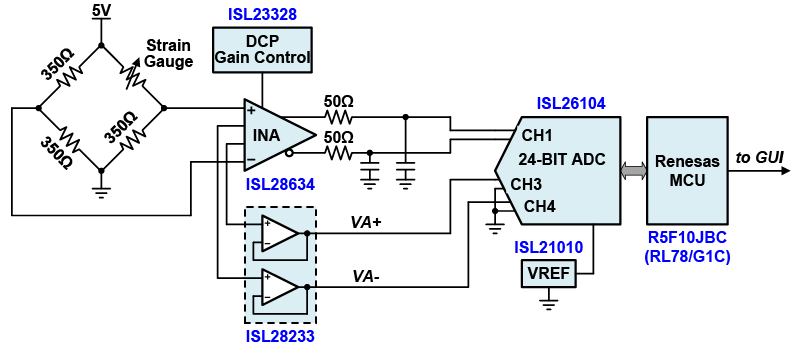
The ISL28535 is a 5V zero-drift rail-to-rail input/output (RRIO) Programmable Gain Instrumentation Amplifiers (PGIA). This instrumentation amplifier features low offset, low noise, low gain error, and high CMRR. It is ideal for high precision applications over the wide industrial temperature range. This in-amp is designed with a unique 2-bit, 3-state logic interface that allows up to 9 selectable gain settings. The ISL2853x single-ended output amplifier includes an additional uncommitted zero-drift amplifier, useful to buffer the REF input or used as a precision amplifier.
アプリケーション
- Pressure and strain gauge transducers
- Weight scales
- Flow sensors
- Biometric: ECG/blood glucose
- Temperature sensors
- Test and measurement
- Data acquisition systems
- Low ohmic current sense
| Part Number | Status | Samples | Stock | RoHS | Package | Lead Count (#) | Carrier Type | Moisture Sensitivity Level (MSL) | Pb (Lead) Free | Pb Free Category | Temp. Range (°C) |
|---|---|---|---|---|---|---|---|---|---|---|---|
| ISL28535FVZ | Obsolete | N/A | Out of Stock | RoHS:EN | TSSOP | 14# | Tube | 2 | Yes | Pb-Free 100% Matte Tin Plate w/Anneal-e3 | -40 to +125°C |
| ISL28535FVZ-T13 | Obsolete | N/A | Out of Stock | RoHS:EN | TSSOP | 14# | Reel | 2 | Yes | Pb-Free 100% Matte Tin Plate w/Anneal-e3 | -40 to +125°C |
| ISL28535FVZ-T7A | Obsolete | N/A | In Stock | RoHS:EN | TSSOP | 14# | Reel | 2 | Yes | Pb-Free 100% Matte Tin Plate w/Anneal-e3 | -40 to +125°C |
- アプリケーションノート英語PDF 992 KB R13AN0012EU0101 Rev.1.01 2022年2月07日AI生成コンテンツ: Current sensing techniques include low-side and high-side sensing using low-voltage precision op-amps combined with current sense resistors. Low-side sensing places the resistor between load and ground, offering simplicity and low cost but limited short-circuit detection. High-side sensing places the resistor between supply and load, enabling short-circuit detection but requiring higher complexity and level shifting. Current-sense resistors convert current to voltage linearly, with key parameters such as tolerance, temperature coefficient, and power rating affecting accuracy. Low-side sensing uses non-inverting amplifiers with tight offset voltage requirements, while high-side sensing employs output transistors to maintain voltage balance. Ultra-low offset amplifiers allow smaller sense resistors, reducing power loss and improving measurement range.
- アプリケーションノート英語PDF 248 KB r13an0007eu-isl2853x-diamond-plot 2020年5月18日
- アプリケーションノート英語PDF 284 KB r13an0006eu-bias-isl2853x-isl2863x 2020年5月15日AI生成コンテンツ: Instrumentation amplifiers require proper DC biasing at their inputs and outputs to function correctly. Input biasing involves referencing inputs to a common-mode voltage (VCM) via bias resistors, ensuring correct transistor operation. Different sensor types, such as DC bridge sensors and thermocouples, have specific biasing needs. AC-coupled inputs require additional biasing to avoid floating inputs. Output biasing sets the output reference voltage (VREF) to center the output range, typically ground in dual supply systems or derived from the supply in single supply systems. Using a voltage reference IC for VREF improves accuracy, PSRR, and CMRR. Ratio-metric applications maintain VREF proportional to supply voltage, using buffered voltage dividers and low-pass filtering to minimize noise and errors.
- アプリケーションノート英語PDF 185 KB r13an0005eu-cascading-instrumentation-amplifiers 2020年5月15日AI生成コンテンツ: Cascading instrumentation amplifiers achieves high gain while maintaining high bandwidth, overcoming the bandwidth limitations of single-stage amplifiers at high gain. Using three cascaded ISL28634 devices, each set to a gain of 10, results in an overall gain of 1000 with a bandwidth of 136kHz, significantly higher than a single amplifier at the same gain. This approach also reduces low-frequency noise compared to a single amplifier operating at high gain. Gain settings are digitally programmable and controlled via GPIO, enabling flexible gain adjustment in powers of 10 for applications requiring precise amplification with low noise and high bandwidth.
- アプリケーションノート英語PDF 324 KB r13an0004eu-instrumentation-amps 2020年4月02日AI生成コンテンツ: High-precision instrumentation amplifiers feature zero-drift architecture, nine programmable gain settings, and rail-to-rail inputs/outputs, enabling accurate amplification of small differential signals amid large common-mode voltages. The input stage distinguishes gain for common-mode and differential signals to prevent saturation. The ISL2853x offers a single-ended output with an uncommitted zero-drift op-amp, while the ISL2863x provides a fully differential output. Gain settings are configurable via pin-strapping or microcontroller control, with internal safeguards against saturation. Practical examples include strain gauge sensor amplification and output stage operation, emphasizing precise signal conditioning across industrial temperature ranges.
- アプリケーションノート英語PDF 263 KB r13an0003eu0100-biasing-op-amps 2019年12月06日AI生成コンテンツ: Proper biasing of operational amplifiers is essential to avoid malfunction in AC-coupled circuits. A missing DC bias path causes long stabilization times and potential failures. Adding input resistors to ground provides a DC path for bias currents, minimizing offset errors. For single-supply AC-coupled amplifiers, biasing uses a reference voltage, ideally from a high-PSRR voltage reference or buffered voltage divider, to maintain signal symmetry and reduce noise. Understanding frequency responses of input and feedback components is crucial for setting bandwidth and gain characteristics.
- アプリケーションノート英語PDF 564 KB an1993 2018年5月22日AI生成コンテンツ: Voltage feedback (VFB) amplifiers use a differential input pair, a high-impedance stage, and an output buffer to convert input voltage differences into output voltage. The VFB amplifier's gain decreases at a dominant pole frequency due to compensation capacitors. Current feedback (CFB) amplifiers include a class AB input amplifier, current mirror, high-impedance stage, and output buffer. CFB amplifiers provide faster switching and higher slew rates by drawing charge/discharge currents directly from supply rails, unlike VFB amplifiers which are limited by biasing current sources.
- データシート英語PDF 2.21 MB isl28533-534-535-633-634-635 2013年8月07日
- データシート英語PDF 2.21 MB isl28533-534-535-633-634-635 2013年8月07日
推奨ドキュメント (1)
- データシート英語PDF 2.21 MB isl28533-534-535-633-634-635 2013年8月07日
データシート (1)
マニュアル、ガイド (1)
- アプリケーションノート英語PDF 992 KB R13AN0012EU0101 Rev.1.01 2022年2月07日AI生成コンテンツ: Current sensing techniques include low-side and high-side sensing using low-voltage precision op-amps combined with current sense resistors. Low-side sensing places the resistor between load and ground, offering simplicity and low cost but limited short-circuit detection. High-side sensing places the resistor between supply and load, enabling short-circuit detection but requiring higher complexity and level shifting. Current-sense resistors convert current to voltage linearly, with key parameters such as tolerance, temperature coefficient, and power rating affecting accuracy. Low-side sensing uses non-inverting amplifiers with tight offset voltage requirements, while high-side sensing employs output transistors to maintain voltage balance. Ultra-low offset amplifiers allow smaller sense resistors, reducing power loss and improving measurement range.
- アプリケーションノート英語PDF 248 KB r13an0007eu-isl2853x-diamond-plot 2020年5月18日
- アプリケーションノート英語PDF 284 KB r13an0006eu-bias-isl2853x-isl2863x 2020年5月15日AI生成コンテンツ: Instrumentation amplifiers require proper DC biasing at their inputs and outputs to function correctly. Input biasing involves referencing inputs to a common-mode voltage (VCM) via bias resistors, ensuring correct transistor operation. Different sensor types, such as DC bridge sensors and thermocouples, have specific biasing needs. AC-coupled inputs require additional biasing to avoid floating inputs. Output biasing sets the output reference voltage (VREF) to center the output range, typically ground in dual supply systems or derived from the supply in single supply systems. Using a voltage reference IC for VREF improves accuracy, PSRR, and CMRR. Ratio-metric applications maintain VREF proportional to supply voltage, using buffered voltage dividers and low-pass filtering to minimize noise and errors.
- アプリケーションノート英語PDF 185 KB r13an0005eu-cascading-instrumentation-amplifiers 2020年5月15日AI生成コンテンツ: Cascading instrumentation amplifiers achieves high gain while maintaining high bandwidth, overcoming the bandwidth limitations of single-stage amplifiers at high gain. Using three cascaded ISL28634 devices, each set to a gain of 10, results in an overall gain of 1000 with a bandwidth of 136kHz, significantly higher than a single amplifier at the same gain. This approach also reduces low-frequency noise compared to a single amplifier operating at high gain. Gain settings are digitally programmable and controlled via GPIO, enabling flexible gain adjustment in powers of 10 for applications requiring precise amplification with low noise and high bandwidth.
- アプリケーションノート英語PDF 324 KB r13an0004eu-instrumentation-amps 2020年4月02日AI生成コンテンツ: High-precision instrumentation amplifiers feature zero-drift architecture, nine programmable gain settings, and rail-to-rail inputs/outputs, enabling accurate amplification of small differential signals amid large common-mode voltages. The input stage distinguishes gain for common-mode and differential signals to prevent saturation. The ISL2853x offers a single-ended output with an uncommitted zero-drift op-amp, while the ISL2863x provides a fully differential output. Gain settings are configurable via pin-strapping or microcontroller control, with internal safeguards against saturation. Practical examples include strain gauge sensor amplification and output stage operation, emphasizing precise signal conditioning across industrial temperature ranges.もっと見る (11)
アプリケーションノート、ホワイトペーパー (11)
製品通知(PCN、EOLなど) (2)
No Results Found.
入力するワードを減らしてみたり、異なるワード、あるいはより一般的なワードを入力してみましょう。
フィルターを適用している場合、フィルターの範囲を見直してみてより広く検索結果が反映される様にしてみましょう。
- ナレッジベースを検索してみましょう。FAQにより、お客様をサポートいたします。
- ルネサスの技術スタッフやコミュニティからのヘルプをサポートフォーラムから受けられます。
No Results Found.
入力するワードを減らしてみたり、異なるワード、あるいはより一般的なワードを入力してみましょう。
フィルターを適用している場合、フィルターの範囲を見直してみてより広く検索結果が反映される様にしてみましょう。
- ナレッジベースを検索してみましょう。FAQにより、お客様をサポートいたします。
- ルネサスの技術スタッフやコミュニティからのヘルプをサポートフォーラムから受けられます。
図、設計ファイル (1)
No Results Found.
入力するワードを減らしてみたり、異なるワード、あるいはより一般的なワードを入力してみましょう。
フィルターを適用している場合、フィルターの範囲を見直してみてより広く検索結果が反映される様にしてみましょう。
- ナレッジベースを検索してみましょう。FAQにより、お客様をサポートいたします。
- ルネサスの技術スタッフやコミュニティからのヘルプをサポートフォーラムから受けられます。
No Results Found.
入力するワードを減らしてみたり、異なるワード、あるいはより一般的なワードを入力してみましょう。
フィルターを適用している場合、フィルターの範囲を見直してみてより広く検索結果が反映される様にしてみましょう。
- ナレッジベースを検索してみましょう。FAQにより、お客様をサポートいたします。
- ルネサスの技術スタッフやコミュニティからのヘルプをサポートフォーラムから受けられます。
No Results Found.
入力するワードを減らしてみたり、異なるワード、あるいはより一般的なワードを入力してみましょう。
フィルターを適用している場合、フィルターの範囲を見直してみてより広く検索結果が反映される様にしてみましょう。
- ナレッジベースを検索してみましょう。FAQにより、お客様をサポートいたします。
- ルネサスの技術スタッフやコミュニティからのヘルプをサポートフォーラムから受けられます。
マーケティング資料 (1)
その他資料 (4)
No Results Found.
入力するワードを減らしてみたり、異なるワード、あるいはより一般的なワードを入力してみましょう。
フィルターを適用している場合、フィルターの範囲を見直してみてより広く検索結果が反映される様にしてみましょう。
- ナレッジベースを検索してみましょう。FAQにより、お客様をサポートいたします。
- ルネサスの技術スタッフやコミュニティからのヘルプをサポートフォーラムから受けられます。
フィルター
適用されたフィルター
ソフトウェア/ツール
タイプでの検索
プロバイダでの検索
サンプルコード
アプリケーションでの検索
ファンクションでの検索
コンパイラでの検索
IDE に関するフィルタリング
シミュレーションモデル
Partner Solutions
No Results Found.
入力するワードを減らしてみたり、異なるワード、あるいはより一般的なワードを入力してみましょう。
フィルターを適用している場合、フィルターの範囲を見直してみてより広く検索結果が反映される様にしてみましょう。
- ナレッジベースを検索してみましょう。FAQにより、お客様をサポートいたします。
- ルネサスの技術スタッフやコミュニティからのヘルプをサポートフォーラムから受けられます。
ソフトウェア/ツール (1)
No Results Found.
入力するワードを減らしてみたり、異なるワード、あるいはより一般的なワードを入力してみましょう。
フィルターを適用している場合、フィルターの範囲を見直してみてより広く検索結果が反映される様にしてみましょう。
- ナレッジベースを検索してみましょう。FAQにより、お客様をサポートいたします。
- ルネサスの技術スタッフやコミュニティからのヘルプをサポートフォーラムから受けられます。
No Results Found.
入力するワードを減らしてみたり、異なるワード、あるいはより一般的なワードを入力してみましょう。
フィルターを適用している場合、フィルターの範囲を見直してみてより広く検索結果が反映される様にしてみましょう。
- ナレッジベースを検索してみましょう。FAQにより、お客様をサポートいたします。
- ルネサスの技術スタッフやコミュニティからのヘルプをサポートフォーラムから受けられます。
No Results Found.
入力するワードを減らしてみたり、異なるワード、あるいはより一般的なワードを入力してみましょう。
フィルターを適用している場合、フィルターの範囲を見直してみてより広く検索結果が反映される様にしてみましょう。
- ナレッジベースを検索してみましょう。FAQにより、お客様をサポートいたします。
- ルネサスの技術スタッフやコミュニティからのヘルプをサポートフォーラムから受けられます。
This video examines the use of instrumentation amplifiers (INA or in amps) for sensor applications. Intersil discusses the basics of the three-op amp INA, advantages of the zero-drift amplifiers, why use an RF input filter, monitoring sensor health, the advantages of programmable gain amplifiers and concludes with application examples for a sensor health monitor and an active shield guard drive.


