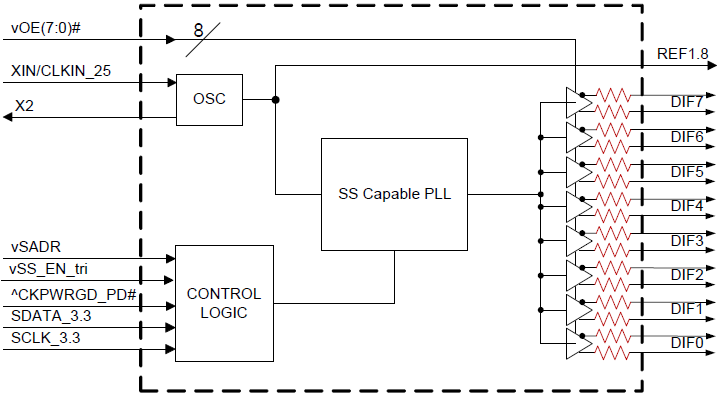
特長
- PCIe Gen1-4準拠
- 終端抵抗の内蔵により100Ωの差動Zoを実現:部品点数と基板面積を削減
- 1.8V動作:消費電力の低減
- オプションで1.05V~1.8Vの任意の電圧から出力可能:最大限の省電力を実現
- OE#端子:DIFパワーマネージメント対応
- LP-HCSL差動クロック出力:消費電力と基板面積の削減
- 各出力のスルーレートをプログラマブルに設定可能:様々な線路長に対応したチューニングが可能
- プログラマブル出力振幅:様々なアプリケーション環境に対応したチューニングが可能
- PLLがロックされるまでDIF出力をブロック:クリーンなシステムスタートアップ
- DIF出力のスプレッドは0%、-0.25%、-0.5%から選択可能:EMIの低減
- 外付け25MHz水晶振動子、0ppmの合成誤差でタイトなppmをサポート
- ストラップピンによる構成が可能:デバイス制御のためのSMBusインタフェースは不要
- 3.3VトレラントSMBusインタフェースは、レガシーコントローラに対応
- 6×6 mmの48ピンVFQFPNで、基板面積を最小限に抑えた省スペース設計
- 選択可能なSMBusアドレス:複数のデバイスでSMBusセグメントを簡単に共有
- AEC-Q100準拠、グレード2(-40℃~+105℃)バージョンで提供(ウェッタブルフランクパッケージ)
説明
9FGV0841は、PCIe Gen1–4アプリケーション用の8出力の超低消費電力クロックジェネレータで、Zo=100Ωの出力終端を内蔵しています。 クロック管理用に8つの出力イネーブルを備え、スペクトラム拡散オフに加えて2種類のスペクトラム拡散レベルをサポートします。
評価ボードや材料に関する情報は、お近くの販売代理店にお問い合わせください。
パラメータ
| 属性 | 値 |
|---|---|
| Diff. Outputs | 8 |
| Diff. Output Signaling | LP-HCSL |
| Output Freq Range (MHz) | 25 - 25, 100 - 100 |
| Power Consumption Typ (mW) | 62 |
| Supply Voltage (V) | 1.8 - 1.8 |
| Output Type | LP-HCSL, LVCMOS |
| Xtal Freq (MHz) | 25 - 25 |
| Diff. Termination Resistors | 0 |
| Package Area (mm²) | 36 |
| Battery Backup | No |
| Battery Seal | No |
| CPU Supervisory Function POR | No |
| Crystal Frequency Trimming | No |
| Frequency Out Pin | No |
| Inputs (#) | 1 |
| Input Freq (MHz) | 25 - 25 |
| Function | Generator |
| Input Type | Crystal, LVCMOS |
| Core Voltage (V) | 1.8 |
| Output Voltage (V) | 0.8V, 1.8V |
パッケージオプション
| Pkg. Type | Pkg. Dimensions (mm) | Lead Count (#) | Pitch (mm) |
|---|---|---|---|
| VFQFPN | 6.0 x 6.0 x 0.9 | 48 | 0.4 |
アプリケーション・ブロック図
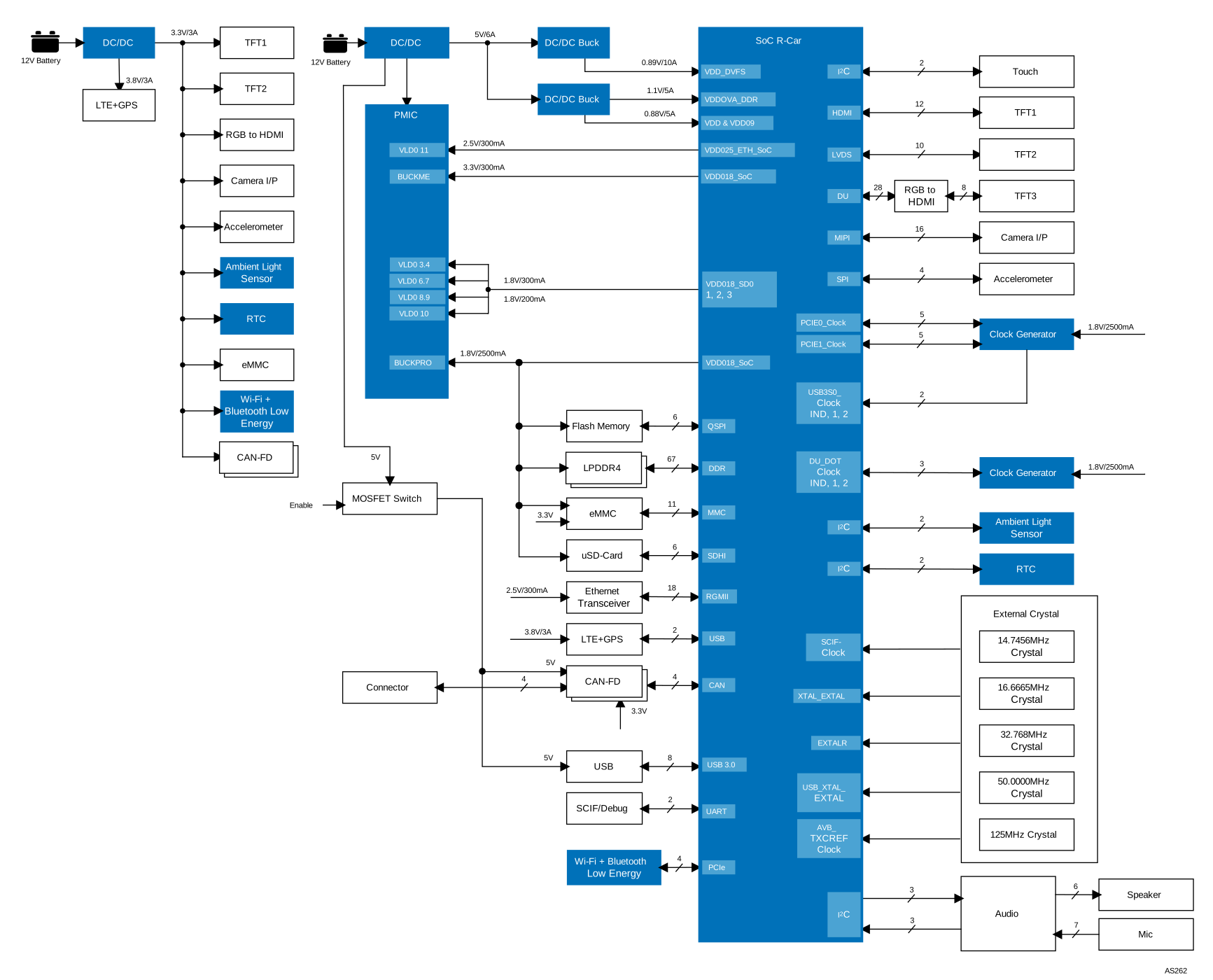
| コネクテッドAndroidベースの車両インストルメントクラスタ ワイヤレス接続とリアルタイムディスプレイを備えたAndroidベースの自動車コックピット。 | |
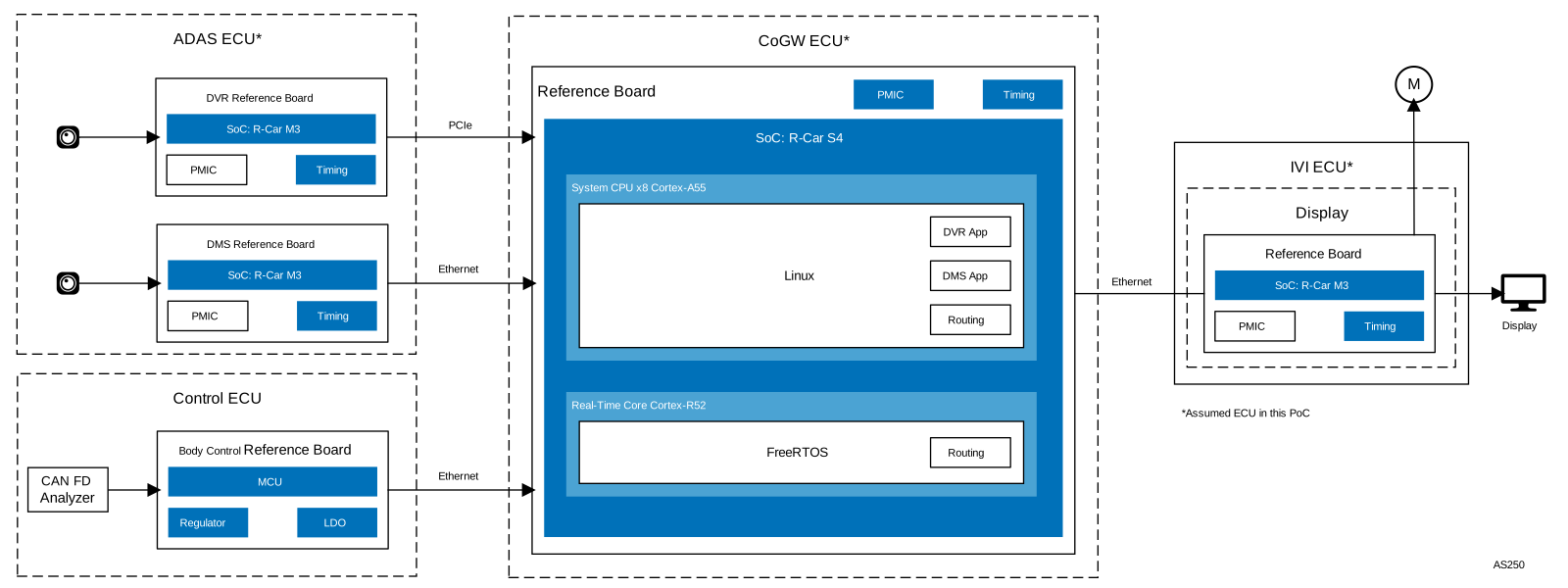
| 通信ゲートウェイおよび統合DVR/DMSシステム CoGWとDVR/DMSビデオ処理を統合した統合車載ゲートウェイ。 | |
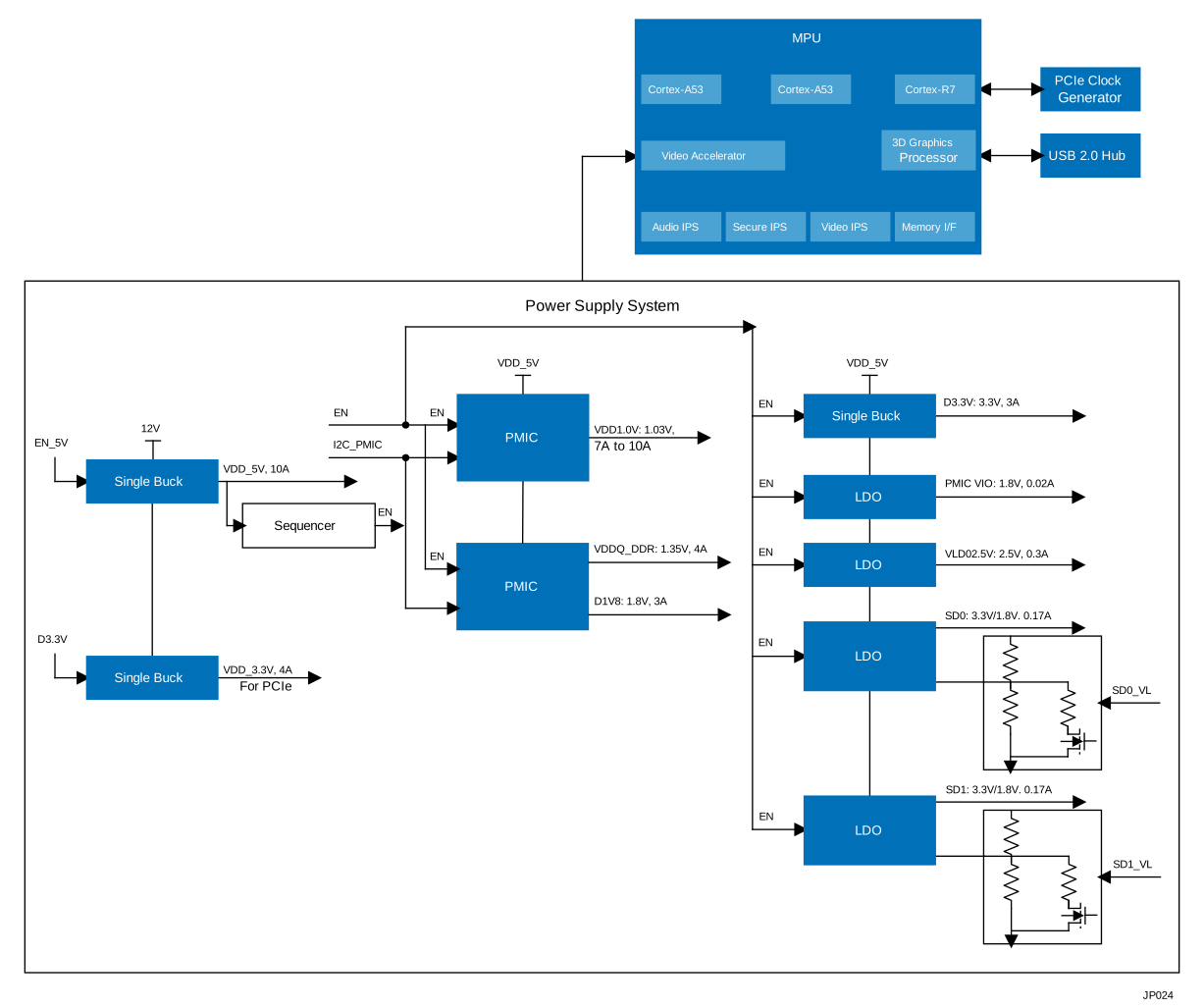
| ハプティクスを備えた自動車コックピットシステム 次世代の触覚、BroadLEDドライバ、PMICを備えた高度なコックピットシステム。 | |
| タイヤ空気圧監視システム PMICを内蔵した低電力Bluetooth LE TPMS設計により、コスト、サイズ、開発時間を短縮します。 | |
| フルグラフィックス クラスタ&コックピットシステム 自動車のコックピットでフルグラフィックス クラスタをサポートする高効率ディスプレイシステム。 | |
| ハイエンドコックピット&インフォテインメントソリューション | |
| 4Kビデオをサポートするフル機能HMI 高性能HMI設計により、シームレスな4Kビデオ、高度なグラフィックス、および信頼性の高いコネクティビティを実現します。 | |
| FHDビデオをサポートするフル機能HMI フル機能のHMIプラットフォームは、高性能MPUを備え、USB 3.0、PCI Express、およびギガビットイーサネットインタフェースを内蔵しています。 |
適用されたフィルター
フィルター
ソフトウェア/ツール
サンプルコード
シミュレーションモデル
Ron Wade, chief PCIe system architect explains the fundamental difference in reference clock jitter budgets between the first three generations of the specification and those of Gen4 and Gen5 which raise new challenges for designers.
Related Resources
This whiteboard video presents a brief overview comparing the evolution of PCI Express data rates through five generations versus that of the common clock jitter specifications.
Renesas's chief PCIe system architect explains how to derive separate reference clock jitter limits from the PCI Express Gen4 and Gen5 specifications.
A detailed overview of IDT's full-featured PCI Express (PCIe) clock and timing solutions. The presentation addresses PCIe Gen 1, Gen 2, Gen 3, and Gen 4 architectures and how IDT's industry-leading solutions provide all the functions, features, and performance required by the application.
Presented by Ron Wade, System Architect at IDT. For more information visit the PCIe clocks page.
This is the first video in our PCIe series. In this video, we define PCIe architectures, focusing on common and separate clock architectures. Watch the rest of the video series below where Ron will cover the impact of different timing architectures.
In this episode, Ron Wade from IDT (acquired by Renesas) explains PCIe common clocking and its impact on timing solutions. Learn about using a single clock source, fan-out buffers, and the considerations for spread spectrum and non-spread spectrum clocking in PCIe systems.
In this video, we explore PCIe with separate reference clocks and the effects of clock selection. Learn how separate reference clocks work and their impact on system performance and stability.
This video provides a high-level overview of Separate Reference Clock with Independent Spread (SRIS) architectures for PCI Express systems, additional performance requirements that this clocking architecture imposes on the reference clocks, and some system implications encountered trying to implement the architecture.
IDT provides a brief overview of the timing solutions optimized for various configurations using the NXP (Freescale) QorIQ / Layerscape processors.
Resources
IDT provides a brief tutorial on the timing solutions required for NXP (Freescale) QorIQ / Layerscape processor-based systems.
Presented by Ron Wade, PCI Express timing expert.
IDT (acquired by Renesas) engineer provides a brief tutorial describing the main differences between standard HCSL and low-power HCSL (LP-HCSL).
Presented by Ron Wade, PCI Express timing expert.
Related Resources
An overview of IDT's full-featured PCI Express (PCIe) clock generators addressing PCIe Gen 1, Gen 2, Gen 3, and Gen 4.
Presented by Ron Wade, System Architect at IDT.
An overview of PCI Express applications and how IDT's industry-leading portfolio of PCIe clock products addresses the requirements. The video briefly discusses PCIe riser cards, embedded SOC, and PCIe storage (NVME) examples.
Presented by Ron Wade, System Architect at IDT.
A brief overview of how data rates have changed from PCI Express (PCIe) Generation 1, Gen 2, Gen 3, Gen 4 and Gen 5.
Presented by Ron Wade, system architect at IDT. For more information about IDT's PCIe timing solutions, visit the PCI Express (PCIe) Clocks page.
A brief overview of how clock and timing specifications have changed from PCI Express (PCIe) Generation 1, Gen 2, Gen 3, Gen 4 and Gen 5.
Presented by Ron Wade, system architect at IDT (acquired by Renesas). For more information, visit Renesas's PCIe Timing Solutions page.
A brief overview of the PCI Express common clock (CC) jitter model, and the transfer functions as they relate to the timing PLLs. This model applies to PCI Express (PCIe) Gen 2, Gen 3, Gen 4 and Gen 5. The equations would be slightly different for other PCIe architectures, such as SRIS, SRnS, or data clocked.
Presented by Ron Wade, system architect at IDT (acquired by Renesas). For more information about Renesas's PCIe timing solutions, visit the PCI Express (PCIe) Clocks page.