メインコンテンツに移動
ルネサス エレクトロニクス株式会社 (Renesas Electronics Corporation)

Reinventing Belt Monitoring: How AI Detects Damage Before Failure

画像
Omar Shrit
Omar Shrit
Product Marketing, AI Core Technology
公開日:2026年7月3日

In industrial motor-driven systems, belts play a critical role in enabling the smooth and efficient transfer of mechanical power between rotating elements. These components connect two shafts, one driven by a motor and the other powered through a belt, to create a reliable belt drive system for a wide range of industrial applications.

Belts remain a preferred choice for engineers due to their high-power transmission efficiency, cost-effectiveness, and ease of installation and replacement. Available in various shapes, materials, and performance characteristics, they are designed to support diverse mechanical motions and system architectures.

However, like any mechanical component, belts degrade over time. Continuous operation exposes them to fatigue, tearing, and abrasion, often intensified by vibration, overload, and harsh environmental conditions. Even minor damage can lead to serious consequences, including reduced performance, elevated vibration, accelerated wear on adjacent components, and, in the worst-case scenarios, unexpected belt failure that disrupts an entire production line.

Belt tears can be difficult to detect while systems are still running, leading to unexpected downtime and costly maintenance. However, an AI-based approach can accurately detect belt damage without additional external sensors. This approach enables engineers to build smarter and more cost-efficient monitoring systems to keep industrial systems running at peak performance.

画像
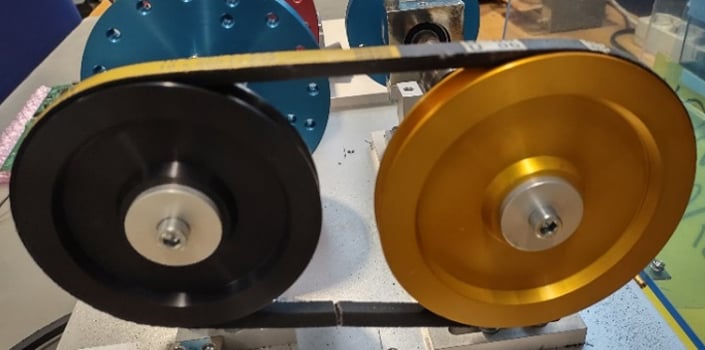
Image of a belt with a visible tear.
Figure 1. Belt with Visible tear
画像
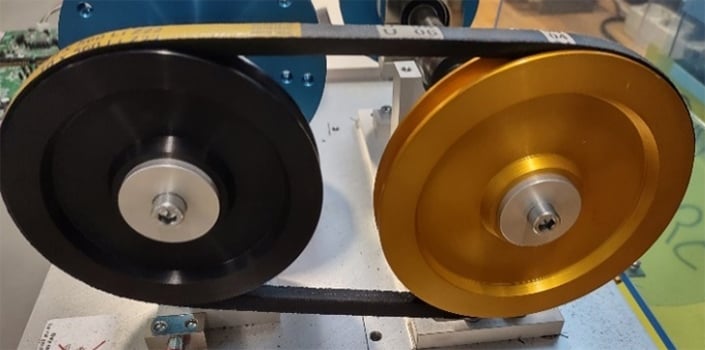
Image showing a belt in good condition with no tear.
Figure 2. Belt in Good Condition

As illustrated in the figures above, we compare two belts:

  • One with a minor structural defect (a small visible tear)
  • One in normal operating condition with no visible damage

In the next section, we demonstrate how our AI-powered approach successfully detects this subtle defect and present the results that highlight the accuracy and effectiveness of the method.

How Do We Detect Belt Damage?

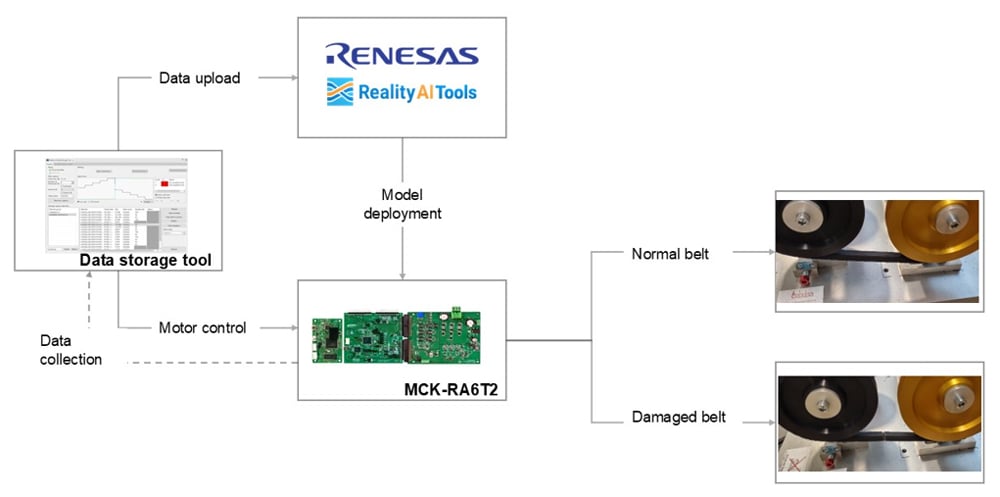
To evaluate the detection methodology, we built a controlled testbench using two belts: one in good condition and another with a visible tear. Each belt was mounted on a dual-shaft system.

This setup provides a precise and reliable platform for motor control and data acquisition.

画像
Flowchart showing the setup for a controlled testbench using two belts.
Figure 3. Set Up for a Controlled Testbench Using Two Belts

We collected baseline data with an undamaged belt, then repeated the process with a damaged belt. Following a fully sensorless approach, inverter voltage and current feedback were captured and used to train the AI model to detect belt damage.

Dataset Collection and AI Model Training

Build a robust, high-performance detection model workflow by combining the Renesas Reality AI Tools® cloud platform with the Data Storage Tool, integrated through Reality AI™ Utilities in e² studio. This workflow offers two key advantages:

  • Efficient dataset preparation, including signal visualization, noise identification, and automated dataset splitting.
  • Streamlined environment for training, optimizing, and fine-tuning AI models for accuracy and a minimal memory footprint.

The dataset was organized into two classes:

  • Normal Belt Class: Data from the undamaged belt
  • Damaged Belt Class: Data from the belt with a tear

After training, cross-validation using an independent dataset was performed to ensure model robustness and generalization. This step ensured that the final model size and computational footprint remained suitable for embedded implementation without compromising accuracy.

  • RAM: 9KB
  • ROM: 4.8KB
  • Cross-validation accuracy: 98%

Real-World Validation

To validate model performance, a physical testbench was deployed and tested under two different operating conditions:

  • Cold start tests: Short runs at ambient motor temperature
  • Thermal stability tests: Extended runs as motor temperature increased

Extensive testing under both conditions confirmed consistent detection performance across real-world operating environments.

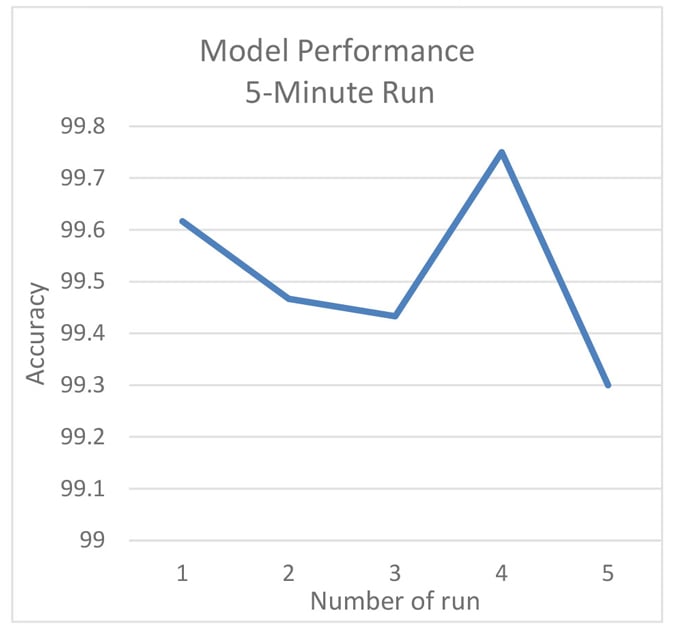
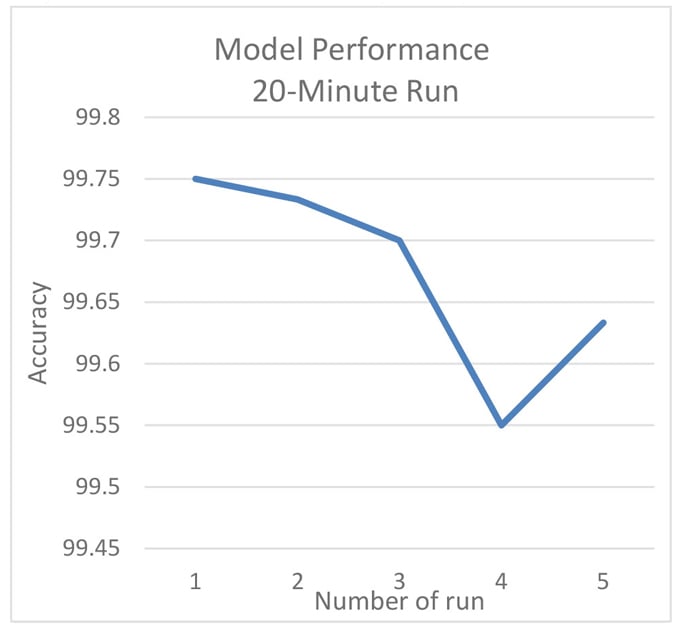
The figures below show the model performance in each condition:

  • Left: Cold-start performance
  • Right: Steady-state performance at elevated temperature
画像
Chart showing model accuracy vs. the number of short independent runs.
Figure 4. Model Accuracy vs. The Number of Short Independent Runs
画像
Chart showing model accuracy vs. the number of long independent runs.
Figure 5. Model Accuracy vs. The Number of Long Independent Runs

Conclusion

Industrial belt damage can lead to unexpected downtime, reduced reliability, and higher maintenance costs. This AI-powered, sensorless detection approach helps solve that challenge by enabling early identification of belt tears without additional sensors. As a result, engineers can move from scheduled inspections to continuous condition monitoring and respond to issues before they disrupt operations. By enabling earlier, smarter maintenance decisions, this approach helps engineers:

  • Reduces unplanned downtime
  • Improves equipment reliability
  • Optimizes maintenance cycles
  • Lowers overall operational costs

Ready to validate sensorless belt monitoring on your motor drive?
Request a demo and connect with Renesas Customer Success to explore how your inverter current/voltage signals can be leveraged to create a fast, efficient proof of concept (PoC).