Features
- Pin-compatible family allows easy design upgrades
- Excellent differential non-linearity (0.7LSB max)
- Low THD: -86dB (typ)
- Simple SPI-compatible serial digital interface
- Low 3mA operating current
- Power-down current between conversions 8µA (typ)
- +5.25V to +2.7V supply
- Excellent ESD survivability: 5kV HBM, 350V MM, 2kV CDM
Description
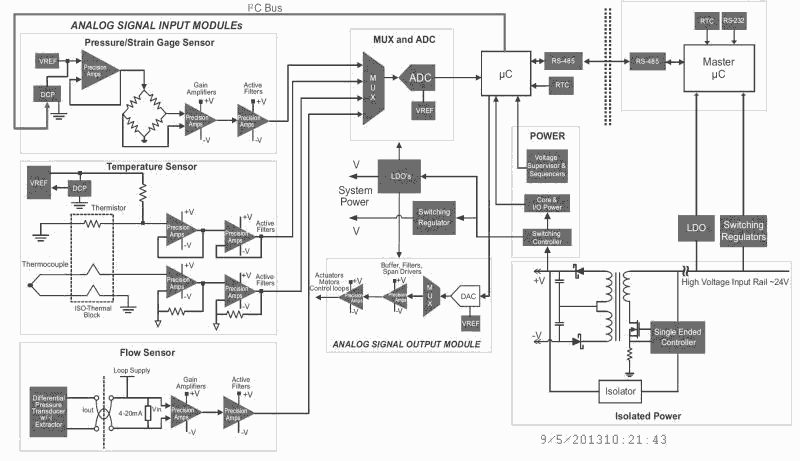
The ISL26320, ISL26321, ISL26322, ISL26323, ISL26324, ISL26325 and ISL26329 family of sampling SAR-type ADCs feature excellent linearity over supply and temperature variations, and offer versions with 1-, 2-, 4- and 8-channel single-ended inputs, and 1-, 2- and 4-channel differential inputs. A proprietary input multiplexer and combination buffer amplifier reduces the input drive requirements, resulting in lower cost and reduced board space. Specified measurement accuracy is maintained with input signals up to VDD. Members of the The ISL26320, ISL26321, ISL26322, ISL26323, ISL26324, ISL26325 and ISL26329 family of Low-Power ADCs offer pinout intercompatibility, differing only in the analog inputs, to support quick replication of proven layouts across multiple design platforms. The serial digital interface is SPI compatible and is easily interfaced to popular FPGAs and microcontrollers. Power consumption is limited to 15mW at a sampling rate of 250kSPS, and an operating current of just 8µA typical between conversions, when configured for Auto Power-down mode. The ISL26320, ISL26321, ISL26322, ISL26323, ISL26324, ISL26325 and ISL26329 feature up to 5kV Human Body Model ESD survivability and are available in the popular SOIC and TSSOP packages. Performance is specified for operation over the full industrial temperature range (-40°C to +125°C).
Applications
- Industrial process control
- Energy measurement
- Multichannel data acquisition systems
- Pressure sensors
- Flow controllers
| Part Number | Status | Samples | Stock | RoHS | Package | Lead Count (#) | Carrier Type | Moisture Sensitivity Level (MSL) | Pb (Lead) Free | Pb Free Category | Temp. Range (°C) |
|---|---|---|---|---|---|---|---|---|---|---|---|
| ISL26329FVZ | Obsolete | N/A | In Stock | RoHS:EN | TSSOP | 16# | Tube | 2 | Yes | Pb-Free 100% Matte Tin Plate w/Anneal-e3 | -40 to +125°C |
| ISL26329FVZ-T | Obsolete | N/A | Out of Stock | RoHS:EN | TSSOP | 16# | Reel | 2 | Yes | Pb-Free 100% Matte Tin Plate w/Anneal-e3 | -40 to +125°C |
| ISL26329FVZ-T7A | Obsolete | N/A | Out of Stock | RoHS:EN | TSSOP | 16# | Reel | 2 | Yes | Pb-Free 100% Matte Tin Plate w/Anneal-e3 | -40 to +125°C |
Filters
Applied Filters
- DatasheetPDF 1.32 MB isl26320-21-22-23-24-25-29 Oct 14, 2010
- Application NotePDF 843 KB an535 Jun 05, 2002AI-generated Summary: A Data Acquisition System (DAS) requires careful design of signal conditioning, transducer selection, and signal transmission to ensure high accuracy. Signal conditioning includes multiplexing, amplification, filtering, and calibration, ideally performed near the transducer. Transducers convert physical variables to electrical signals, often voltage, with low source resistance preferred. Signal paths can be single-ended or differential; differential paths better reject common mode noise, especially for low-level signals. Shielded twisted pairs and balanced lines reduce interference. Filters, typically Butterworth low-pass, prevent aliasing and maintain signal integrity.
- Application NotePDF 503 KB an9675 Aug 13, 1999AI-generated Summary: Effective Number of Bits (ENOB) depends critically on precise coherence in A/D sampling, with small frequency shifts significantly impacting accuracy. Unwrapping reconstructs coherently sampled sine waves, while windowing controls spectral leakage by shaping the acquisition window. Resampling and interpolation adjust sample sets to avoid leakage in FFT analysis. Different window functions balance side lobe levels and bandwidth, affecting spectral resolution and leakage reduction.
- Application NotePDF 1.08 MB an002 Nov 19, 1998AI-generated Summary: Data acquisition and conversion involve quantization, where the smallest resolvable analog difference (quantum) depends on the full scale range and resolution. Quantization introduces an irreducible error called quantizing error or noise. Aperture time, the conversion time uncertainty, causes amplitude errors when signals change during conversion. Sample-hold circuits reduce aperture time by storing sampled signals. The Sampling Theorem states that sampling frequency must be at least twice the highest signal frequency to avoid distortion from frequency folding or aliasing. Natural binary code is commonly used for digital representation in converters, with the most and least significant bits defining the code's resolution and value.
- Application NotePDF 287 KB an9705 Feb 21, 1997AI-generated Summary: Coherent sampling requires the ratio of signal frequency to sampling frequency to be a rational number, expressed as ko/N. When this condition is not met, frequency smearing occurs across bins. Data Acquisition Systems (DAS) can mitigate this by windowing, fixing sampling frequency and tuning input frequency, or fixing input frequency and tuning sampling frequency. The latter two methods are practical for most systems. Pseudo-code illustrates the frequency response for non-integer ko values.
- DatasheetPDF 1.32 MB isl26320-21-22-23-24-25-29 Oct 14, 2010
Recommended Documents (1)
- DatasheetPDF 1.32 MB isl26320-21-22-23-24-25-29 Oct 14, 2010
Datasheets (1)
No Results Found.
Make sure all keywords are spelled correctly.
Try fewer, different, or more general terms to vary your search.
If you have filters applied, consider deselecting some to broaden your results.
- Search our extensive knowledgebase, designed to help customers with their FAQs.
- Get help from our expert Renesas technical staff and community on our support forums.
- Application NotePDF 843 KB an535 Jun 05, 2002AI-generated Summary: A Data Acquisition System (DAS) requires careful design of signal conditioning, transducer selection, and signal transmission to ensure high accuracy. Signal conditioning includes multiplexing, amplification, filtering, and calibration, ideally performed near the transducer. Transducers convert physical variables to electrical signals, often voltage, with low source resistance preferred. Signal paths can be single-ended or differential; differential paths better reject common mode noise, especially for low-level signals. Shielded twisted pairs and balanced lines reduce interference. Filters, typically Butterworth low-pass, prevent aliasing and maintain signal integrity.
- Application NotePDF 503 KB an9675 Aug 13, 1999AI-generated Summary: Effective Number of Bits (ENOB) depends critically on precise coherence in A/D sampling, with small frequency shifts significantly impacting accuracy. Unwrapping reconstructs coherently sampled sine waves, while windowing controls spectral leakage by shaping the acquisition window. Resampling and interpolation adjust sample sets to avoid leakage in FFT analysis. Different window functions balance side lobe levels and bandwidth, affecting spectral resolution and leakage reduction.
- Application NotePDF 1.08 MB an002 Nov 19, 1998AI-generated Summary: Data acquisition and conversion involve quantization, where the smallest resolvable analog difference (quantum) depends on the full scale range and resolution. Quantization introduces an irreducible error called quantizing error or noise. Aperture time, the conversion time uncertainty, causes amplitude errors when signals change during conversion. Sample-hold circuits reduce aperture time by storing sampled signals. The Sampling Theorem states that sampling frequency must be at least twice the highest signal frequency to avoid distortion from frequency folding or aliasing. Natural binary code is commonly used for digital representation in converters, with the most and least significant bits defining the code's resolution and value.
- Application NotePDF 287 KB an9705 Feb 21, 1997AI-generated Summary: Coherent sampling requires the ratio of signal frequency to sampling frequency to be a rational number, expressed as ko/N. When this condition is not met, frequency smearing occurs across bins. Data Acquisition Systems (DAS) can mitigate this by windowing, fixing sampling frequency and tuning input frequency, or fixing input frequency and tuning sampling frequency. The latter two methods are practical for most systems. Pseudo-code illustrates the frequency response for non-integer ko values.
Application Notes & White Papers (4)
Product Notices (PCN, EOL, etc) (2)
No Results Found.
Make sure all keywords are spelled correctly.
Try fewer, different, or more general terms to vary your search.
If you have filters applied, consider deselecting some to broaden your results.
- Search our extensive knowledgebase, designed to help customers with their FAQs.
- Get help from our expert Renesas technical staff and community on our support forums.
No Results Found.
Make sure all keywords are spelled correctly.
Try fewer, different, or more general terms to vary your search.
If you have filters applied, consider deselecting some to broaden your results.
- Search our extensive knowledgebase, designed to help customers with their FAQs.
- Get help from our expert Renesas technical staff and community on our support forums.
No Results Found.
Make sure all keywords are spelled correctly.
Try fewer, different, or more general terms to vary your search.
If you have filters applied, consider deselecting some to broaden your results.
- Search our extensive knowledgebase, designed to help customers with their FAQs.
- Get help from our expert Renesas technical staff and community on our support forums.
No Results Found.
Make sure all keywords are spelled correctly.
Try fewer, different, or more general terms to vary your search.
If you have filters applied, consider deselecting some to broaden your results.
- Search our extensive knowledgebase, designed to help customers with their FAQs.
- Get help from our expert Renesas technical staff and community on our support forums.
No Results Found.
Make sure all keywords are spelled correctly.
Try fewer, different, or more general terms to vary your search.
If you have filters applied, consider deselecting some to broaden your results.
- Search our extensive knowledgebase, designed to help customers with their FAQs.
- Get help from our expert Renesas technical staff and community on our support forums.
No Results Found.
Make sure all keywords are spelled correctly.
Try fewer, different, or more general terms to vary your search.
If you have filters applied, consider deselecting some to broaden your results.
- Search our extensive knowledgebase, designed to help customers with their FAQs.
- Get help from our expert Renesas technical staff and community on our support forums.
Marketing Collateral (1)
No Results Found.
Make sure all keywords are spelled correctly.
Try fewer, different, or more general terms to vary your search.
If you have filters applied, consider deselecting some to broaden your results.
- Search our extensive knowledgebase, designed to help customers with their FAQs.
- Get help from our expert Renesas technical staff and community on our support forums.
No Results Found.
Make sure all keywords are spelled correctly.
Try fewer, different, or more general terms to vary your search.
If you have filters applied, consider deselecting some to broaden your results.
- Search our extensive knowledgebase, designed to help customers with their FAQs.
- Get help from our expert Renesas technical staff and community on our support forums.