

As consumers demand faster charging, longer ranges, and more cost-effective EVs, the role of the on-board charger (OBC) in the battery lifecycle has never been more critical.
Traditionally, EVs use a two-stage OBC architecture because it cleanly separates grid-side power quality control from battery-side isolation and regulation. The front-stage power factor correction (PFC) rectifier shapes the AC input and produces the high-voltage DC, while the rear-stage isolated DC/DC converter provides galvanic isolation and precisely conditions the voltage for safe battery charging. However, as 800V high-voltage platforms become mainstream and power ratings climb to 11kW and beyond, the limitations of this two-stage design, including bulk, inefficiency, and high costs, have become increasingly apparent.
The Two-Stage OBC: A Mature but Constrained Design
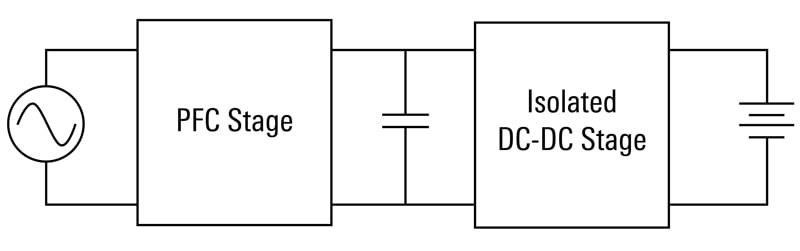
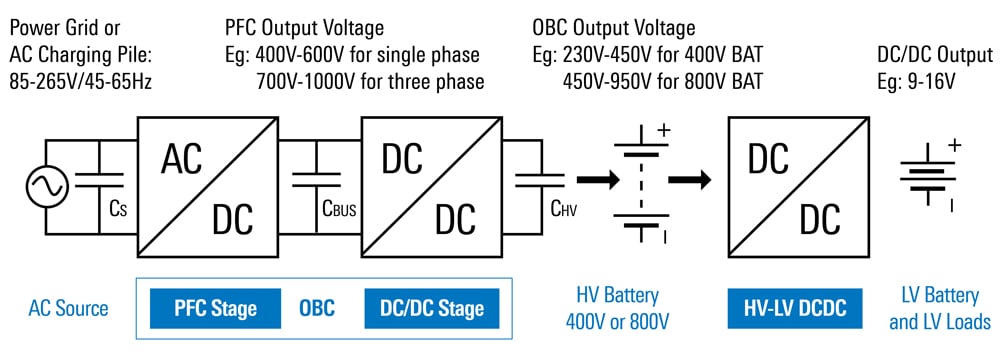
The two-stage OBC is the industry's workhorse, consisting of two sequential conversion stages:
- Front-stage PFC: Converts AC grid power to a stable DC bus voltage while achieving unity power factor (PF > 0.99) and low THD (< 5%), complying with international grid standards. Topologies like interleaved totem-pole PFC (with SiC/GaN devices) dominate here, offering high efficiency but requiring dedicated boost inductors and DC-link capacitors.
- Isolated DC/DC: Converts the DC bus voltage to the traction battery's required voltage (~500V to 900V for 800V systems) while providing galvanic isolation. Leading topologies include LLC resonant converters (for high efficiency) and dual active bridge (DAB) (for bidirectional Vehicle-to-Everything (V2X) functionality).
While this architecture is mature, it faces inherent limitations:
- Component redundancy: Two stages mean duplicated power devices, magnetic components, and control circuits, increasing BOM cost, size, and weight.
- Efficiency loss cascade: Even if each stage achieves 97% efficiency, the total system efficiency drops to 94.1%—a critical shortfall for high-power EVs.
- Reliability bottlenecks: Bulky electrolytic DC-link capacitors, the life-limiting component in two-stage designs, reduce overall system lifespan (typically 5 to 8 years).
- Power density limits: The need for large inductors, capacitors, and dual thermal management systems restricts power density, making it hard to meet the compact size requirements of modern EVs.
The Introduction of Single-Stage OBC DC/DC
Single-stage OBC DC/DC converters solve these problems by integrating PFC and isolated DC/DC conversion into a single power conversion stage. This eliminates the intermediate DC bus and its associated components.
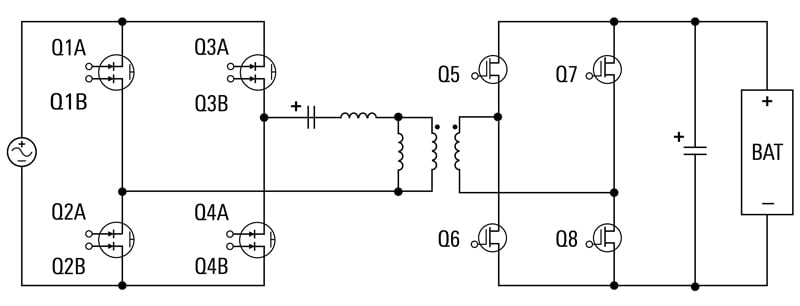
Matrix converter-based designs utilize bidirectional GaN switches to significantly reduce DC-link energy storage, enabling ultra-high power density but requiring advanced control algorithms.
Key enablers for a single-stage design adoption are wide-bandgap (WBG) semiconductors (SiC/GaN). These devices support higher switching frequencies (up to 900kHz for GaN), reduce switching losses, and enable compact magnetic components, which are critical for compensating for the higher control complexity of single-stage topologies.
Advantages of Single-Stage OBC DC/DC Converters
Single-stage OBC DC/DC converters deliver transformative benefits across efficiency, size, cost, and functionality to address the most pressing needs of next-gen EVs.
Unprecedented Power Density: Compact Design for EV Packaging
The most immediate advantage is a dramatic reduction in size and weight. By eliminating the DC-link capacitor, boost inductor, and redundant components, single-stage designs reduce the overall volume of the OBC by up to 50% compared to two-stage equivalents.
Higher System Efficiency
Single-stage conversion cuts out the intermediate DC bus loss, delivering up to a 2% boost in total system efficiency. Key efficiency drivers include:
- Single power conversion: Eliminates the two-stage loss cascade.
- Wide ZVS range: WBG devices enable zero-voltage switching with a wide ZVS operating range, minimizing switching losses.
- Reduced conduction losses: Fewer semiconductors and lower RMS currents reduce conduction losses.
Lower BOM Cost
While WBG semiconductors add upfront cost, the reduction in passive components (inductors, capacitors) and power devices offsets this significantly.
Additional cost benefits include:
- Simplified thermal management: A single thermal loop reduces cooling system complexity and cost.
- Fewer PCB layers and assembly steps: Streamlines manufacturing and reduces production time.
Enhanced Reliability: Extending System Lifespan
Electrolytic DC link capacitors are a major reliability bottleneck in two-stage OBCs, typically lasting only 5 to 8 years. Single-stage designs avoid these large electrolytics altogether, using long-life film capacitors, or, in matrix converter topologies, entirely eliminating the DC link capacitor.
This helps boost system reliability, reduce maintenance costs and warranty claims, and improve resilience to high-temperature operating environments (up to 125°C).
Current Challenges and Future Outlook
While single-stage OBC DC/DC converters offer transformative benefits, they are not without challenges. The primary barrier is increased control complexity, including:
- EMI design complexity: Higher switching frequencies and single-stage conversion require more sophisticated EMI filtering to meet automotive EMC standards.
- Control algorithm tuning: Calibrating single-stage controllers for wide input/output voltage ranges demands significant engineering resources.
However, these challenges are being addressed through rapid technological advancements. Intelligent algorithms optimize modulation strategies in real time, simplifying tuning and improving performance, while co-design of transformers and inductors reduces size and EMI, further boosting power density. In addition, as SiC/GaN production scales, the cost premium for WBG-based single-stage designs is narrowing.
Conclusion
The single-stage OBC DC/DC converter represents the next frontier in EV charging technology. By merging PFC and isolated DC/DC conversion into a single stage, it addresses the core limitations of traditional two-stage designs, such as size, inefficiency, and cost, while unlocking new capabilities like bidirectional V2X functionality.
To learn more about Renesas' OBC DC/DC converter solution, visit Electric & Hybrid Vehicles (EV/HEV).