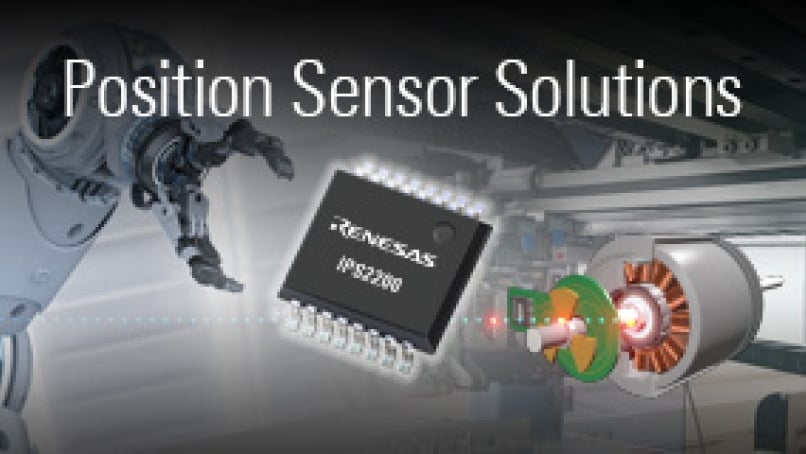
The automotive industry is in the midst of a historic transformation. Electrification, autonomous driving, and software-defined architectures are reshaping vehicle design and functionality. Among the most critical innovations enabling this shift are X-by-Wire systems, electronic replacements for mechanical linkages in steering, braking, throttling, and transmission and high-speed motor commutation for electric powertrains.

*Source: Automotive X-by-Wire Systems Market Size Report, 2030
These technologies promise lighter, safer, and more efficient vehicles, but they also introduce new engineering challenges that traditional sensing solutions struggle to meet.
Key Challenges in Modern Automotive Systems
- Functional Safety at Scale: Steering and braking are safety-critical functions. Any failure can lead to catastrophic accidents. ISO 26262 compliance and achieving ASIL D (Automotive Safety Integrity Level) for these systems is mandatory. Scaling safety across multiple platforms and architectures while maintaining cost efficiency is key. Sensors must provide redundant channels, diagnostics, and fail-safe mechanisms.
- Electromagnetic Immunity: EV powertrains and high-voltage systems generate strong stray magnetic fields. Conventional magnetic sensors (Hall-effect, magnetoresistive) can suffer from signal distortion or failure. Sensors that are inherently immune to magnetic interference ensure reliable operation in harsh EV environments.
- Compact, Lightweight Designs: OEMs aim to reduce weight for better efficiency and range. Therefore, position sensors must fit into tight spaces without compromising accuracy or robustness. This implies that slim, PCB-based inductive sensors replace bulky resolvers or magnet-based systems.
- High-Speed Performance: Electric traction motors and steer-by-wire actuators operate at electrical speeds up to 600k rpm. The requirements on the sensors are tight, i.e., ultra-low latency (<100ns) and high resolution for precise commutation and control. Any delay or error can cause torque ripple, vibration, or safety hazards.
- Cost and Sustainability: Rare-earth magnets used in traditional sensors are expensive and environmentally problematic. The target is to reduce dependency on magnets and simplify mechanical design. Thus, magnet-free inductive sensors offer lower cost, improve recyclability, and support sustainability goals.
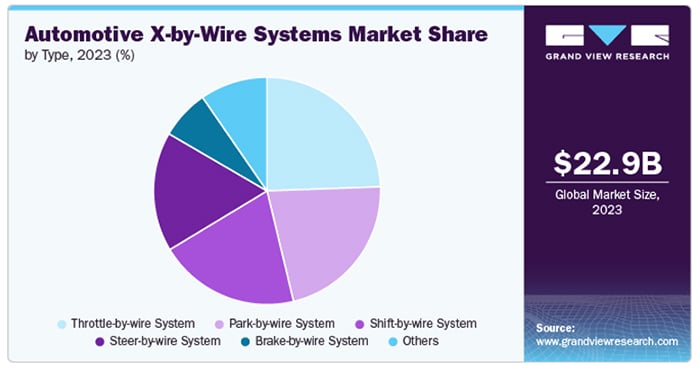
*Source: Automotive X-by-Wire Systems Market Size Report, 2030
Renesas Inductive Position Sensors: A Game-Changer
Renesas' newly announced Inductive Position Sensor (IPS) ICs, including the automotive-grade RAA2P452x and RAA2P4500, deliver a breakthrough solution for these challenges. Leveraging magnet-free inductive technology, these sensors provide:
- Stray Field Immunity: IPS technology is inherently immune to magnetic interference, making it ideal for EV environments.
- High Accuracy & Speed: Up to 19-bit resolution and propagation delays under 100ns ensure precise control for high-speed motor commutation.
- Flexible Configurations: Supports on-axis, off-axis, through-shaft, and side-shaft designs for steering, braking, and traction applications.
- Slim, Lightweight Form Factor: Perfect for space-constrained automotive systems.
- ISO 26262 Compliance: Enables ASIL C/D system-level safety requirements.
- Maintenance-Free Operation: No magnets, no wear, no recalibration, reducing lifetime costs.
Combined with Renesas MCUs, gate drivers, and motor drivers, IPS ICs enable complete solutions for steer-by-wire, brake-by-wire, and traction motor control.
Why Inductive Technology Wins
Compared to magnetic or optical encoders, inductive sensors thrive in harsh automotive environments:
- Immune to dust, moisture, vibration, and EMI.
- No rare-earth magnets, lower cost, and environmental impact.
- Long-term stability and reduced service needs.
This makes IPS the ideal choice for next-generation EV and ADAS platforms.
Accelerate Your Design with the Inductive Position Sensor Coil Optimizer
To simplify customization, Renesas offers the Inductive Position Sensor Coil Optimizer, a powerful web-based design tool that:
- Automates coil layout and simulation.
- Predicts linearity error and inductance.
- Provides Gerber files for PCB manufacturing.
- Supports rotary, linear, and arc motion templates.
- Enables engineers to achieve optimal performance without manual trial-and-error.
Start designing today: Inductive Position Sensor Coil Optimizer
The Road Ahead
As vehicles become smarter, safer, and more electric, position sensing is mission-critical. Renesas inductive position sensors deliver the precision, robustness, and flexibility needed for next-generation automotive systems, empowering OEMs to meet the demands of X-by-Wire and high-speed motor commutation with confidence.
Learn more about our Inductive Position Sensor portfolio and design resources