
Features
- Dual solid-state potentiometers
- Individual Up/Down interfaces
- 32 wiper tap points per potentiometer
- Wiper position stored in nonvolatile memory and recalled on power-up
- 31 resistive elements per potentiometer
- Temperature compensated
- Maximum resistance tolerance of ±25%
- Terminal voltage, 0 to VCC
- Low power CMOS
- VCC = 2.7V to 5.5V.
- Active current, 200µA typical per potentiometer
- Standby current, 4µA max per potentiometer
- High reliability
- Endurance 200,000 data changes per bit
- Register data retention, 100 years
- RTOTAL value = 12.5kΩ, 50kΩ
- Package
- 14 Ld TSSOP
- Pb-free available (RoHS compliant)
Description
Support is limited to customers who have already adopted these products.
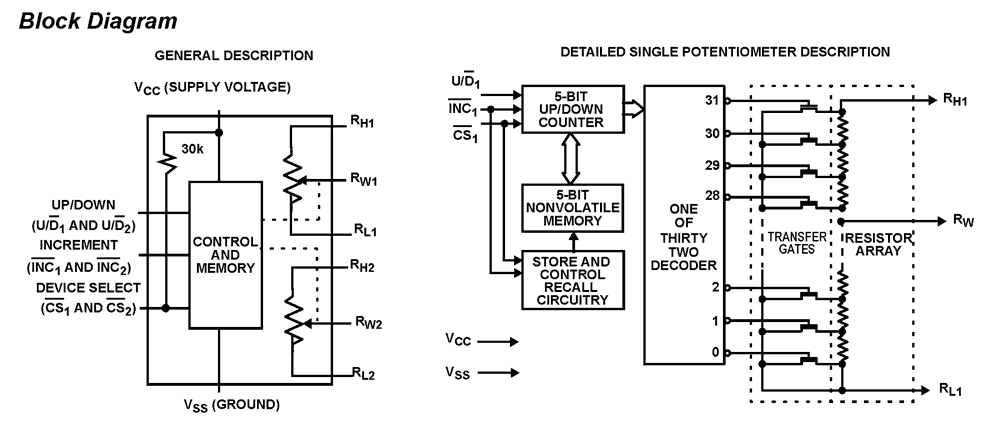
The Intersil X93256 is a dual digitally controlled potentiometer (XDCP). The device consists of two resistor arrays, wiper switches, a control section, and nonvolatile memory. The wiper positions are controlled by individual Up/Down interfaces. A potentiometer is implemented by a resistor array composed of 31 resistive elements and a wiper switching network. The position of each wiper element is controlled by a set of independent CS, U/D, and INC inputs. The position of the wiper can be stored in nonvolatile memory and then be recalled upon a subsequent power-up operation. Each potentiometer is connected as a three-terminal variable resistor and can be used in a wide variety of applications including:
- Bias and Gain control
- LCD Contrast Adjustment
| Part Number | Status | Samples | Stock | Package | Carrier Type | MOQ |
|---|---|---|---|---|---|---|
| X93256UV14IZ-2.7 | Obsolete | N/A | Out of Stock | TSSOP | Tube | 2280 |
| X93256UV14IZ-2.7T1 | Obsolete | N/A | In Stock | TSSOP | Reel | 2500 |
| X93256WV14IZ-2.7 | Obsolete | N/A | In Stock | TSSOP | Tube | 2280 |
| X93256WV14IZ-2.7T1 | Obsolete | N/A | Out of Stock | TSSOP | Reel | 2500 |
Filters
Applied Filters
- Manual - Development ToolsPDF 2.16 MB AN1555 Sep 17, 2025
- End Of Life NoticePDF 292 KB PLC17007 Feb 15, 2017
- Application NotePDF 281 KB an1425 May 22, 2008AI-generated Summary: Digitally Controlled Potentiometers (DCPs) offer precise resistance control with configurations in both serial and parallel modes, featuring fixed resistors and various resistance options. The ISL22317 model provides 1% precision with 128 taps and can function as a two-terminal variable resistor or three-terminal potentiometer, delivering high accuracy and low temperature coefficient. DCPs can outperform DACs in fine tuning within limited ranges, offering better resolution with fewer bits. Resolution varies with voltage and tap count, as detailed in the provided tables. Usage guidelines and liability disclaimers emphasize proper application and safety considerations.
- Application NotePDF 207 KB an1151 Jul 12, 2005AI-generated Summary: The document details 80C31 microcontroller routines for controlling the X9241 quad EEPROM. It defines pin assignments for SCL and SDA, register usage, and instruction handling via an interpret routine that decodes and executes commands such as reading and writing WCR and data registers. The code includes jump vectors, instruction generators, and specific subroutines for EEPROM operations like data transfer and wiper position incrementing.
- Application NotePDF 534 KB an133 Jun 06, 2005AI-generated Summary: The document explains how digitally controlled potentiometers (XDCPs) enable programmability in amplifier circuits by adjusting cutoff frequency and gain. It details the design of a non-inverting amplifier with variable resistors forming an RC low pass filter and gain control. Techniques to reduce potentiometer resistance for high-frequency applications are described, allowing gain from 1 to 2 and cutoff frequency from 130kHz to over 1MHz. The amplifier’s parameters are controlled via a serial bus, enabling computer-based customization.
- Application NotePDF 460 KB an134 May 04, 2005AI-generated Summary: Programmable Tee Networks utilize digitally-controlled potentiometers to adjust filter characteristics such as gain and cutoff frequency dynamically. The wiper position, represented by k (0 to 1), controls the potentiometer resistance, enabling programmable gain and frequency responses in amplifier and Sallen-Key low pass filters. These networks allow precise tuning of filter parameters, overcoming component tolerance limitations. Devices like the Intersil XDCP and X9418 provide digital interfaces (3-wire, SPI, I2C) for programming and storing settings, facilitating applications in audio, control, and signal processing.
- Application NotePDF 467 KB an1149 May 03, 2005AI-generated Summary: The document details circuits using Intersil digitally controlled potentiometers (X9C103, X9312) combined with op amps (LT1226, OP37, LT1028) for applications like null adjustment, amplifier biasing, and proportional-integral temperature control. It explains modes controlled by NADJ/ADJ signals, automatic nulling via feedback loops, and bias stabilization in high-output buffer amplifiers. The circuits optimize gain, bandwidth, noise, and minimize distortion and power consumption. It also covers clocking options for nulling and temperature control using digital potentiometers and comparators.
- Application NotePDF 398 KB an1158 May 02, 2005AI-generated Summary: Electromigration significantly affects the reliability of digitally controlled potentiometers (XDCPs), with current density and temperature playing key roles. A 1mA wiper current limit ensures long-term reliability, though CMOS devices can tolerate up to 3.5mA. Techniques like voltage follower op amps boost output current and voltage range. XDCPs avoid mechanical hysteresis, offer independent linearity around 1%, and have a typical MTBF of over 2000 years. Differences between NMOS and CMOS XDCPs include standby modes and switching behavior. Logarithmic taper options and frequency response characteristics vary by model.
- Application NotePDF 280 KB an1157 Apr 29, 2005AI-generated Summary: Digitally controlled potentiometers (XDCPs) enable precise power supply and DC to DC converter control by allowing cascading configurations for fine and coarse voltage adjustments. These devices store wiper settings in nonvolatile memory, ensuring long-term reliability and simplifying manufacturing and testing. XDCPs improve repeatability, reduce human error, and enhance resistance to environmental stress, making them superior to mechanical potentiometers in power applications.
- Application NotePDF 324 KB an124 Apr 27, 2005AI-generated Summary: Digitally-controlled potentiometers have key analog parameters including number of taps (16 to 256), end-to-end resistance (1kΩ to 1MΩ), wiper resistance (~40Ω), wiper current (1-3mA), power rating (10-50mW), resolution, noise, linearity, and temperature coefficients. Voltage limits range from ±5V to ±15V on pins. Absolute linearity ensures accuracy within one least significant bit, while relative linearity guarantees tap-to-tap accuracy within 0.2 LSB. Temperature coefficients affect resistance stability. Various circuit techniques exist to mitigate these limitations. The document also includes usage notices, quality grades, and liability disclaimers from Renesas Electronics.
- Application NotePDF 243 KB an175 Apr 23, 2005AI-generated Summary: The document outlines important legal disclaimers and usage guidelines for semiconductor products. It emphasizes user responsibility for product design and safety, disclaims liability for damages, and clarifies intellectual property rights. It categorizes products into standard and high-quality grades with intended applications. It advises compliance with usage conditions, laws, and export controls, and warns against unauthorized modifications or use in life-critical systems. Contact information for Renesas Electronics sales offices worldwide is provided.
- Application NotePDF 275 KB an88 Apr 23, 2005AI-generated Summary: The document provides important legal and usage notices for semiconductor products, emphasizing user responsibility for design incorporation and compliance with laws. It disclaims liability for damages from misuse, alteration, or intellectual property infringement. Products are categorized into Standard and High Quality grades, with specific application guidelines. Users must follow specified operating conditions and implement safety measures. Environmental and export regulations compliance is required. Contact information for global Renesas sales offices is provided.
Recommended Documents (1)
Datasheets (1)
- Manual - Development ToolsPDF 2.16 MB AN1555 Sep 17, 2025
Manuals & Guides (1)
- Application NotePDF 281 KB an1425 May 22, 2008AI-generated Summary: Digitally Controlled Potentiometers (DCPs) offer precise resistance control with configurations in both serial and parallel modes, featuring fixed resistors and various resistance options. The ISL22317 model provides 1% precision with 128 taps and can function as a two-terminal variable resistor or three-terminal potentiometer, delivering high accuracy and low temperature coefficient. DCPs can outperform DACs in fine tuning within limited ranges, offering better resolution with fewer bits. Resolution varies with voltage and tap count, as detailed in the provided tables. Usage guidelines and liability disclaimers emphasize proper application and safety considerations.
- Application NotePDF 207 KB an1151 Jul 12, 2005AI-generated Summary: The document details 80C31 microcontroller routines for controlling the X9241 quad EEPROM. It defines pin assignments for SCL and SDA, register usage, and instruction handling via an interpret routine that decodes and executes commands such as reading and writing WCR and data registers. The code includes jump vectors, instruction generators, and specific subroutines for EEPROM operations like data transfer and wiper position incrementing.
- Application NotePDF 534 KB an133 Jun 06, 2005AI-generated Summary: The document explains how digitally controlled potentiometers (XDCPs) enable programmability in amplifier circuits by adjusting cutoff frequency and gain. It details the design of a non-inverting amplifier with variable resistors forming an RC low pass filter and gain control. Techniques to reduce potentiometer resistance for high-frequency applications are described, allowing gain from 1 to 2 and cutoff frequency from 130kHz to over 1MHz. The amplifier’s parameters are controlled via a serial bus, enabling computer-based customization.
- Application NotePDF 460 KB an134 May 04, 2005AI-generated Summary: Programmable Tee Networks utilize digitally-controlled potentiometers to adjust filter characteristics such as gain and cutoff frequency dynamically. The wiper position, represented by k (0 to 1), controls the potentiometer resistance, enabling programmable gain and frequency responses in amplifier and Sallen-Key low pass filters. These networks allow precise tuning of filter parameters, overcoming component tolerance limitations. Devices like the Intersil XDCP and X9418 provide digital interfaces (3-wire, SPI, I2C) for programming and storing settings, facilitating applications in audio, control, and signal processing.
- Application NotePDF 467 KB an1149 May 03, 2005AI-generated Summary: The document details circuits using Intersil digitally controlled potentiometers (X9C103, X9312) combined with op amps (LT1226, OP37, LT1028) for applications like null adjustment, amplifier biasing, and proportional-integral temperature control. It explains modes controlled by NADJ/ADJ signals, automatic nulling via feedback loops, and bias stabilization in high-output buffer amplifiers. The circuits optimize gain, bandwidth, noise, and minimize distortion and power consumption. It also covers clocking options for nulling and temperature control using digital potentiometers and comparators.View More (21)
Application Notes & White Papers (21)
- End Of Life NoticePDF 292 KB PLC17007 Feb 15, 2017
Product Notices (PCN, EOL, etc) (3)
No Results Found.
Make sure all keywords are spelled correctly.
Try fewer, different, or more general terms to vary your search.
If you have filters applied, consider deselecting some to broaden your results.
- Search our extensive knowledgebase, designed to help customers with their FAQs.
- Get help from our expert Renesas technical staff and community on our support forums.
No Results Found.
Make sure all keywords are spelled correctly.
Try fewer, different, or more general terms to vary your search.
If you have filters applied, consider deselecting some to broaden your results.
- Search our extensive knowledgebase, designed to help customers with their FAQs.
- Get help from our expert Renesas technical staff and community on our support forums.
Schematics & Design Files (1)
No Results Found.
Make sure all keywords are spelled correctly.
Try fewer, different, or more general terms to vary your search.
If you have filters applied, consider deselecting some to broaden your results.
- Search our extensive knowledgebase, designed to help customers with their FAQs.
- Get help from our expert Renesas technical staff and community on our support forums.
No Results Found.
Make sure all keywords are spelled correctly.
Try fewer, different, or more general terms to vary your search.
If you have filters applied, consider deselecting some to broaden your results.
- Search our extensive knowledgebase, designed to help customers with their FAQs.
- Get help from our expert Renesas technical staff and community on our support forums.
No Results Found.
Make sure all keywords are spelled correctly.
Try fewer, different, or more general terms to vary your search.
If you have filters applied, consider deselecting some to broaden your results.
- Search our extensive knowledgebase, designed to help customers with their FAQs.
- Get help from our expert Renesas technical staff and community on our support forums.
Marketing Collateral (1)
Other (1)
No Results Found.
Make sure all keywords are spelled correctly.
Try fewer, different, or more general terms to vary your search.
If you have filters applied, consider deselecting some to broaden your results.
- Search our extensive knowledgebase, designed to help customers with their FAQs.
- Get help from our expert Renesas technical staff and community on our support forums.
Filters
Applied Filters
Software & Tools
Filter by Type
Filter by Provider
Sample Code
Filter by Application
Filter by Function
Filter by Compiler
Filter by IDE
Simulation Models
Partner Solutions
No Results Found.
Make sure all keywords are spelled correctly.
Try fewer, different, or more general terms to vary your search.
If you have filters applied, consider deselecting some to broaden your results.
- Search our extensive knowledgebase, designed to help customers with their FAQs.
- Get help from our expert Renesas technical staff and community on our support forums.
Software & Tools (2)
No Results Found.
Make sure all keywords are spelled correctly.
Try fewer, different, or more general terms to vary your search.
If you have filters applied, consider deselecting some to broaden your results.
- Search our extensive knowledgebase, designed to help customers with their FAQs.
- Get help from our expert Renesas technical staff and community on our support forums.
No Results Found.
Make sure all keywords are spelled correctly.
Try fewer, different, or more general terms to vary your search.
If you have filters applied, consider deselecting some to broaden your results.
- Search our extensive knowledgebase, designed to help customers with their FAQs.
- Get help from our expert Renesas technical staff and community on our support forums.
No Results Found.
Make sure all keywords are spelled correctly.
Try fewer, different, or more general terms to vary your search.
If you have filters applied, consider deselecting some to broaden your results.
- Search our extensive knowledgebase, designed to help customers with their FAQs.
- Get help from our expert Renesas technical staff and community on our support forums.

Support Communities


