Features
- Up to 87% efficiency
- 2.3V to 5.5V input
- Up to 28V output
- 50mA at 18V
- Integrated boost Schottky diode
- Input voltage disconnect switch
- Synchronization input
- Chip enable
- 10 Ld 3x3 DFN package
- Pb-free (RoHS compliant)
Description
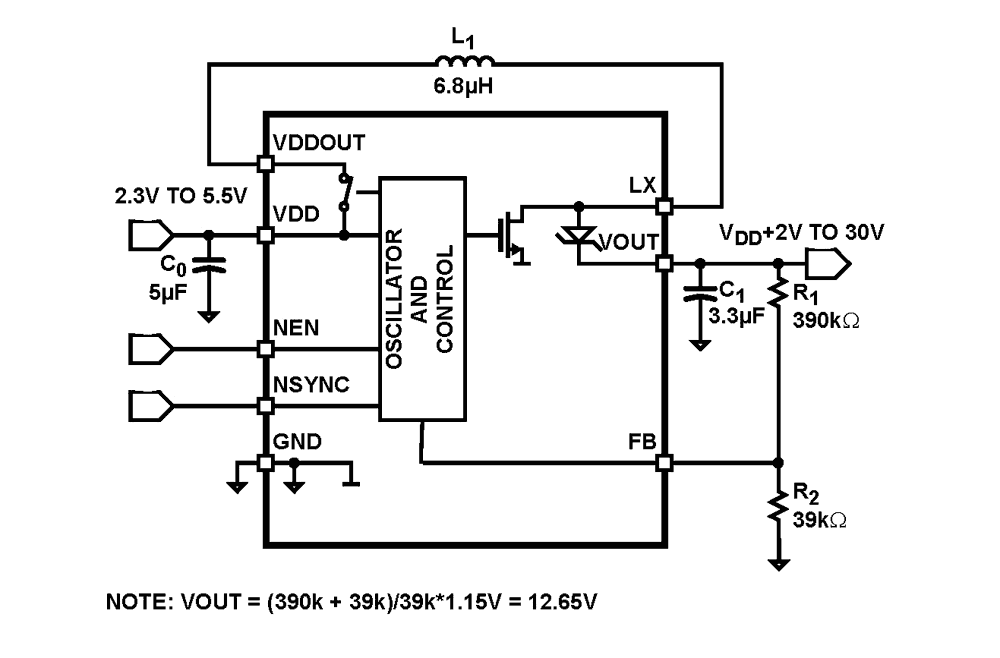
The ISL97701 represents a high efficiency boost converter with integrated boost FET, boost diode and input disconnect FET. With an input voltage of 2. 3V to 5. 5V the ISL97701 has an output capability of up to 50mA at 18V using integrated 500mA switches. Efficiencies are up to 87%. The integrated protection FET is used to disconnect the boost inductor from the input supply whenever an output fault condition is detected, or when the device is disabled. This gives 0 output current in the disabled mode, compared to standard boost converters where current can still flow when the device is disabled. The ISL97701 comes in the 10 Ld 3x3 DFN package and is specified for operation over the -40°C to +85°C temperature range.
Applications
- OLED display power
- LED display power
- Adjustable power supplies
| Part Number | Status | Samples | Stock | RoHS | Package | Lead Count (#) | Carrier Type | Moisture Sensitivity Level (MSL) | Pb (Lead) Free | Pb Free Category | Temp. Range (°C) |
|---|---|---|---|---|---|---|---|---|---|---|---|
| ISL97701IRZ | Obsolete | N/A | Out of Stock | RoHS:EN | DFN | 10# | Tube | 3 | Yes | Pb-Free 100% Matte Tin Plate w/Anneal-e3 | -40 to +85°C |
| ISL97701IRZ-T13 | Obsolete | N/A | Out of Stock | RoHS:EN | DFN | 10# | Reel | 3 | Yes | Pb-Free 100% Matte Tin Plate w/Anneal-e3 | -40 to +85°C |
| ISL97701IRZ-T7 | Obsolete | N/A | In Stock | RoHS:EN | DFN | 10# | Reel | 3 | Yes | Pb-Free 100% Matte Tin Plate w/Anneal-e3 | -40 to +85°C |
Filters
Applied Filters
- Application NotePDF 592 KB an9208 Feb 01, 2018AI-generated Summary: The document discusses high frequency power converters, focusing on ZVS-QRC and multi-resonant topologies that reduce switching losses by operating switches at zero voltage. It highlights challenges like EMI and high voltage stress. The SEPIC converter is introduced, explaining its ability to buck or boost voltage without polarity inversion. The document details SEPIC’s operating modes, voltage-current relationships, and the importance of inductor values for continuous or discontinuous conduction modes.
- Product Change NoticePDF 398 KB PCN15046 Jan 07, 2016
- Product Change NoticePDF 248 KB PCN10055 Jun 30, 2010
- Application NotePDF 397 KB an1684 Jan 19, 2004AI-generated Summary: The document outlines important legal disclaimers and usage guidelines for semiconductor products. It emphasizes user responsibility for product design and safety, disclaims liability for damages, and clarifies no intellectual property licenses are granted. Products are categorized by quality grades with specific application recommendations. Users must comply with laws, avoid unauthorized modifications, and ensure safe use within specified conditions. Contact details for Renesas Electronics sales offices worldwide are provided.
- Application NotePDF 509 KB an1681 Jan 19, 2004AI-generated Summary: The document explains grounding techniques for PCB layouts using a dual op amp example on a single-layer copper board. It compares three grounding schemes: a center spine ground trace, an outer ground plane, and a split/star ground plane, highlighting the benefits of single-point grounding to minimize noise and antenna effects. It emphasizes following current paths, minimizing loop lengths, and ensuring close forward and return paths to reduce interference. The document also includes disclaimers on product use, quality grades, safety, and legal compliance.
- Application NotePDF 382 KB an1673 Jan 19, 2004AI-generated Summary: The document explains the design and operation of a circuit generating positive and negative voltage supplies using a boost regulator. It details the calculation of minimum inductor values to maintain continuous conduction mode for efficiency, the importance of low ESR output capacitors to reduce voltage ripple, and the charging mechanism of the negative supply capacitor. Output voltage regulation is achieved using two op amps, with design restrictions on current and inductor ranges to ensure optimal performance. The document also includes disclaimers on product use and safety.
- Application NotePDF 650 KB an9210 Dec 21, 2001AI-generated Summary: This document presents a new PSPICE subcircuit model for power MOSFETs with global temperature options. It details synchronous rectifier circuit operation, including gate biasing and conduction modes. The model accurately simulates switching waveforms, diode recovery, and temperature-dependent efficiency. Measured and modeled data show excellent correlation for output characteristics, threshold voltage, breakdown voltage, and on-resistance across temperature ranges. Limitations in linear mode modeling are noted due to PSPICE assumptions.
- Application NotePDF 387 KB an9209 Aug 13, 1998AI-generated Summary: The document presents an empirical SPICE-2 subcircuit model for power MOSFETs, accurately simulating static and dynamic behaviors including first and third-quadrant operations and avalanche breakdown. The model aligns closely with measured data and is compatible with all SPICE versions without code modification. It uses parameters derived from datasheets or simple measurements. The document also includes detailed comparisons of measured and calculated curves for transfer, output, switching, and diode recovery characteristics. Additionally, it provides legal and usage disclaimers from Renesas Electronics.
- Application NotePDF 349 KB an7244 Aug 12, 1998AI-generated Summary: Power MOSFETs feature a positive temperature coefficient of resistance, enhancing stability and preventing thermal runaway by increasing resistance as temperature rises. Their gate terminals have extremely high input impedance with minimal leakage current, dominated by capacitive characteristics. Switching speed depends on gate resistance and capacitance, with polysilicon gates offering higher resistance and lower frequency operation than metal gates. MOSFETs require a gate-to-source voltage exceeding a threshold (around 2V) and typically about 10V to fully saturate and deliver maximum drain current. TTL and CMOS drivers differ in voltage capability and switching speed, often requiring buffering for optimal performance.
Recommended Documents (1)
Datasheets (1)
No Results Found.
Make sure all keywords are spelled correctly.
Try fewer, different, or more general terms to vary your search.
If you have filters applied, consider deselecting some to broaden your results.
- Search our extensive knowledgebase, designed to help customers with their FAQs.
- Get help from our expert Renesas technical staff and community on our support forums.
- Application NotePDF 592 KB an9208 Feb 01, 2018AI-generated Summary: The document discusses high frequency power converters, focusing on ZVS-QRC and multi-resonant topologies that reduce switching losses by operating switches at zero voltage. It highlights challenges like EMI and high voltage stress. The SEPIC converter is introduced, explaining its ability to buck or boost voltage without polarity inversion. The document details SEPIC’s operating modes, voltage-current relationships, and the importance of inductor values for continuous or discontinuous conduction modes.
- Application NotePDF 397 KB an1684 Jan 19, 2004AI-generated Summary: The document outlines important legal disclaimers and usage guidelines for semiconductor products. It emphasizes user responsibility for product design and safety, disclaims liability for damages, and clarifies no intellectual property licenses are granted. Products are categorized by quality grades with specific application recommendations. Users must comply with laws, avoid unauthorized modifications, and ensure safe use within specified conditions. Contact details for Renesas Electronics sales offices worldwide are provided.
- Application NotePDF 509 KB an1681 Jan 19, 2004AI-generated Summary: The document explains grounding techniques for PCB layouts using a dual op amp example on a single-layer copper board. It compares three grounding schemes: a center spine ground trace, an outer ground plane, and a split/star ground plane, highlighting the benefits of single-point grounding to minimize noise and antenna effects. It emphasizes following current paths, minimizing loop lengths, and ensuring close forward and return paths to reduce interference. The document also includes disclaimers on product use, quality grades, safety, and legal compliance.
- Application NotePDF 382 KB an1673 Jan 19, 2004AI-generated Summary: The document explains the design and operation of a circuit generating positive and negative voltage supplies using a boost regulator. It details the calculation of minimum inductor values to maintain continuous conduction mode for efficiency, the importance of low ESR output capacitors to reduce voltage ripple, and the charging mechanism of the negative supply capacitor. Output voltage regulation is achieved using two op amps, with design restrictions on current and inductor ranges to ensure optimal performance. The document also includes disclaimers on product use and safety.
- Application NotePDF 650 KB an9210 Dec 21, 2001AI-generated Summary: This document presents a new PSPICE subcircuit model for power MOSFETs with global temperature options. It details synchronous rectifier circuit operation, including gate biasing and conduction modes. The model accurately simulates switching waveforms, diode recovery, and temperature-dependent efficiency. Measured and modeled data show excellent correlation for output characteristics, threshold voltage, breakdown voltage, and on-resistance across temperature ranges. Limitations in linear mode modeling are noted due to PSPICE assumptions.View More (7)
Application Notes & White Papers (7)
- Product Change NoticePDF 398 KB PCN15046 Jan 07, 2016
- Product Change NoticePDF 248 KB PCN10055 Jun 30, 2010
Product Notices (PCN, EOL, etc) (5)
No Results Found.
Make sure all keywords are spelled correctly.
Try fewer, different, or more general terms to vary your search.
If you have filters applied, consider deselecting some to broaden your results.
- Search our extensive knowledgebase, designed to help customers with their FAQs.
- Get help from our expert Renesas technical staff and community on our support forums.
No Results Found.
Make sure all keywords are spelled correctly.
Try fewer, different, or more general terms to vary your search.
If you have filters applied, consider deselecting some to broaden your results.
- Search our extensive knowledgebase, designed to help customers with their FAQs.
- Get help from our expert Renesas technical staff and community on our support forums.
No Results Found.
Make sure all keywords are spelled correctly.
Try fewer, different, or more general terms to vary your search.
If you have filters applied, consider deselecting some to broaden your results.
- Search our extensive knowledgebase, designed to help customers with their FAQs.
- Get help from our expert Renesas technical staff and community on our support forums.
No Results Found.
Make sure all keywords are spelled correctly.
Try fewer, different, or more general terms to vary your search.
If you have filters applied, consider deselecting some to broaden your results.
- Search our extensive knowledgebase, designed to help customers with their FAQs.
- Get help from our expert Renesas technical staff and community on our support forums.
No Results Found.
Make sure all keywords are spelled correctly.
Try fewer, different, or more general terms to vary your search.
If you have filters applied, consider deselecting some to broaden your results.
- Search our extensive knowledgebase, designed to help customers with their FAQs.
- Get help from our expert Renesas technical staff and community on our support forums.
No Results Found.
Make sure all keywords are spelled correctly.
Try fewer, different, or more general terms to vary your search.
If you have filters applied, consider deselecting some to broaden your results.
- Search our extensive knowledgebase, designed to help customers with their FAQs.
- Get help from our expert Renesas technical staff and community on our support forums.
No Results Found.
Make sure all keywords are spelled correctly.
Try fewer, different, or more general terms to vary your search.
If you have filters applied, consider deselecting some to broaden your results.
- Search our extensive knowledgebase, designed to help customers with their FAQs.
- Get help from our expert Renesas technical staff and community on our support forums.
No Results Found.
Make sure all keywords are spelled correctly.
Try fewer, different, or more general terms to vary your search.
If you have filters applied, consider deselecting some to broaden your results.
- Search our extensive knowledgebase, designed to help customers with their FAQs.
- Get help from our expert Renesas technical staff and community on our support forums.
No Results Found.
Make sure all keywords are spelled correctly.
Try fewer, different, or more general terms to vary your search.
If you have filters applied, consider deselecting some to broaden your results.
- Search our extensive knowledgebase, designed to help customers with their FAQs.
- Get help from our expert Renesas technical staff and community on our support forums.
Renesas Boards & Kits
RZ/V2H Quad-core Vision AI MPU Evaluation Kit
The RZ/V2H AI MPU evaluation kit (RTK0EF0168C04000BJ) is used to evaluate Renesas' RZ/V2H quad-core vision AI MPU. The kit includes a CPU board and an expansion (EXP) board. It supports RZ/V2H standard software packages and enables easy implementation of software development tasks such as low... Read More
Test This Board Remotely
Support Communities
-
How to connect the EPAD on the ISL97701?
The data sheet says this: "The heat of the IC is mainly dissipated through the thermalpad. Maximizing the copper area connected to the thermal padis preferable. In addition, a solid ground plane is helpful for theEMI performance." It DOES NOT explicitly say whether the "copper area connected to the thermal ...
May 19, 2022