Features
- RH accuracy: ±2.8% RH typical
- Fast RH response time (typical 6 seconds)
- Temperature sensor accuracy: ±0.2 °C typical (-10 °C to +80 °C)
- 14-bit resolution: 0.01% RH (typical)
- Low power consumption: 1.0µA average (one RH+T measurement per second, 8-bit resolution, 1.8V supply)
- Extended supply voltage: 2.3V to 5.5V
Description
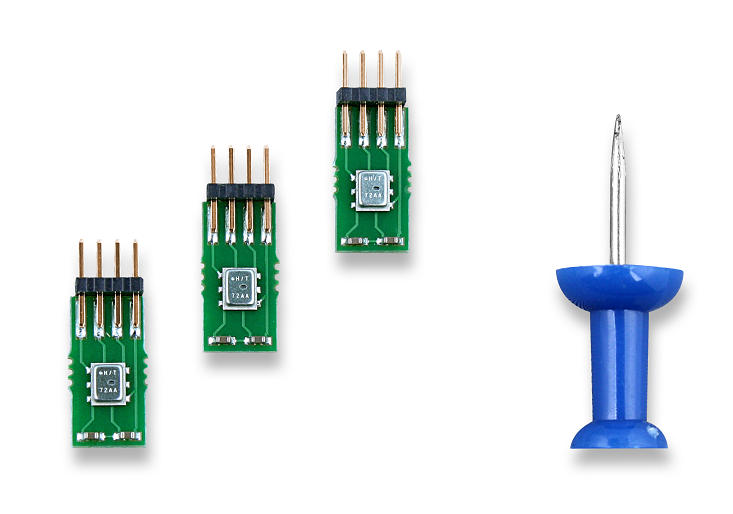
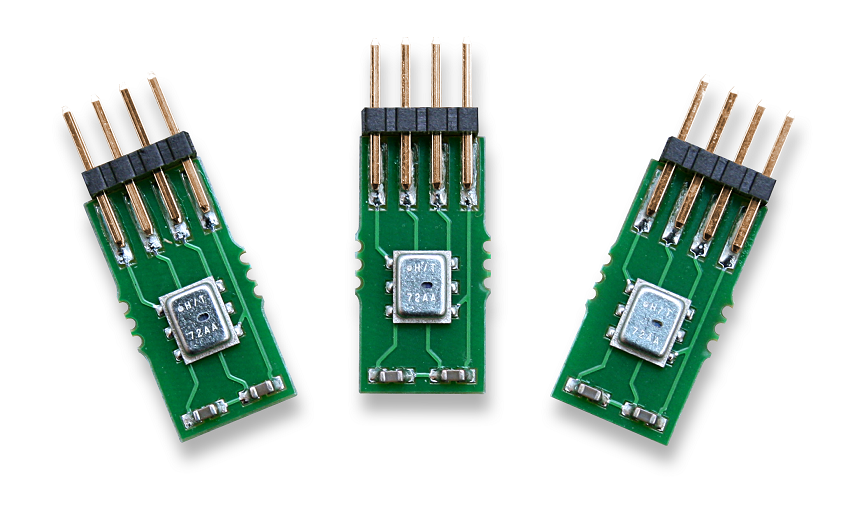
The HS3003 is a highly accurate, fully calibrated relative humidity and temperature sensor. The high accuracy, fast measurement response time, and long-term stability, along with the small package size, make the HS3003 ideal for a wide number of applications from portable to harsh environments.
An integrated calibration and temperature compensation logic provides fully corrected RH and T values via a standard I²C output. The measured data is internally corrected and compensated for accurate operation over a wide range of temperature and humidity levels–user calibration is not required.
| Part Number | Status | Samples | Stock | Package | Lead Count (#) | Carrier Type | Moisture Sensitivity Level (MSL) | Pb (Lead) Free | Pb Free Category | Temp. Range (°C) |
|---|---|---|---|---|---|---|---|---|---|---|
| HS3003 | Obsolete | N/A | In Stock | LGA | 6# | Cut Tape | 3 | Yes | e4 Au | -40 to 125°C |
Filters
Applied Filters
- End Of Life NoticePDF 748 KB Apr 15, 2025
- Application NotePDF 1.81 MB R36AN0021EU0100 Rev.1.00 Jan 14, 2025AI-generated Summary: Optimal methods for measuring and evaluating polymer-based capacitive relative humidity (RH) and temperature (T) sensors in the HSx series focus on ensuring accurate, stable, and reliable sensor performance. Key practices include using temperature/humidity-controlled chambers, precise calibration with traceable reference instruments, proper sensor placement, and adequate air circulation. Testing involves controlled RH and temperature profiles, sensor conditioning, and data logging at 1Hz with averaging to reduce noise. Performance metrics like RMSE and mean error help analyze sensor accuracy. The document also addresses troubleshooting common issues such as temperature offsets and humidity variations due to environmental or PCB factors.
- Product Change NoticePDF 316 KB Apr 26, 2024
- Application NotePDF 131 KB R36AN0017EU0100 Rev.1.00 Nov 17, 2023AI-generated Summary: Temperature and relative humidity readings from HS sensors on PCBs can be affected by heat generated by nearby components and limited ventilation. Compensation involves measuring the sensor temperature and environmental temperature with an external calibrated sensor, then correcting the sensor output by subtracting the heating effect. Relative humidity compensation requires calculating saturation vapor pressures at both measured and corrected temperatures, then adjusting the humidity reading accordingly. Equations and examples demonstrate how to apply these corrections to improve accuracy in environments where PCB heat influences sensor readings.
- Product Change NoticePDF 301 KB Aug 28, 2023
- Product Change NoticePDF 368 KB Jul 26, 2023
- Product Change NoticePDF 99 KB Apr 13, 2022
- Application NotePDF 76 KB Oct 14, 2020AI-generated Summary: Instructions explain how to change the default I2C address of the HS300x sensor by entering programming mode within 10ms of power-up. The sensor’s non-volatile memory stores the I2C address in specific 16-bit registers, with only the lower 7 bits modifiable. The process involves reading the register to preserve upper bits, modifying bits [6:0], and writing back with strict timing requirements to avoid data corruption. The new address activates after power cycling or by sending a specific command to exit programming mode without power reset. Timing and command sequences are critical to ensure successful address programming.
Recommended Documents (1)
Datasheets (1)
No Results Found.
Make sure all keywords are spelled correctly.
Try fewer, different, or more general terms to vary your search.
If you have filters applied, consider deselecting some to broaden your results.
- Search our extensive knowledgebase, designed to help customers with their FAQs.
- Get help from our expert Renesas technical staff and community on our support forums.
- Application NotePDF 1.81 MB R36AN0021EU0100 Rev.1.00 Jan 14, 2025AI-generated Summary: Optimal methods for measuring and evaluating polymer-based capacitive relative humidity (RH) and temperature (T) sensors in the HSx series focus on ensuring accurate, stable, and reliable sensor performance. Key practices include using temperature/humidity-controlled chambers, precise calibration with traceable reference instruments, proper sensor placement, and adequate air circulation. Testing involves controlled RH and temperature profiles, sensor conditioning, and data logging at 1Hz with averaging to reduce noise. Performance metrics like RMSE and mean error help analyze sensor accuracy. The document also addresses troubleshooting common issues such as temperature offsets and humidity variations due to environmental or PCB factors.
- Application NotePDF 131 KB R36AN0017EU0100 Rev.1.00 Nov 17, 2023AI-generated Summary: Temperature and relative humidity readings from HS sensors on PCBs can be affected by heat generated by nearby components and limited ventilation. Compensation involves measuring the sensor temperature and environmental temperature with an external calibrated sensor, then correcting the sensor output by subtracting the heating effect. Relative humidity compensation requires calculating saturation vapor pressures at both measured and corrected temperatures, then adjusting the humidity reading accordingly. Equations and examples demonstrate how to apply these corrections to improve accuracy in environments where PCB heat influences sensor readings.
- Application NotePDF 76 KB Oct 14, 2020AI-generated Summary: Instructions explain how to change the default I2C address of the HS300x sensor by entering programming mode within 10ms of power-up. The sensor’s non-volatile memory stores the I2C address in specific 16-bit registers, with only the lower 7 bits modifiable. The process involves reading the register to preserve upper bits, modifying bits [6:0], and writing back with strict timing requirements to avoid data corruption. The new address activates after power cycling or by sending a specific command to exit programming mode without power reset. Timing and command sequences are critical to ensure successful address programming.
Application Notes & White Papers (3)
- End Of Life NoticePDF 748 KB Apr 15, 2025
- Product Change NoticePDF 316 KB Apr 26, 2024
- Product Change NoticePDF 301 KB Aug 28, 2023
- Product Change NoticePDF 368 KB Jul 26, 2023
- Product Change NoticePDF 99 KB Apr 13, 2022View More (6)
Product Notices (PCN, EOL, etc) (6)
No Results Found.
Make sure all keywords are spelled correctly.
Try fewer, different, or more general terms to vary your search.
If you have filters applied, consider deselecting some to broaden your results.
- Search our extensive knowledgebase, designed to help customers with their FAQs.
- Get help from our expert Renesas technical staff and community on our support forums.
No Results Found.
Make sure all keywords are spelled correctly.
Try fewer, different, or more general terms to vary your search.
If you have filters applied, consider deselecting some to broaden your results.
- Search our extensive knowledgebase, designed to help customers with their FAQs.
- Get help from our expert Renesas technical staff and community on our support forums.
No Results Found.
Make sure all keywords are spelled correctly.
Try fewer, different, or more general terms to vary your search.
If you have filters applied, consider deselecting some to broaden your results.
- Search our extensive knowledgebase, designed to help customers with their FAQs.
- Get help from our expert Renesas technical staff and community on our support forums.
No Results Found.
Make sure all keywords are spelled correctly.
Try fewer, different, or more general terms to vary your search.
If you have filters applied, consider deselecting some to broaden your results.
- Search our extensive knowledgebase, designed to help customers with their FAQs.
- Get help from our expert Renesas technical staff and community on our support forums.
No Results Found.
Make sure all keywords are spelled correctly.
Try fewer, different, or more general terms to vary your search.
If you have filters applied, consider deselecting some to broaden your results.
- Search our extensive knowledgebase, designed to help customers with their FAQs.
- Get help from our expert Renesas technical staff and community on our support forums.
No Results Found.
Make sure all keywords are spelled correctly.
Try fewer, different, or more general terms to vary your search.
If you have filters applied, consider deselecting some to broaden your results.
- Search our extensive knowledgebase, designed to help customers with their FAQs.
- Get help from our expert Renesas technical staff and community on our support forums.
No Results Found.
Make sure all keywords are spelled correctly.
Try fewer, different, or more general terms to vary your search.
If you have filters applied, consider deselecting some to broaden your results.
- Search our extensive knowledgebase, designed to help customers with their FAQs.
- Get help from our expert Renesas technical staff and community on our support forums.
No Results Found.
Make sure all keywords are spelled correctly.
Try fewer, different, or more general terms to vary your search.
If you have filters applied, consider deselecting some to broaden your results.
- Search our extensive knowledgebase, designed to help customers with their FAQs.
- Get help from our expert Renesas technical staff and community on our support forums.
No Results Found.
Make sure all keywords are spelled correctly.
Try fewer, different, or more general terms to vary your search.
If you have filters applied, consider deselecting some to broaden your results.
- Search our extensive knowledgebase, designed to help customers with their FAQs.
- Get help from our expert Renesas technical staff and community on our support forums.
No Results Found.
Make sure all keywords are spelled correctly.
Try fewer, different, or more general terms to vary your search.
If you have filters applied, consider deselecting some to broaden your results.
- Search our extensive knowledgebase, designed to help customers with their FAQs.
- Get help from our expert Renesas technical staff and community on our support forums.
Support Communities
-
HS3003 Accuracy Problem – Need Guidance
Hi team, I am using the HS3003 sensor with my MCU, but the sensor is not showing accurate values. I tested 15 sensors, and all of them are giving different readings. What should I do to resolve this issue? I have attached the data chart below for reference. Regards Arun
Sep 2, 2025 -
How to differentiate versions of HS300X?
Hi all, I've acquired different versions of the HS300X temperature/humidity sensors. Is there any way to differentiate it? The mark on package seems not help, since it has the format H3YW, with Y=year and W= work week code. The sensors have an ID number, but I ...
Jul 4, 2023