Features
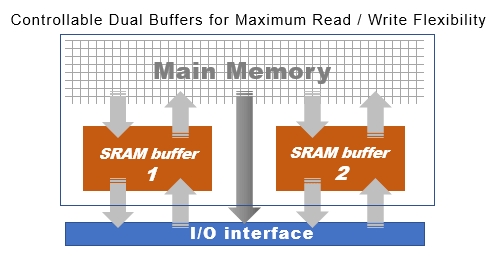
- Includes controllable Dual R/W SRAM buffers for maximum flexibility
- Standard block architecture with added 256-byte page erase for energy efficient Data Logging
- Byte-write provides Serial EEPROM functionality in a Serial NOR Flash device
- Ultra-deep power down
- Comprehensive security and unique ID features protect the device from outside tampering
Description
The AT45DB321E DataFlash is a member of our System Enhancing class of code and data storage solutions designed with an advanced dual SRAM buffer architecture that makes it the most efficient memory for data logging. It also incorporates a suite of advanced features that save system power, reduce processor overhead, simplify software development, and provide comprehensive data security and integrity options.
Parameters
| Attributes | Value |
|---|---|
| Memory Class | DataFlash |
| Memory Density | 32 |
| Operating Voltage Range (V) | 2.3 - 3.6 |
| Speed | 85 MHz |
| Interface | Single SPI |
| Temp. Range (°C) | -40 to +85°C |
| Deep Power Down (µA) | 0.4 |
| Read Current (mA) | 6 |
| Key Benefit | Includes controllable SRAM |
Package Options
| Pkg. Type | Pkg. Dimensions (mm) | Pitch (mm) |
|---|---|---|
| DFN | 5 x 6 | 1.27 |
| DFN | 6 x 8 | 0.5 |
| SOIC 208MIL 8S2 8 | — | — |
| SOIC-W | 5.18 x 7.70 | 1.27 |
| Part Number | Status | Longevity | Stock | Package | Budgetary Price (USD) | Sample Catalog | Carrier Type | Moisture Sensitivity Level (MSL) | Country of Assembly | Country of Wafer Fabrication |
|---|---|---|---|---|---|---|---|---|---|---|
| AT45DB321E-MHF-T | Active | 2034 Jan | In Stock | DFN | 1ku | $2.67 | <a href="https://www.renesas.com/samplecomponents/scripts/samplecenter/adestotech?cmd=menu" title="Request Samples" rel="noreferrer">Request Samples</a> | Tape & Reel | 1 | TAIWAN | TAIWAN |
| AT45DB321E-MHF-Y | Active | 2034 Jan | In Stock | DFN | 1ku | $2.67 | <a href="https://www.renesas.com/samplecomponents/scripts/samplecenter/adestotech?cmd=menu" title="Request Samples" rel="noreferrer">Request Samples</a> | Tray | 1 | TAIWAN | TAIWAN |
| AT45DB321E-MHF2B-T | Active | 2034 Jan | In Stock | DFN | 1ku | $2.67 | <a href="https://www.renesas.com/samplecomponents/scripts/samplecenter/adestotech?cmd=menu" title="Request Samples" rel="noreferrer">Request Samples</a> | Tape & Reel | 1 | TAIWAN | TAIWAN |
| AT45DB321E-MWHF-T | Active | 2034 Jan | In Stock | DFN | 1ku | $2.67 | <a href="https://www.renesas.com/samplecomponents/scripts/samplecenter/adestotech?cmd=menu" title="Request Samples" rel="noreferrer">Request Samples</a> | Tape & Reel | 1 | TAIWAN | TAIWAN |
| AT45DB321E-MWHF-Y | Active | 2034 Jan | In Stock | DFN | 1ku | $2.67 | <a href="https://www.renesas.com/samplecomponents/scripts/samplecenter/adestotech?cmd=menu" title="Request Samples" rel="noreferrer">Request Samples</a> | Tray | 1 | TAIWAN | TAIWAN |
| AT45DB321E-MWHF2B-T | Active | 2034 Jan | In Stock | DFN | 1ku | $2.67 | <a href="https://www.renesas.com/samplecomponents/scripts/samplecenter/adestotech?cmd=menu" title="Request Samples" rel="noreferrer">Request Samples</a> | Tape & Reel | 1 | TAIWAN | TAIWAN |
| AT45DB321E-SHF-B | Active | 2034 Jan | In Stock | SOIC-W | 1ku | $2.03 | <a href="https://www.renesas.com/samplecomponents/scripts/samplecenter/adestotech?cmd=menu" title="Request Samples" rel="noreferrer">Request Samples</a> | Tube | 1 | TAIWAN | TAIWAN |
| AT45DB321E-SHF-T | Active | 2034 Jan | In Stock | SOIC-W | 1ku | $2.03 | <a href="https://www.renesas.com/samplecomponents/scripts/samplecenter/adestotech?cmd=menu" title="Request Samples" rel="noreferrer">Request Samples</a> | Tape & Reel | 1 | TAIWAN | TAIWAN |
| AT45DB321E-SHF2B-T | Active | 2034 Jan | In Stock | SOIC-W | 1ku | $2.07 | <a href="https://www.renesas.com/samplecomponents/scripts/samplecenter/adestotech?cmd=menu" title="Request Samples" rel="noreferrer">Request Samples</a> | Tape & Reel | 1 | TAIWAN | TAIWAN |
| AT45DB321E-SHFHA-T | Active | 2034 Jan | In Stock | SOIC-W | 1ku | $2.12 | <a href="https://www.renesas.com/samplecomponents/scripts/samplecenter/adestotech?cmd=menu" title="Request Samples" rel="noreferrer">Request Samples</a> | Tape & Reel | 1 | TAIWAN | TAIWAN |
| AT45DB321E-SHFHC-T | Active | 2034 Jan | Out of Stock | SOIC 208MIL 8S2 8 | <a href="https://www.renesas.com/samplecomponents/scripts/samplecenter/adestotech?cmd=menu" title="Request Samples" rel="noreferrer">Request Samples</a> | 1 |
Filters
Applied Filters
- Application NotePDF 884 KB R10AN0038EU0100 Rev.1.00 Mar 10, 2026This application note discusses endurance and data retention in NOR Flash memory products. It describes the structure and operation of the NOR Flash transistor, the mechanisms of NOR Flash device failure and oxide degradation which limit endurance and data retention. It explains JEDEC-based test procedures for certifying endurance and data retention specifications and ways to mitigate limitations. The first part of this document and the appendix provide background for understanding the issue. The later sections describe practical scenarios of interest to most customers.
- Application NotePDF 695 KB AN503 Sep 05, 2025Explores thermal resistance in integrated circuits (ICs) and details its role in managing heat from power consumption to ensure reliable operation. Proper thermal management enhances IC performance and longevity. Thermal resistance, measured in °C/W, quantifies heat flow resistance from the silicon die to the environment or PCB, with key types including junction-to-case (θJC), case-to-ambient (θCA), junction-to-ambient (θJA), and junction-to-board (θJB).
- Application NotePDF 2.62 MB AN500 Feb 13, 2024AI-generated Summary: NOR Flash memory requires an erase operation before programming, which occurs in three phases: Pre-Program, Erase, and Recovery. The erase process affects entire blocks simultaneously, not byte-by-byte. Memory cells use floating gate MOSFETs to store data, organized into arrays of rows (Word-Lines) and columns (Bit-Lines). Physical Blocks contain multiple Logical Blocks and share common p-wells and Bit-Lines, impacting operation. Smaller Logical Blocks enable improved erase performance through parallelization. Understanding these processes and potential interruptions is crucial for designing reliable systems.
- Application NotePDF 710 KB AN502 Jan 24, 2024AI-generated Summary: Renesas NOR flash devices require decoupling capacitors close to VCC and GND pins to stabilize voltage, typically 1 μF with an optional 100 nF capacitor. Pull-up resistors are recommended on CS#, WP#/IO2, and HOLD#/IO3 pins to ensure proper signal states and facilitate debugging. Signal routing should minimize trace length and maintain a solid ground plane for high-speed signals. Power supply must rise monotonically during power-up. Basic system bring-up involves verifying installation, voltage levels, and SPI communication using manufacturer/device ID commands. Software drivers depend on host MCU architecture; Renesas offers example drivers and support. Correct erase/program sequences include write-enable, erase/program commands, and status checks. Tools for programming include flash loader plug-ins and debug probes. Switching from single to quad-SPI involves setting the quad-enable bit, changing pin functions. Dummy cycles introduce necessary wait times during read commands to accommodate latency.
- GuidePDF 790 KB SPI_NOR_Flash_Product_Guide_PBFLASH03102022rev-C Jun 16, 2023
- DocumentPDF 1 MB R10DS0315EU0000 Rev.0.00 Jun 28, 2022
- Application NotePDF 794 KB May 12, 2022AI-generated Summary: Renesas NOR flash devices implement multiple protection methods to safeguard memory arrays, status registers, flash states, and resets from accidental or intentional modifications. Protection types include hardware-based write protection via the WP pin and software-based protection through commands controlling status registers and memory blocks. Memory array protection schemes include individual block protection, allowing sector-level lock/unlock, and memory edge protection, which protects contiguous regions aligned to memory edges. Status register protection indirectly secures memory by blocking changes to protection states. Detailed command sets and register bits configure these protections, ensuring robust flash memory integrity.
- Application NotePDF 663 KB Oct 18, 2021AI-generated Summary: Proper power-up and power-down sequencing is critical for NOR Flash memory operation to ensure reliable system performance. The power supply voltage must ramp up monotonically without dips, reaching the minimum operational voltage within specified timing to avoid corrupted initialization. Reset methods, including hardware and JEDEC resets, help ensure the device starts from a known state. Brown-out conditions and power cycling require careful handling to prevent data corruption and ensure stable operation. The document covers power sequencing, reset types, brown-out recovery, power-down, and power-saving modes, providing essential guidelines for system engineers and application developers.
- Application NotePDF 576 KB Feb 17, 2021AI-generated Summary: Critical data can be saved during power failures by using the DataFlash E-Series devices, which feature dual 264-byte SRAM buffers. One buffer holds mission-critical data ready to be written to Flash memory when power loss occurs. A capacitor and Schottky diode extend power availability after failure, enabling data transfer before voltage drops below 1.7V. Capacitor sizing depends on current and transfer time, with 60µF or higher recommended for 264-byte transfers. Higher SPI clock speeds reduce transfer time without increasing current. Erasing Flash before writing increases save time significantly. Test results show successful data retention with appropriate capacitor and clock configurations.
- Application NoteZIP 32 KB Aug 07, 2020Related Files:
- Application NotePDF 485 KB Aug 07, 2020AI-generated Summary: The document explains how to interface AVR microcontrollers with serial SPI memories such as AT25128A/256A and AT25F1024/2048/4096. It details hardware connections, SPI communication protocols, and memory access types including single byte commands, status register operations, sector erase, and data read/write. The document highlights features like burst read/write, write protection, and busy detection, providing driver architecture and function descriptions to facilitate efficient memory integration in AVR systems.Related Files:
Recommended Documents (1)
Datasheets (1)
- GuidePDF 790 KB SPI_NOR_Flash_Product_Guide_PBFLASH03102022rev-C Jun 16, 2023
Manuals & Guides (4)
- Application NotePDF 884 KB R10AN0038EU0100 Rev.1.00 Mar 10, 2026This application note discusses endurance and data retention in NOR Flash memory products. It describes the structure and operation of the NOR Flash transistor, the mechanisms of NOR Flash device failure and oxide degradation which limit endurance and data retention. It explains JEDEC-based test procedures for certifying endurance and data retention specifications and ways to mitigate limitations. The first part of this document and the appendix provide background for understanding the issue. The later sections describe practical scenarios of interest to most customers.
- Application NotePDF 695 KB AN503 Sep 05, 2025Explores thermal resistance in integrated circuits (ICs) and details its role in managing heat from power consumption to ensure reliable operation. Proper thermal management enhances IC performance and longevity. Thermal resistance, measured in °C/W, quantifies heat flow resistance from the silicon die to the environment or PCB, with key types including junction-to-case (θJC), case-to-ambient (θCA), junction-to-ambient (θJA), and junction-to-board (θJB).
- Application NotePDF 2.62 MB AN500 Feb 13, 2024AI-generated Summary: NOR Flash memory requires an erase operation before programming, which occurs in three phases: Pre-Program, Erase, and Recovery. The erase process affects entire blocks simultaneously, not byte-by-byte. Memory cells use floating gate MOSFETs to store data, organized into arrays of rows (Word-Lines) and columns (Bit-Lines). Physical Blocks contain multiple Logical Blocks and share common p-wells and Bit-Lines, impacting operation. Smaller Logical Blocks enable improved erase performance through parallelization. Understanding these processes and potential interruptions is crucial for designing reliable systems.
- Application NotePDF 710 KB AN502 Jan 24, 2024AI-generated Summary: Renesas NOR flash devices require decoupling capacitors close to VCC and GND pins to stabilize voltage, typically 1 μF with an optional 100 nF capacitor. Pull-up resistors are recommended on CS#, WP#/IO2, and HOLD#/IO3 pins to ensure proper signal states and facilitate debugging. Signal routing should minimize trace length and maintain a solid ground plane for high-speed signals. Power supply must rise monotonically during power-up. Basic system bring-up involves verifying installation, voltage levels, and SPI communication using manufacturer/device ID commands. Software drivers depend on host MCU architecture; Renesas offers example drivers and support. Correct erase/program sequences include write-enable, erase/program commands, and status checks. Tools for programming include flash loader plug-ins and debug probes. Switching from single to quad-SPI involves setting the quad-enable bit, changing pin functions. Dummy cycles introduce necessary wait times during read commands to accommodate latency.
Application Notes & White Papers (15)
- Product Change NoticePDF 579 KB Jun 26, 2020
- Product Change NoticePDF 528 KB Jun 26, 2020View More (8)
Product Notices (PCN, EOL, etc) (8)
No Results Found.
Make sure all keywords are spelled correctly.
Try fewer, different, or more general terms to vary your search.
If you have filters applied, consider deselecting some to broaden your results.
- Search our extensive knowledgebase, designed to help customers with their FAQs.
- Get help from our expert Renesas technical staff and community on our support forums.
No Results Found.
Make sure all keywords are spelled correctly.
Try fewer, different, or more general terms to vary your search.
If you have filters applied, consider deselecting some to broaden your results.
- Search our extensive knowledgebase, designed to help customers with their FAQs.
- Get help from our expert Renesas technical staff and community on our support forums.
No Results Found.
Make sure all keywords are spelled correctly.
Try fewer, different, or more general terms to vary your search.
If you have filters applied, consider deselecting some to broaden your results.
- Search our extensive knowledgebase, designed to help customers with their FAQs.
- Get help from our expert Renesas technical staff and community on our support forums.
No Results Found.
Make sure all keywords are spelled correctly.
Try fewer, different, or more general terms to vary your search.
If you have filters applied, consider deselecting some to broaden your results.
- Search our extensive knowledgebase, designed to help customers with their FAQs.
- Get help from our expert Renesas technical staff and community on our support forums.
No Results Found.
Make sure all keywords are spelled correctly.
Try fewer, different, or more general terms to vary your search.
If you have filters applied, consider deselecting some to broaden your results.
- Search our extensive knowledgebase, designed to help customers with their FAQs.
- Get help from our expert Renesas technical staff and community on our support forums.
No Results Found.
Make sure all keywords are spelled correctly.
Try fewer, different, or more general terms to vary your search.
If you have filters applied, consider deselecting some to broaden your results.
- Search our extensive knowledgebase, designed to help customers with their FAQs.
- Get help from our expert Renesas technical staff and community on our support forums.
No Results Found.
Make sure all keywords are spelled correctly.
Try fewer, different, or more general terms to vary your search.
If you have filters applied, consider deselecting some to broaden your results.
- Search our extensive knowledgebase, designed to help customers with their FAQs.
- Get help from our expert Renesas technical staff and community on our support forums.
- DocumentPDF 1 MB R10DS0315EU0000 Rev.0.00 Jun 28, 2022
Other (3)
No Results Found.
Make sure all keywords are spelled correctly.
Try fewer, different, or more general terms to vary your search.
If you have filters applied, consider deselecting some to broaden your results.
- Search our extensive knowledgebase, designed to help customers with their FAQs.
- Get help from our expert Renesas technical staff and community on our support forums.
Filters
Applied Filters
Software & Tools
Filter by Type
Filter by Provider
Sample Code
Filter by Application
Filter by Function
Filter by Compiler
Filter by IDE
Simulation Models
Partner Solutions
- Development ToolµISP is a compact standalone and universal solution, specifically designed for production environments, based on Algocrafts WriteNow! Technology. This is a standard tool for many families and devices and supports multi programming protocol (JTAG, SPI, UART, DAP, SWD, I2C, BDM, custom protocol, etc).Provided By: Algocraft Srl
- Development ToolWriteNow! Series of In-System Programmers is a breakthrough in the programming industry. The programmers support a large number of devices (microcontrollers, memories, CPLDs and other programmable devices) from various manufacturers and have a compact size for easy ATE/fixture integration. They work in standalone or connected to a ...Provided By: Algocraft Srl
No Results Found.
Make sure all keywords are spelled correctly.
Try fewer, different, or more general terms to vary your search.
If you have filters applied, consider deselecting some to broaden your results.
- Search our extensive knowledgebase, designed to help customers with their FAQs.
- Get help from our expert Renesas technical staff and community on our support forums.
No Results Found.
Make sure all keywords are spelled correctly.
Try fewer, different, or more general terms to vary your search.
If you have filters applied, consider deselecting some to broaden your results.
- Search our extensive knowledgebase, designed to help customers with their FAQs.
- Get help from our expert Renesas technical staff and community on our support forums.
No Results Found.
Make sure all keywords are spelled correctly.
Try fewer, different, or more general terms to vary your search.
If you have filters applied, consider deselecting some to broaden your results.
- Search our extensive knowledgebase, designed to help customers with their FAQs.
- Get help from our expert Renesas technical staff and community on our support forums.
Simulation Models (2)
- Development ToolµISP is a compact standalone and universal solution, specifically designed for production environments, based on Algocrafts WriteNow! Technology. This is a standard tool for many families and devices and supports multi programming protocol (JTAG, SPI, UART, DAP, SWD, I2C, BDM, custom protocol, etc).Provided By: Algocraft Srl
- Development ToolWriteNow! Series of In-System Programmers is a breakthrough in the programming industry. The programmers support a large number of devices (microcontrollers, memories, CPLDs and other programmable devices) from various manufacturers and have a compact size for easy ATE/fixture integration. They work in standalone or connected to a ...Provided By: Algocraft Srl
Partner Solutions (2)
Support Communities
-
AT45DB321E-SHF-T material composition List
PLS provide AT45DB321E-SHF-T material composition List
May 27, 2022 -
Programming flash memory IC AT45DB321E-SHF2B-T
Greetings to the Renesas community, I am working on interfacing the AT45DB321E-SHF2B-T flash memory chip with the RA6M1 MCU for my project. While programming through QSPI is feasible, it presents challenges in mass production scenarios. To streamline production, I explored hardware solutions such as serial flash programmers tailored ...
Mar 31, 2025