
Features
- PCIe Gen6 additive phase jitter: 4fs RMS
- PCIe Gen7 additive phase jitter: 2.8fs RMS
- DB2000Q/DB1206 additive phase jitter: 12fs RMS
- 12kHz–20MHz additive phase jitter: 36fs RMS at 156.25MHz
- Power-down tolerant (PDT) inputs
- Flexible startup sequencing (FSS)
- SMBus-enabled automatic clock parking (ACP)
- CLKIN accepts HCSL or LVDS signal levels
- 12 LP-HCSL outputs with 85Ω impedance
Description
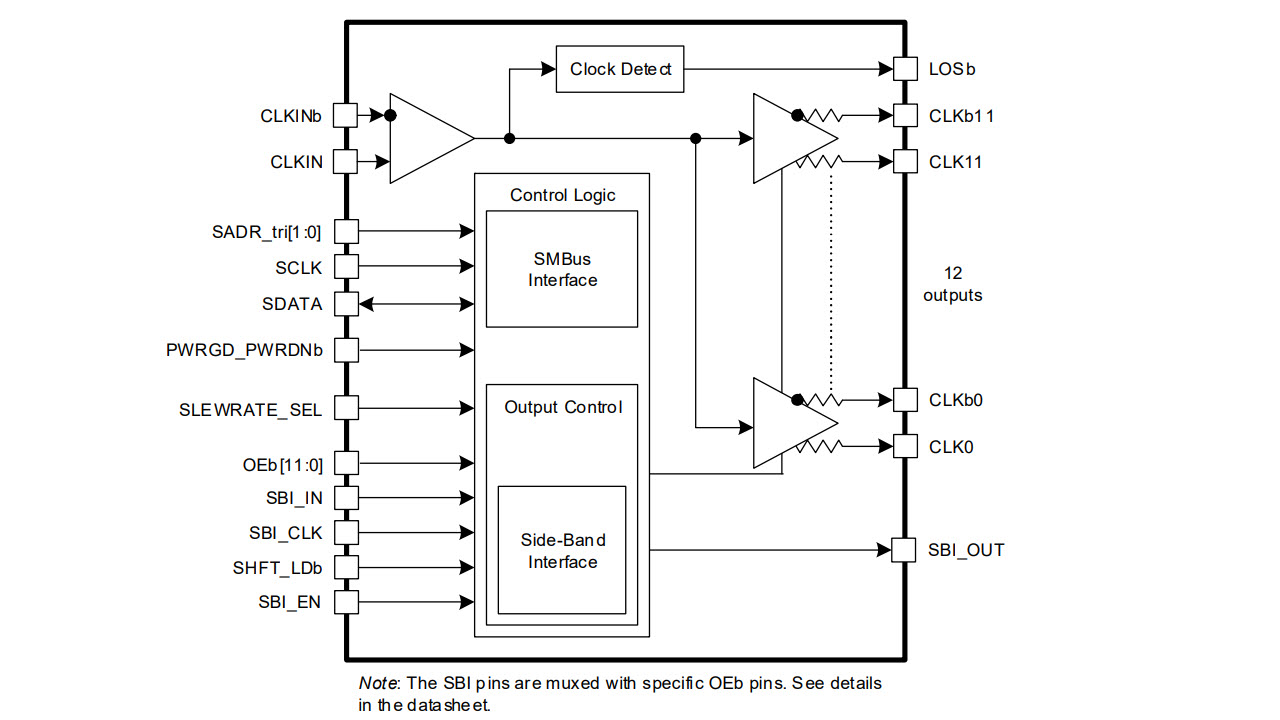
The 9QXL1200 is an ultra-high performance PCIe Gen7 fanout buffer that is backward compatible with earlier PCIe generations. It features a loss-of-signal (LOS) output for system monitoring and resiliency. The device also incorporates power-down tolerant (PDT) and flexible startup sequencing (FSS) capabilities, simplifying system design.
Parameters
| Attributes | Value |
|---|---|
| Diff. Outputs | 12 |
| Diff. Output Signaling | LP-HCSL |
| Output Freq Range (MHz) | 1 - 400 |
| Diff. Inputs | 1 |
| Diff. Input Signaling | HCSL |
| Accepts Spread Spec Input | Yes |
| Power Consumption Typ (mW) | 441 |
| Supply Voltage (V) | 3.3 - 3.3 |
| Output Type | LP-HCSL |
| Package Area (mm²) | 25 |
| Battery Backup | No |
| Battery Seal | No |
| CPU Supervisory Function POR | No |
| Crystal Frequency Trimming | No |
| Frequency Out Pin | No |
| Inputs (#) | 1 |
| Input Freq (MHz) | 1 - 400 |
| Additive Phase Jitter Typ RMS (fs) | 2.8 |
| Function | Fanout Buffer |
| Input Type | HCSL |
| Output Banks (#) | 1 |
| Core Voltage (V) | 3.3 |
| Product Category | Clock Buffers & Drivers, PCI Express Clocks |
Package Options
| Pkg. Type | Pkg. Dimensions (mm) | Lead Count (#) | Pitch (mm) |
|---|---|---|---|
| LGA | 5.0 x 5.0 x 0.66 | 64 | 0.5 |
Product Comparison
 | | |
| 9QXL1200 | 9QXL2001C | |
| Core Voltage (V) | 3.3 | 3.3 |
| Output Impedance | 85 | 85 |
| App Jitter Compliance | DB1206, DB2000Q, PCIe Gen1, PCIe Gen2, PCIe Gen3, PCIe Gen4, PCIe Gen5, PCIe Gen6, PCIe Gen7, QPI, UPI | 25G EDR, DB2000Q, IF-UPI, PCIe Gen1, PCIe Gen2, PCIe Gen3, PCIe Gen4, PCIe Gen5, PCIe Gen6, QPI, UPI |
| VOUT Slew-rate Control | Yes | No |
| Additive Jitter | 4fs | 4fs |
Applications
- Cloud and high-performance computing
- NVMe storage
- Networking
- AI accelerators