Multi-Motor Systems Are Growing—And So Are Their Problems
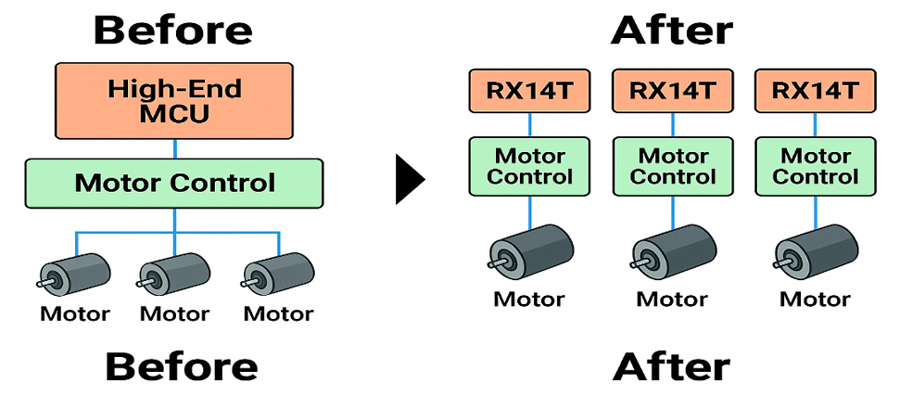
As products, from home appliances to industrial equipment, add more motion functions, systems increasingly need to control multiple motors. Many engineering teams naturally gravitate toward using a single high-end MCU to centrally manage all motors. On the surface, this looks efficient: fewer MCUs, one software project, and a single control point.
In practice, centralized control often introduces significant challenges including:
- Software grows large and difficult to maintain
- Even small changes require system-wide regression testing
- Unchanged motor control blocks still require re-testing
- Hardware constraints add complexity
- Development effort increases with every update
The root cause is not insufficient processing power. It is structural concentration, placing too much responsibility on a single MCU. To overcome this, engineering teams should reconsider the architecture and shift from a centralized approach to a distributed one.
Why Centralized Motor Control Reaches Its Limits
In centralized architectures, multiple motor control modules must share limited resources, including:
- Interrupts
- Timers
- Analog‑to‑digital converter (ADC) sampling windows
- Communication channels
- Safety mechanisms
Initially, this may seem manageable, but interactions between shared resources multiply over time. A once-clean design becomes tightly coupled and unpredictable. Firmware size scales disproportionately with each added motor, and even minor changes trigger broad evaluation efforts. Hardware issues compound the problem. Motor currents and sensor signals must be routed to a single MCU, often over long distances, which can degrade analog integrity. PCB layout flexibility decreases, and additional filtering or calibration is needed, shifting more burden to the software. While a single MCU may appear cheaper, true system cost often tells a different story. Extra wiring, more PCB layers, added analog components, assembly time, debugging effort, and long-term maintenance all add up. Centralized systems can ultimately cost more despite seeming simpler upfront.
Distributed Motor Control—A More Scalable and Maintainable Architecture
A distributed architecture simplifies the problem through modularity. Instead of grouping multiple motors into one control structure, each motor becomes an independent unit with its own dedicated MCU, one motor per controller.
From a software perspective, the benefits are immediate:
- Smaller, modular firmware
- Minimal cross-interference between motors
- Faster updates with reduced regression testing
- Simplified debugging and validation
Hardware also improves. Locating the MCU near the motor shortens wiring, improves current sensing accuracy, reduces electromagnetic interference (EMI), and increases PCB design flexibility.
Scalability follows naturally. Adding a motor simply means adding another unit, without impacting the existing system.
RX14T—A Practical MCU for Distributed Motor Control
The RX14T 32-bit MCU, part of the Renesas RX family, was developed specifically for compact, cost-efficient motor control applications. It provides the performance and analog integration needed for per-motor control without unnecessary overhead.
Key Technical Highlights
- 48MHz RXv2 CPU with floating-point unit (FPU) and digital signal processing (DSP) support
- Trigonometric function unit (TFU) for high-speed sin, cos, atan2, and sqrt operations
- Dual 12-bit ADCs with simultaneous sampling (min 0.5µs)
- Optimized multi-function timer unit (MTU) + general-purpose pulse-width modulation (PWM) timer (GPT) timer set for single-motor inverter control
- Up to 11 PWM channels designed for motor applications
- 5V operation for strong noise immunity
- –40°C to +125°C operating range for consumer and industrial products
The feature set delivers strong motor control performance while maintaining a compact footprint and competitive cost.
Internal Analog Functions Reduce Bill of Materials (BOM) Cost
Many analog components typically required for motor control are already integrated into the RX14T, including:
- Reset circuit
- Three programmable-gain amplifiers (PGAs)
- Three high-speed comparators
- Two units of digital-to-analog converters (DACs) for comparator references
- High-accuracy internal oscillator (±1% max)
These integrated analog blocks reduce the need for external operational amplifiers, comparator ICs, oscillators, reference circuits, and protection components. Designs become leaner and easier to source and assemble, benefits that multiply quickly in multi-motor systems.

Distributed Control Using the RX14T
Pairing a distributed architecture with the RX14T MCU amplifies advantages across firmware, hardware, and cost:
- Modular firmware enables easier tuning, debugging, and long-term maintenance
- Short wiring improves analog performance while reducing EMI
- High on-chip integration reduces reliance on external components
- Lower part count reduces per-motor BOM and simplifies manufacturing
- System scalability increases with clear isolation between motors
While centralized control may appear efficient initially, its structural drawbacks accumulate. Distributed control offers a cleaner, more scalable alternative:
- Software stays modular
- Hardware becomes more robust
- BOM cost decreases
- Future expansion becomes easier
The RX14T MCU provides the right balance of analog integration, performance, and cost efficiency to make distributed motor control practical.
Learn more at renesas.com/rx14t