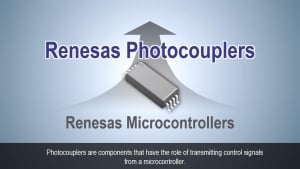
Photocouplers (Optocouplers)

Renesas offers a comprehensive range of photocouplers (optocouplers) designed to deliver reliable performance across diverse applications. From high-speed IC output photocouplers (1Mbps to 15Mbps) to general-purpose transistor output devices, our solutions provide high isolation voltage, high-temperature operation, and compliance with international safety standards. For specialized needs, such as motor drive systems and automotive applications, our photocouplers deliver high output current, high-speed switching, and compact designs tailored to meet stringent safety and performance requirements.

High Performance Across Applications

High Performance Across Applications

Our photocouplers deliver high-speed response rates from 1Mbps to 15Mbps and provide high isolation voltage and temperature resilience, ensuring reliable performance in a variety of demanding environments.

Automotive-Grade Solutions

Automotive-Grade Solutions

Compact automotive photocouplers, like the RV1S2752Q, feature high dielectric strength (3.75KV) and operation up to 135°C. These devices are customizable to meet safety and performance needs for automotive systems.

Optimized for Motor Drive Systems

Optimized for Motor Drive Systems

Photocouplers for motor drives offer high output current, high-speed switching, and robust isolation, ensuring reliable performance in demanding motor control applications.

Compliance with Global Standards

Compliance with Global Standards

All of our photocouplers meet international safety standards, ensuring reliability and compliance for critical applications across industries and environments.

Compare All Products

Specifications & Applications

Photocoupler Specifications & Applications

Explanation of Specifications

General specifications are available for various usage environments, including absolute maximum ratings and electrical characteristics.

How Photocouplers Are Used

Photocouplers are mainly used as a switching device to transfer pulse signals and transfer feedback error signals in analog switching regulators.

Noise Phenomena

Since a photocoupler operates without any circuit connection to the base of a phototransistor, two typical types of noise phenomena are sometimes generated.

CTR/Response Time

Learn about current transfer ratio (CTR) characteristics and response time of photocouplers/optocouplers.

AC Input Capable Photocouplers

Learn how an AC input capable photocoupler enables the input of an AC current using two LEDs connected back-to-back on the input side.

Photocouplers vs. OCMOS FETS

Both photocouplers/optocouplers and optical-coupled MOSFET (SSRs) transmit signals while remaining electrically isolated. Learn the differences between these devices.

Solid State Relays (OCMOS FETs)

Solid State Relays (OCMOS FETs)

Specifications

General specifications are available for various usage environments, including absolute maximum ratings and electrical characteristics for Renesas OCMOS FETs.

Structure & Features

An optical-coupled MOSFET is a full solid state relay that consists of a light-emitting diode (LED) for the input side and MOSFETs for the contact point.

Operating Models

There are two types of optical-coupled MOSFETs, the "make" type (normally open) and "break" type (normally closed).

Precautions & Resources

Precautions for Correct Usage of Optoelectronics

To ensure optimal performance, take special care during mounting and handling of optoelectronic devices. Follow recommended guidelines to maintain optical characteristics and device reliability.

Brochure cover featuring photocoupler products.

Photocouplers Brochure & Selection Guide

Discover how Renesas technology powers innovation in the most demanding applications across the globe—and what it can do for you.

Support

Browse Articles

Knowledge Base

Browse our knowledge base for helpful articles, FAQs, and other useful resources.
Support Communities

Support Communities

Get quick technical support online from Renesas Engineering Community technical staff.