
パッケージ情報
| CADモデル: | View CAD Model |
| Pkg. Type: | QFN |
| Pkg. Code: | LLF |
| Lead Count (#): | 24 |
| Pkg. Dimensions (mm): | 4.0 x 5.0 x 0.90 |
| Pitch (mm): |
環境及び輸出分類情報
| Moisture Sensitivity Level (MSL) | |
| Pb (Lead) Free | No |
| ECCN (US) | |
| HTS (US) |
製品スペック
| Pkg. Type | QFN |
| Carrier Type | Tube |
| MOQ | 900 |
| Bandwidth (MHz) | 60 |
| Channels (#) | 2 |
| Enable | Yes |
| IBIAS (nA) | 7.5 |
| IOUT (A) | 0.45 |
| IS per Amp (mA) | 4 |
| Lead Count (#) | 24 |
| Length (mm) | 4 |
| Noise VN (nV/√Hz) | 10 |
| Offset Voltage (Max) (mV) | 10 |
| PSRR (db) | 55 |
| Pb (Lead) Free | No |
| Pkg. Dimensions (mm) | 4.0 x 5.0 x 0.90 |
| Qualification Level | Standard |
| Rail-to-Rail Input | No |
| Rail-to-Rail Output | No |
| Slew Rate (V/µs) | 400 |
| THD (dB) | 68 |
| Temp. Range (°C) | -40 to +85°C |
| Thermal Shutdown | No |
| Thickness (mm) | 0.9 |
| VOUT (V) | 22.2 |
| VS (Max) (V) | 30 |
| VS (Min) (V) | 8 |
| Width (mm) | 5 |
ISL1533 に関するリソース
説明
Support is limited to customers who have already adopted these products.
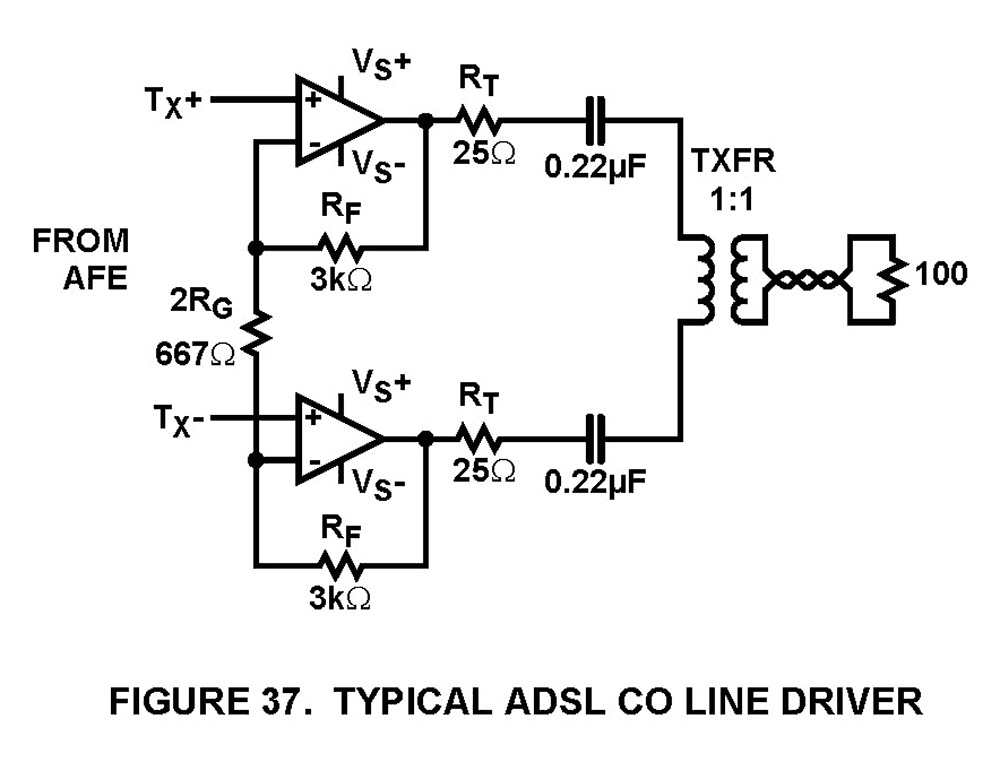
The ISL1533 is a dual channel differential amplifier designed for driving full rate ADSL2+ signals at very low power dissipation. The high drive capability of 450mA makes this driver ideal for DMT designs. It contains two pairs of wideband, high-voltage, current mode feedback amplifiers designed on Intersil's HS30 Bipolar SOI process for low power consumption in DSL systems. This process also provides for very rugged protection against lightning induced surges on the line. These drivers achieve an MTPR distortion measurement of better than 70dB, while consuming typically 5mA per DSL channel of total supply current in 1/2 IS mode. This supply current can be set using a resistor on the IADJ pin. Two other pins (C0 and C1) can also be used to adjust supply current to one of four preset modes (full-IS, 3/4-IS, 1/2-IS, and full power-down). The ISL1533 integrates 50k pull-up resistors on C0 and C1 pins to initially disable the device. The ISL1533 operates on ±5V to ±15V supplies and retains its bandwidth and linearity over the complete supply range. The device is supplied in a thermally-enhanced 20 Ld HTSSOP and the small footprint (4mmx5mm) 24 Ld QFN packages. The ISL1533 is specified for operation over the full -40°C to +85°C temperature range.