Features
- Ultra-compact, efficient wireless power receiver for up to 5W applications
- WPC 1.2 Qi Baseline Power Profile (BPP) compatible
- Optimized light load efficiency for low-power applications
- Ping detection for reduced power consumption at the end of charging
- Low undervoltage lockout (UVLO) for low-voltage start-up for faster connections over an extended area
- ASK and FSK modulation/demodulation for bidirectional communication: Rx-to-Tx and Tx-to-Rx
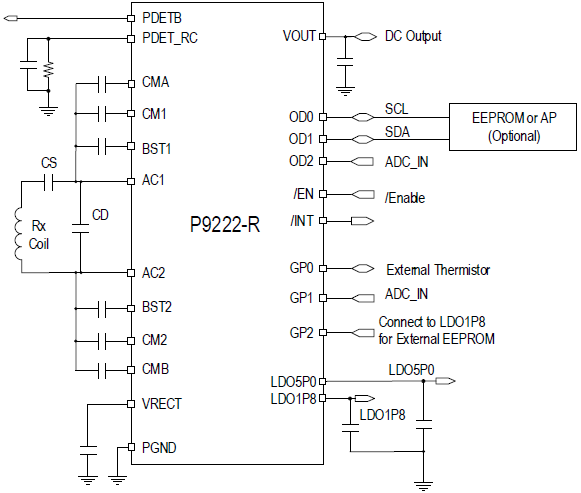
- Easy configuration of design parameters through I²C interface on an external EEPROM
- ADC input to measure battery voltage or system voltage
- Embedded 32-bit Arm Cortex-M0 processor
- Internal overvoltage clamping
- Low standby and operating mode power consumption
- High-performance low dropout (LDO) regulator with low RDS(on) and programmable current limiting
- Supports I²C slave/master mode
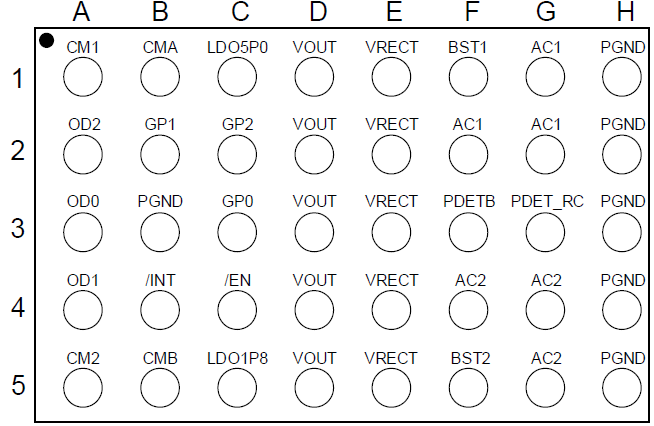
- 40-WLCSP: 5 x 8 ball array, 2.28mm x 3.38mm, 0.4mm pitch
Description
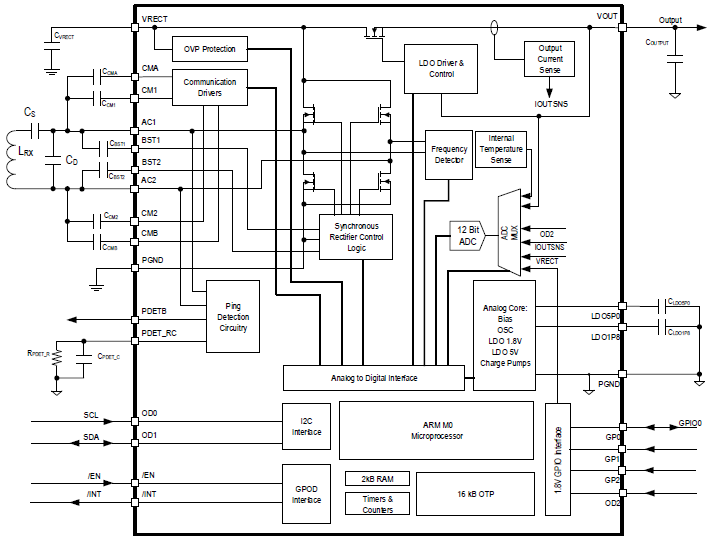
The P9222-R is an integrated single-chip wireless power receiver IC (Rx) for up to 5W applications. The P9222-R is highly efficient at light loads and very well-suited for low-power applications such as earbud case charging. A unique Ping detect feature gives the user an early indication of the wireless charger connection and improves thermal performance at the end of complete battery charging. A low undervoltage lockout (UVLO) threshold allows the receiver to start up even with a weaker digital ping strength signal from a transmitter over an extended area.
The device includes over-temperature and undervoltage/overvoltage protection. The internal overvoltage clamping protects the rectifier output from rising above the overvoltage level when the receiver is quickly moved from a low-coupling position to a high-coupling position. The integrated 32-bit Arm® Cortex®-M0 processor offers a high level of programmability and design parameters that can be easily configured through the I²C interface or an external EEPROM.
The P9222-R is available in a RoHS ultra-small WLCSP-40 package and it is rated for a -40 °C to +85 °C ambient operating temperature range.
Applications
- Wireless earbud case charging
- Wearables and fitness trackers
- Mobile devices
- Hearing aids case charging
| Part Number | Status | Samples | Stock | Package | Lead Count (#) | Temp. Grade | Pb (Lead) Free | Carrier Type | Moisture Sensitivity Level (MSL) |
|---|---|---|---|---|---|---|---|---|---|
| P9222-RAZGI8 | Obsolete | N/A | Out of Stock | WLCSP | 40# | I | Yes | Reel | 1 |
Filters
Applied Filters
- End Of Life NoticePDF 824 KB Jul 02, 2025
- Product Change NoticePDF 108 KB Mar 01, 2022
- Product Change NoticePDF 104 KB Jul 30, 2020
- Application Note
- Application NotePDF 1.28 MB Jan 17, 2018AI-generated Summary: The guide details optimal PCB layout practices for the P9222 wireless power receiver, emphasizing component placement by circuit function to maximize performance within a compact 37mm² area. It prioritizes wide power traces, solid ground planes, and thermal management through vias-in-pad and thermal tabs. Critical components such as VRECT, LDO, BST, resonance, and communication capacitors are placed in a specific order near the IC to minimize noise and heat. The document highlights the importance of minimizing current loop areas, using low ESR capacitors, and maintaining continuous copper planes for heat dissipation. Layer usage recommendations include solid ground planes under the IC and concentrated routing layers to enhance thermal performance and signal integrity.
- White PaperPDF 627 KB 7WDXRDKU4E7E-5-61641 May 10, 2017Wireless power transfer uses an air-core transformer with separate transmitter and receiver coils, making accurate performance modeling difficult due to low magnetic coupling and increased losses. This paper addresses simulation challenges and describes methods to approximate circuit behavior. It demonstrates best practices for tuning Qi and PMA inductive resonance circuits to maximize charging efficiency for mobile devices.
- Application NotePDF 301 KB Feb 02, 2017AI-generated Summary: The document explains a circuit design that automatically switches between wireless charging and wired charging (via USB or AC adaptors) for portable devices. It ensures seamless power source selection without energy loss or performance degradation. The design uses two P-Channel MOSFETs controlled by the power source and the enable pin of the wireless receiver IC to prevent leakage currents and conflicts between power supplies. Detailed operational scenarios illustrate how the circuit manages transitions between power sources. Proper component selection and timing adjustments optimize efficiency and reliability. The document includes efficiency data and practical guidance for implementation.
Recommended Documents (1)
Datasheets (1)
No Results Found.
Make sure all keywords are spelled correctly.
Try fewer, different, or more general terms to vary your search.
If you have filters applied, consider deselecting some to broaden your results.
- Search our extensive knowledgebase, designed to help customers with their FAQs.
- Get help from our expert Renesas technical staff and community on our support forums.
- Application Note
- Application NotePDF 1.28 MB Jan 17, 2018AI-generated Summary: The guide details optimal PCB layout practices for the P9222 wireless power receiver, emphasizing component placement by circuit function to maximize performance within a compact 37mm² area. It prioritizes wide power traces, solid ground planes, and thermal management through vias-in-pad and thermal tabs. Critical components such as VRECT, LDO, BST, resonance, and communication capacitors are placed in a specific order near the IC to minimize noise and heat. The document highlights the importance of minimizing current loop areas, using low ESR capacitors, and maintaining continuous copper planes for heat dissipation. Layer usage recommendations include solid ground planes under the IC and concentrated routing layers to enhance thermal performance and signal integrity.
- White PaperPDF 627 KB 7WDXRDKU4E7E-5-61641 May 10, 2017Wireless power transfer uses an air-core transformer with separate transmitter and receiver coils, making accurate performance modeling difficult due to low magnetic coupling and increased losses. This paper addresses simulation challenges and describes methods to approximate circuit behavior. It demonstrates best practices for tuning Qi and PMA inductive resonance circuits to maximize charging efficiency for mobile devices.
- Application NotePDF 301 KB Feb 02, 2017AI-generated Summary: The document explains a circuit design that automatically switches between wireless charging and wired charging (via USB or AC adaptors) for portable devices. It ensures seamless power source selection without energy loss or performance degradation. The design uses two P-Channel MOSFETs controlled by the power source and the enable pin of the wireless receiver IC to prevent leakage currents and conflicts between power supplies. Detailed operational scenarios illustrate how the circuit manages transitions between power sources. Proper component selection and timing adjustments optimize efficiency and reliability. The document includes efficiency data and practical guidance for implementation.
Application Notes & White Papers (5)
- End Of Life NoticePDF 824 KB Jul 02, 2025
- Product Change NoticePDF 108 KB Mar 01, 2022
- Product Change NoticePDF 104 KB Jul 30, 2020
Product Notices (PCN, EOL, etc) (4)
No Results Found.
Make sure all keywords are spelled correctly.
Try fewer, different, or more general terms to vary your search.
If you have filters applied, consider deselecting some to broaden your results.
- Search our extensive knowledgebase, designed to help customers with their FAQs.
- Get help from our expert Renesas technical staff and community on our support forums.
No Results Found.
Make sure all keywords are spelled correctly.
Try fewer, different, or more general terms to vary your search.
If you have filters applied, consider deselecting some to broaden your results.
- Search our extensive knowledgebase, designed to help customers with their FAQs.
- Get help from our expert Renesas technical staff and community on our support forums.
No Results Found.
Make sure all keywords are spelled correctly.
Try fewer, different, or more general terms to vary your search.
If you have filters applied, consider deselecting some to broaden your results.
- Search our extensive knowledgebase, designed to help customers with their FAQs.
- Get help from our expert Renesas technical staff and community on our support forums.
No Results Found.
Make sure all keywords are spelled correctly.
Try fewer, different, or more general terms to vary your search.
If you have filters applied, consider deselecting some to broaden your results.
- Search our extensive knowledgebase, designed to help customers with their FAQs.
- Get help from our expert Renesas technical staff and community on our support forums.
No Results Found.
Make sure all keywords are spelled correctly.
Try fewer, different, or more general terms to vary your search.
If you have filters applied, consider deselecting some to broaden your results.
- Search our extensive knowledgebase, designed to help customers with their FAQs.
- Get help from our expert Renesas technical staff and community on our support forums.
No Results Found.
Make sure all keywords are spelled correctly.
Try fewer, different, or more general terms to vary your search.
If you have filters applied, consider deselecting some to broaden your results.
- Search our extensive knowledgebase, designed to help customers with their FAQs.
- Get help from our expert Renesas technical staff and community on our support forums.
No Results Found.
Make sure all keywords are spelled correctly.
Try fewer, different, or more general terms to vary your search.
If you have filters applied, consider deselecting some to broaden your results.
- Search our extensive knowledgebase, designed to help customers with their FAQs.
- Get help from our expert Renesas technical staff and community on our support forums.
No Results Found.
Make sure all keywords are spelled correctly.
Try fewer, different, or more general terms to vary your search.
If you have filters applied, consider deselecting some to broaden your results.
- Search our extensive knowledgebase, designed to help customers with their FAQs.
- Get help from our expert Renesas technical staff and community on our support forums.
No Results Found.
Make sure all keywords are spelled correctly.
Try fewer, different, or more general terms to vary your search.
If you have filters applied, consider deselecting some to broaden your results.
- Search our extensive knowledgebase, designed to help customers with their FAQs.
- Get help from our expert Renesas technical staff and community on our support forums.
No Results Found.
Make sure all keywords are spelled correctly.
Try fewer, different, or more general terms to vary your search.
If you have filters applied, consider deselecting some to broaden your results.
- Search our extensive knowledgebase, designed to help customers with their FAQs.
- Get help from our expert Renesas technical staff and community on our support forums.
Support Communities
-
P9222-R pins application (CMA/CMB)
Hi all, I'm trying to simplify our current P9222-R usage in terms of required components and by looking through docs I can see two references like this: CMA: High-voltage, open-drain output from the modulation FETs. By default, CMA capacitor is not used for communication. This pin ...
Oct 12, 2020 -
P9242-R3 --> P9222 proprietary data transfer
Hello! We've got a WP15WBD-RK Bi-directional Data Transfer Evaluation Kit with P9242-R3 power transmitter. Our engineers have designed a custom PCB equipped with wireless power receiver P9222-R. By programming P9222 registers I'm able to send 4 proprietary bytes to P9242-R3, the power transmitter ...
Jan 17, 2023 -
P9235A-RB EVK Wireless Power Transmitter "Power Limit" status
I am using the P9235A-RB-EVK and the P9222-R-EVK to evaluate a non-standard coil configuration that results in an overall efficiency of 62% after tuning. I have it working pretty well, but when the load increases to where the input power is 4.0W to 4 ...
Oct 1, 2021