Features
- QML Qualified per MIL-PRF-38535 Requirements
- High Slew Rate 100V/µs Min, 120V/µs (Typ)
- Wide Power Bandwidth 1.5MHz(Min)
- Wide Gain Bandwidth 10MHz Min, 20MHz (Typ)
- High Input Impedance 50MΩ Min, 100MΩ (Typ)
- Low Offset Current 25nA Min, 10nA (Typ)
- Fast Settling (0.1% of 10V Step) 200ns (Typ)
- Low Quiescent Supply Current 6mA (Max)
- Gamma Dose 1 x 10⁴RAD(Si)
Description
Support is limited to customers who have already adopted these products.
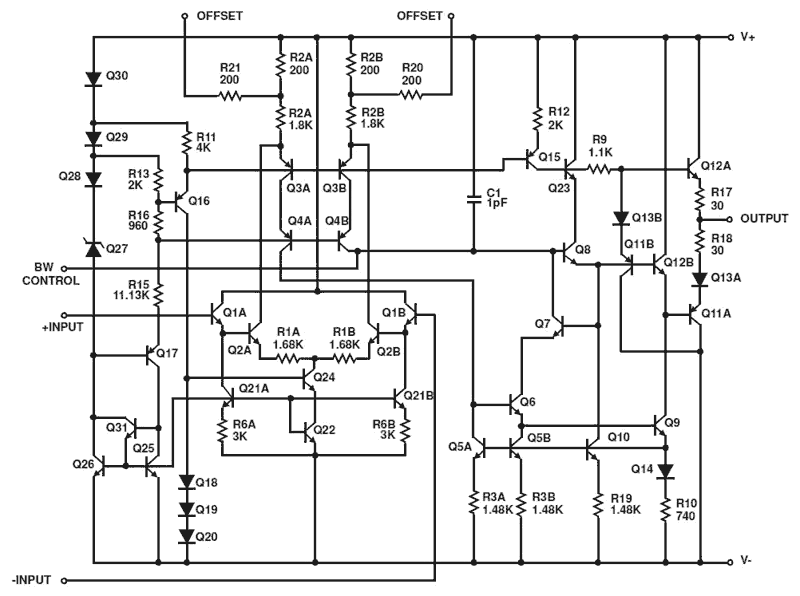
The HS-2520RH is a radiation hardened monolithic operational amplifier which delivers an unsurpassed combination of specifications for slew rate, bandwidth, and settling time. This dielectrically isolated amplifier is designed for closed loop gains of 3 or greater without external compensation. In addition, this high-performance component also provides low offset current and high input impedance. The 100V/µs (Min) slew rate and fast settling time of this amplifier make it an ideal component for pulse amplification and data acquisition designs. To ensure compliance with slew rate and transient response specifications, all devices are 100% tested for AC performance characteristics over full temperature. This device is a valuable component for RF and video circuitry requiring wideband operation. For accurate signal conditioning designs, the HS-2520RH's superior dynamic specifications are complemented by 25nA (Max) offset current and offset voltage trim capability. Specifications for Rad Hard QML devices are controlled by the Defense Supply Center in Columbus (DSCC). The SMD numbers listed here must be used when ordering. Detailed Electrical Specifications for these devices are contained in SMD 5962-95685. A hot-link is provided on our homepage for downloading.
Applications
- Data Acquisition Systems
- RF Amplifiers
- Video Amplifiers
- Signal Generators
- PulseAmplifiers
| Part Number | Status | Samples | Stock | Package | Lead Count (#) | Carrier Type | Moisture Sensitivity Level (MSL) | Pitch (mm) | Pkg. Dimensions (mm) | DLA SMD | Pb (Lead) Free | Pb Free Category | MOQ | Temp. Range (°C) | CAGE code |
|---|---|---|---|---|---|---|---|---|---|---|---|---|---|---|---|
| HS2-2520RH-Q | Obsolete | N/A | Out of Stock | CAN | 8# | Tray | Not Applicable | 5.1mm | 9.1 x 9.1 x 0.00 | 5962-95685 | No | Hot Solder dip over Compliant Undercoat | 25 | -55 to +125°C | 34371 |
| HS7B-2520RH-Q | Obsolete | N/A | Out of Stock | SBDIP | 8# | Box | Not Applicable | 2.5mm | 9.9 x 7.5 x 2.41 | 5962-95685 | Yes | Gold Plate over compliant Undercoat-e4 | 25 | -55 to +125°C | 34371 |
- Application NotePDF 263 KB r13an0003eu0100-biasing-op-amps Dec 06, 2019AI-generated Summary: Proper biasing of operational amplifiers is essential to avoid malfunction in AC-coupled circuits. A missing DC bias path causes long stabilization times and potential failures. Adding input resistors to ground provides a DC path for bias currents, minimizing offset errors. For single-supply AC-coupled amplifiers, biasing uses a reference voltage, ideally from a high-PSRR voltage reference or buffered voltage divider, to maintain signal symmetry and reduce noise. Understanding frequency responses of input and feedback components is crucial for setting bandwidth and gain characteristics.
- Application NotePDF 338 KB an9867 Nov 10, 1999AI-generated Summary: Electrical parameters are monitored during life testing to detect drift and failures, defined by exceeding datasheet limits. New products require less than 1% failure during burn-in, with failure analysis and corrective actions if exceeded. Sampling plans ensure defect rates below 3%. Life tests last 1000-3000 hours at 125°C depending on process maturity. Failure mechanisms include electromigration, ionic contamination, hot carrier injection, and dielectric rupture. Product sign-off requires all parties' approval after reliability confirmation. Space products undergo burn-in and quality conformance inspections with strict failure limits. Derating is unnecessary as datasheet limits are set at 6-sigma from characterization data, ensuring reliability.
- Application NotePDF 224 KB an9654 May 05, 1999AI-generated Summary: The document explains the reliability and failure mechanisms of semiconductor parts, focusing on life testing and wearout. It discusses how switching states cause transient current pulses and hot carrier injection, which only occur briefly during switching. Life testing at elevated temperatures accelerates aging to remove infant mortality failures, improving reliability. The failure rate follows a bathtub curve with infant mortality, useful life, and wearout phases, modeled by lognormal and exponential distributions. The Arrhenius equation relates failure rates at different temperatures. Burn-in and life tests reduce early failures without harming intrinsic reliability.
Recommended Documents (1)
Datasheets (1)
No Results Found.
Make sure all keywords are spelled correctly.
Try fewer, different, or more general terms to vary your search.
If you have filters applied, consider deselecting some to broaden your results.
- Search our extensive knowledgebase, designed to help customers with their FAQs.
- Get help from our expert Renesas technical staff and community on our support forums.
- Application NotePDF 263 KB r13an0003eu0100-biasing-op-amps Dec 06, 2019AI-generated Summary: Proper biasing of operational amplifiers is essential to avoid malfunction in AC-coupled circuits. A missing DC bias path causes long stabilization times and potential failures. Adding input resistors to ground provides a DC path for bias currents, minimizing offset errors. For single-supply AC-coupled amplifiers, biasing uses a reference voltage, ideally from a high-PSRR voltage reference or buffered voltage divider, to maintain signal symmetry and reduce noise. Understanding frequency responses of input and feedback components is crucial for setting bandwidth and gain characteristics.
- Application NotePDF 338 KB an9867 Nov 10, 1999AI-generated Summary: Electrical parameters are monitored during life testing to detect drift and failures, defined by exceeding datasheet limits. New products require less than 1% failure during burn-in, with failure analysis and corrective actions if exceeded. Sampling plans ensure defect rates below 3%. Life tests last 1000-3000 hours at 125°C depending on process maturity. Failure mechanisms include electromigration, ionic contamination, hot carrier injection, and dielectric rupture. Product sign-off requires all parties' approval after reliability confirmation. Space products undergo burn-in and quality conformance inspections with strict failure limits. Derating is unnecessary as datasheet limits are set at 6-sigma from characterization data, ensuring reliability.
- Application NotePDF 224 KB an9654 May 05, 1999AI-generated Summary: The document explains the reliability and failure mechanisms of semiconductor parts, focusing on life testing and wearout. It discusses how switching states cause transient current pulses and hot carrier injection, which only occur briefly during switching. Life testing at elevated temperatures accelerates aging to remove infant mortality failures, improving reliability. The failure rate follows a bathtub curve with infant mortality, useful life, and wearout phases, modeled by lognormal and exponential distributions. The Arrhenius equation relates failure rates at different temperatures. Burn-in and life tests reduce early failures without harming intrinsic reliability.
Application Notes & White Papers (3)
No Results Found.
Make sure all keywords are spelled correctly.
Try fewer, different, or more general terms to vary your search.
If you have filters applied, consider deselecting some to broaden your results.
- Search our extensive knowledgebase, designed to help customers with their FAQs.
- Get help from our expert Renesas technical staff and community on our support forums.
No Results Found.
Make sure all keywords are spelled correctly.
Try fewer, different, or more general terms to vary your search.
If you have filters applied, consider deselecting some to broaden your results.
- Search our extensive knowledgebase, designed to help customers with their FAQs.
- Get help from our expert Renesas technical staff and community on our support forums.
No Results Found.
Make sure all keywords are spelled correctly.
Try fewer, different, or more general terms to vary your search.
If you have filters applied, consider deselecting some to broaden your results.
- Search our extensive knowledgebase, designed to help customers with their FAQs.
- Get help from our expert Renesas technical staff and community on our support forums.
No Results Found.
Make sure all keywords are spelled correctly.
Try fewer, different, or more general terms to vary your search.
If you have filters applied, consider deselecting some to broaden your results.
- Search our extensive knowledgebase, designed to help customers with their FAQs.
- Get help from our expert Renesas technical staff and community on our support forums.
No Results Found.
Make sure all keywords are spelled correctly.
Try fewer, different, or more general terms to vary your search.
If you have filters applied, consider deselecting some to broaden your results.
- Search our extensive knowledgebase, designed to help customers with their FAQs.
- Get help from our expert Renesas technical staff and community on our support forums.
No Results Found.
Make sure all keywords are spelled correctly.
Try fewer, different, or more general terms to vary your search.
If you have filters applied, consider deselecting some to broaden your results.
- Search our extensive knowledgebase, designed to help customers with their FAQs.
- Get help from our expert Renesas technical staff and community on our support forums.
No Results Found.
Make sure all keywords are spelled correctly.
Try fewer, different, or more general terms to vary your search.
If you have filters applied, consider deselecting some to broaden your results.
- Search our extensive knowledgebase, designed to help customers with their FAQs.
- Get help from our expert Renesas technical staff and community on our support forums.
Marketing Collateral (1)
No Results Found.
Make sure all keywords are spelled correctly.
Try fewer, different, or more general terms to vary your search.
If you have filters applied, consider deselecting some to broaden your results.
- Search our extensive knowledgebase, designed to help customers with their FAQs.
- Get help from our expert Renesas technical staff and community on our support forums.
No Results Found.
Make sure all keywords are spelled correctly.
Try fewer, different, or more general terms to vary your search.
If you have filters applied, consider deselecting some to broaden your results.
- Search our extensive knowledgebase, designed to help customers with their FAQs.
- Get help from our expert Renesas technical staff and community on our support forums.