Features
- Complete 12-Bit A/D Converter with Reference and Clock
- Full 8-Bit, 12-Bit or 16-Bit Microprocessor Bus Interface
- Bus Access Time 150ns
- No Missing Codes Over Temperature
- Minimal Setup Time for Control Signals
- Fast Conversion Times
- HI-574A (Max) 25µs
- HI-674A (Max) 15µs
- Low Noise, via Current-Mode Signal Transmission Between Chips
- Byte Enable/Short Cycle (AO Input)
- Guaranteed Break-Before-Make Action, Eliminating Bus Contention During Read Operation. Latched by Start Convert Input (To Set the Conversion Length)
- Supply Voltage ±12V to ±15V
- Pb-Free Available (RoHS Compliant)
Description
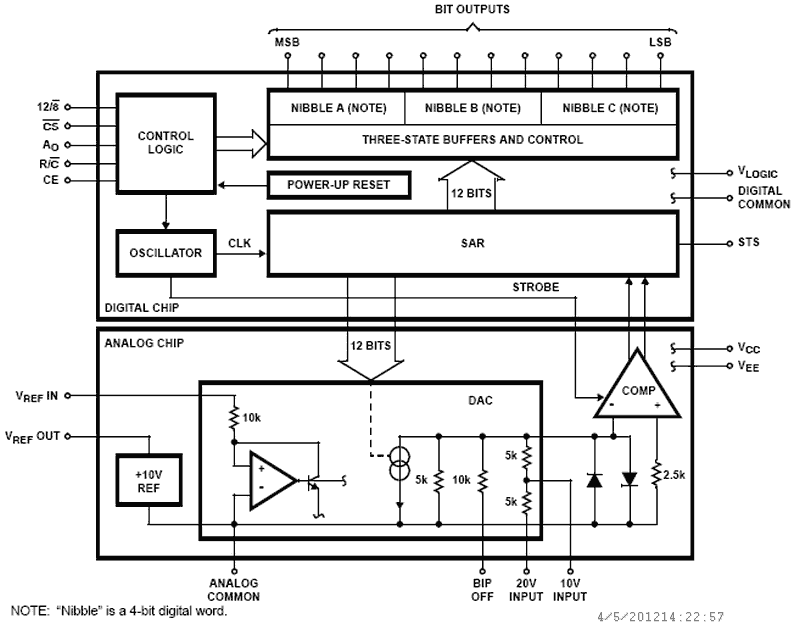
The HI-X74(A) is a complete 12-bit, Analog-to-Digital Converter, including a +10V reference clock, three-state outputs and a digital interface for microprocessor control. Successive approximation conversion is performed by two monolithic dice housed in a 28 lead package. The bipolar analog die features the Intersil Dielectric Isolation process, which provides enhanced AC performance and freedom from latch-up. Custom design of each IC (bipolar analog and CMOS digital) has yielded improved performance over existing versions of this converter. The voltage comparator features high PSRR plus a High-Speed current-mode latch, and provides precise decisions down to 0. 1 LSB of input overdrive. More than 2X reduction in noise has been achieved by using current instead of voltage for transmission of all signals between the analog and digital ICs. Also, the clock oscillator is current controlled for excellent stability over temperature. The HI-X74(A) offers standard unipolar and bipolar input ranges, laser trimmed for specified linearity, gain and offset accuracy. The low noise buried zener reference circuit is trimmed for minimum temperature coefficient. Power requirements are +5V and ±12V to ±15V, with typical dissipation of 385mW (HI-574A/674A) at 12V.
Applications
- Military and Industrial Data Acquisition Systems
- Electronic Test and Scientific Instrumentation
- Process Control Systems
| Part Number | Status | Samples | Stock | Package | Lead Count (#) | Carrier Type | Moisture Sensitivity Level (MSL) | Pb (Lead) Free | Pb Free Category | Temp. Range (°C) |
|---|---|---|---|---|---|---|---|---|---|---|
| HI1-674AKD-5 | Obsolete | N/A | In Stock | SBDIP | 28# | Tube | Not Applicable | Yes | Gold Plate-e4 | See Datasheet |
Filters
Applied Filters
- Product Change NoticePDF 260 KB PCN16087 Sep 30, 2016
- Product Change NoticePDF 134 KB PCN11041 Apr 07, 2011
- Application NotePDF 843 KB an535 Jun 05, 2002AI-generated Summary: A Data Acquisition System (DAS) requires careful design of signal conditioning, transducer selection, and signal transmission to ensure high accuracy. Signal conditioning includes multiplexing, amplification, filtering, and calibration, ideally performed near the transducer. Transducers convert physical variables to electrical signals, often voltage, with low source resistance preferred. Signal paths can be single-ended or differential; differential paths better reject common mode noise, especially for low-level signals. Shielded twisted pairs and balanced lines reduce interference. Filters, typically Butterworth low-pass, prevent aliasing and maintain signal integrity.
- Application NotePDF 503 KB an9675 Aug 13, 1999AI-generated Summary: Effective Number of Bits (ENOB) depends critically on precise coherence in A/D sampling, with small frequency shifts significantly impacting accuracy. Unwrapping reconstructs coherently sampled sine waves, while windowing controls spectral leakage by shaping the acquisition window. Resampling and interpolation adjust sample sets to avoid leakage in FFT analysis. Different window functions balance side lobe levels and bandwidth, affecting spectral resolution and leakage reduction.
- Application NotePDF 1.08 MB an002 Nov 19, 1998AI-generated Summary: Data acquisition and conversion involve quantization, where the smallest resolvable analog difference (quantum) depends on the full scale range and resolution. Quantization introduces an irreducible error called quantizing error or noise. Aperture time, the conversion time uncertainty, causes amplitude errors when signals change during conversion. Sample-hold circuits reduce aperture time by storing sampled signals. The Sampling Theorem states that sampling frequency must be at least twice the highest signal frequency to avoid distortion from frequency folding or aliasing. Natural binary code is commonly used for digital representation in converters, with the most and least significant bits defining the code's resolution and value.
- Application NotePDF 508 KB an9510 Aug 19, 1998AI-generated Summary: The document explains fundamental analog circuit concepts for digital designers, focusing on superposition, Thevenin equivalent circuits, and feedback principles. It details the operation and assumptions of inverting and non-inverting op amps, differential amplifiers, and the use of T networks in feedback paths. The text highlights the importance of feedback in controlling closed-loop gain and stability, and distinguishes between voltage and current feedback op amps, especially in high-frequency applications like video amplifiers.
- Application NotePDF 287 KB an9705 Feb 21, 1997AI-generated Summary: Coherent sampling requires the ratio of signal frequency to sampling frequency to be a rational number, expressed as ko/N. When this condition is not met, frequency smearing occurs across bins. Data Acquisition Systems (DAS) can mitigate this by windowing, fixing sampling frequency and tuning input frequency, or fixing input frequency and tuning sampling frequency. The latter two methods are practical for most systems. Pseudo-code illustrates the frequency response for non-integer ko values.
Recommended Documents (1)
Datasheets (1)
No Results Found.
Make sure all keywords are spelled correctly.
Try fewer, different, or more general terms to vary your search.
If you have filters applied, consider deselecting some to broaden your results.
- Search our extensive knowledgebase, designed to help customers with their FAQs.
- Get help from our expert Renesas technical staff and community on our support forums.
- Application NotePDF 843 KB an535 Jun 05, 2002AI-generated Summary: A Data Acquisition System (DAS) requires careful design of signal conditioning, transducer selection, and signal transmission to ensure high accuracy. Signal conditioning includes multiplexing, amplification, filtering, and calibration, ideally performed near the transducer. Transducers convert physical variables to electrical signals, often voltage, with low source resistance preferred. Signal paths can be single-ended or differential; differential paths better reject common mode noise, especially for low-level signals. Shielded twisted pairs and balanced lines reduce interference. Filters, typically Butterworth low-pass, prevent aliasing and maintain signal integrity.
- Application NotePDF 503 KB an9675 Aug 13, 1999AI-generated Summary: Effective Number of Bits (ENOB) depends critically on precise coherence in A/D sampling, with small frequency shifts significantly impacting accuracy. Unwrapping reconstructs coherently sampled sine waves, while windowing controls spectral leakage by shaping the acquisition window. Resampling and interpolation adjust sample sets to avoid leakage in FFT analysis. Different window functions balance side lobe levels and bandwidth, affecting spectral resolution and leakage reduction.
- Application NotePDF 1.08 MB an002 Nov 19, 1998AI-generated Summary: Data acquisition and conversion involve quantization, where the smallest resolvable analog difference (quantum) depends on the full scale range and resolution. Quantization introduces an irreducible error called quantizing error or noise. Aperture time, the conversion time uncertainty, causes amplitude errors when signals change during conversion. Sample-hold circuits reduce aperture time by storing sampled signals. The Sampling Theorem states that sampling frequency must be at least twice the highest signal frequency to avoid distortion from frequency folding or aliasing. Natural binary code is commonly used for digital representation in converters, with the most and least significant bits defining the code's resolution and value.
- Application NotePDF 508 KB an9510 Aug 19, 1998AI-generated Summary: The document explains fundamental analog circuit concepts for digital designers, focusing on superposition, Thevenin equivalent circuits, and feedback principles. It details the operation and assumptions of inverting and non-inverting op amps, differential amplifiers, and the use of T networks in feedback paths. The text highlights the importance of feedback in controlling closed-loop gain and stability, and distinguishes between voltage and current feedback op amps, especially in high-frequency applications like video amplifiers.
- Application NotePDF 287 KB an9705 Feb 21, 1997AI-generated Summary: Coherent sampling requires the ratio of signal frequency to sampling frequency to be a rational number, expressed as ko/N. When this condition is not met, frequency smearing occurs across bins. Data Acquisition Systems (DAS) can mitigate this by windowing, fixing sampling frequency and tuning input frequency, or fixing input frequency and tuning sampling frequency. The latter two methods are practical for most systems. Pseudo-code illustrates the frequency response for non-integer ko values.
Application Notes & White Papers (5)
- Product Change NoticePDF 260 KB PCN16087 Sep 30, 2016
- Product Change NoticePDF 134 KB PCN11041 Apr 07, 2011
Product Notices (PCN, EOL, etc) (3)
No Results Found.
Make sure all keywords are spelled correctly.
Try fewer, different, or more general terms to vary your search.
If you have filters applied, consider deselecting some to broaden your results.
- Search our extensive knowledgebase, designed to help customers with their FAQs.
- Get help from our expert Renesas technical staff and community on our support forums.
No Results Found.
Make sure all keywords are spelled correctly.
Try fewer, different, or more general terms to vary your search.
If you have filters applied, consider deselecting some to broaden your results.
- Search our extensive knowledgebase, designed to help customers with their FAQs.
- Get help from our expert Renesas technical staff and community on our support forums.
No Results Found.
Make sure all keywords are spelled correctly.
Try fewer, different, or more general terms to vary your search.
If you have filters applied, consider deselecting some to broaden your results.
- Search our extensive knowledgebase, designed to help customers with their FAQs.
- Get help from our expert Renesas technical staff and community on our support forums.
No Results Found.
Make sure all keywords are spelled correctly.
Try fewer, different, or more general terms to vary your search.
If you have filters applied, consider deselecting some to broaden your results.
- Search our extensive knowledgebase, designed to help customers with their FAQs.
- Get help from our expert Renesas technical staff and community on our support forums.
No Results Found.
Make sure all keywords are spelled correctly.
Try fewer, different, or more general terms to vary your search.
If you have filters applied, consider deselecting some to broaden your results.
- Search our extensive knowledgebase, designed to help customers with their FAQs.
- Get help from our expert Renesas technical staff and community on our support forums.
No Results Found.
Make sure all keywords are spelled correctly.
Try fewer, different, or more general terms to vary your search.
If you have filters applied, consider deselecting some to broaden your results.
- Search our extensive knowledgebase, designed to help customers with their FAQs.
- Get help from our expert Renesas technical staff and community on our support forums.
Marketing Collateral (1)
No Results Found.
Make sure all keywords are spelled correctly.
Try fewer, different, or more general terms to vary your search.
If you have filters applied, consider deselecting some to broaden your results.
- Search our extensive knowledgebase, designed to help customers with their FAQs.
- Get help from our expert Renesas technical staff and community on our support forums.
No Results Found.
Make sure all keywords are spelled correctly.
Try fewer, different, or more general terms to vary your search.
If you have filters applied, consider deselecting some to broaden your results.
- Search our extensive knowledgebase, designed to help customers with their FAQs.
- Get help from our expert Renesas technical staff and community on our support forums.
No Results Found.
Make sure all keywords are spelled correctly.
Try fewer, different, or more general terms to vary your search.
If you have filters applied, consider deselecting some to broaden your results.
- Search our extensive knowledgebase, designed to help customers with their FAQs.
- Get help from our expert Renesas technical staff and community on our support forums.