
Features
- Solid-State Potentiometer
- SPI Serial Interface
- Register Oriented Format
- Direct read/write/transfer wiper positions
- Store as many as four positions per potentiometer
- Power Supplies
- VCC = 2.7V to 5.5V
- V+ = 2.7V to 5.5V
- V- = -2.7V to -5.5V
- Low Power CMOS
- Standby current 1µA
- High Reliability
- Endurance-100,000 data changes per bit per register
- Register data retention-100 years
- 8-bytes of Nonvolatile EEPROM Memory
- 10kΩ or 2.5kΩ Resistor Arrays
- Resolution: 64 Taps Each Pot
- 14 Ld TSSOP and 16 Ld SOIC Packages
- Pb-Free Plus Anneal Available (RoHS Compliant)
Description
Support is limited to customers who have already adopted these products.
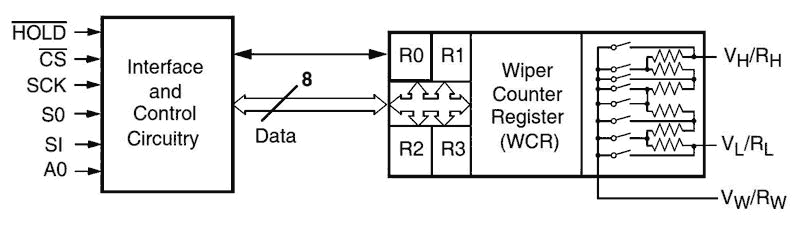
The X9420 integrates a single digitally controlled potentiometers (XDCP) on a monolithic CMOS integrated microcircuit. The digitally controlled potentiometer is implemented using 63 resistive elements in a series array. Between each element are tap points connected to the wiper terminal through switches. The position of the wiper on the array is controlled by the user through the SPI bus interface. The potentiometer has associated with it a volatile Wiper Counter Register (WCR) and 4 nonvolatile Data Registers (DR0:DR3) that can be directly written to and read by the user. The contents of the WCR controls the position of the wiper on the resistor array through the switches. Power-up recalls the contents of DR0 to the WCR. The XDCP can be used as a three-terminal potentiometer or as a two-terminal variable resistor in a wide variety of applications including control, parameter adjustments, and signal processing.
| Part Number | Status | Samples | Stock | Package | Carrier Type | MOQ |
|---|---|---|---|---|---|---|
| X9420WV14IZ-2.7 | Obsolete | N/A | In Stock | TSSOP | Tube | 190 |
Filters
Applied Filters
- Manual - Development ToolsPDF 2.16 MB AN1555 Sep 17, 2025
- End Of Life NoticePDF 270 KB PLC14054 Nov 26, 2014
- Product Change NoticePDF 121 KB PCN11113A Aug 13, 2012
- Product Change NoticePDF 120 KB PCN11113 Oct 31, 2011
- Application NotePDF 281 KB an1425 May 22, 2008AI-generated Summary: Digitally Controlled Potentiometers (DCPs) offer precise resistance control with configurations in both serial and parallel modes, featuring fixed resistors and various resistance options. The ISL22317 model provides 1% precision with 128 taps and can function as a two-terminal variable resistor or three-terminal potentiometer, delivering high accuracy and low temperature coefficient. DCPs can outperform DACs in fine tuning within limited ranges, offering better resolution with fewer bits. Resolution varies with voltage and tap count, as detailed in the provided tables. Usage guidelines and liability disclaimers emphasize proper application and safety considerations.
- Application NotePDF 750 KB an139 Jun 30, 2005AI-generated Summary: The document details the design of power supplies using Intersil’s XDCP mixed signal products. It explains four key circuit schematics: Front End, Power Mesh, Secondary Control, and Primary Control, highlighting their interconnections. The Front End converts AC line power to an unregulated 320V DC, incorporating protection and EMI filtering components. The Power Mesh is a single switch forward DC/DC converter that regulates 320V DC to 12V DC at 10A, using a cascode transistor arrangement and a digitally controlled switching frequency to meet EMI requirements.
- Application NotePDF 534 KB an133 Jun 06, 2005AI-generated Summary: The document explains how digitally controlled potentiometers (XDCPs) enable programmability in amplifier circuits by adjusting cutoff frequency and gain. It details the design of a non-inverting amplifier with variable resistors forming an RC low pass filter and gain control. Techniques to reduce potentiometer resistance for high-frequency applications are described, allowing gain from 1 to 2 and cutoff frequency from 130kHz to over 1MHz. The amplifier’s parameters are controlled via a serial bus, enabling computer-based customization.
- Application NotePDF 467 KB an1149 May 03, 2005AI-generated Summary: The document details circuits using Intersil digitally controlled potentiometers (X9C103, X9312) combined with op amps (LT1226, OP37, LT1028) for applications like null adjustment, amplifier biasing, and proportional-integral temperature control. It explains modes controlled by NADJ/ADJ signals, automatic nulling via feedback loops, and bias stabilization in high-output buffer amplifiers. The circuits optimize gain, bandwidth, noise, and minimize distortion and power consumption. It also covers clocking options for nulling and temperature control using digital potentiometers and comparators.
- Application NotePDF 280 KB an1157 Apr 29, 2005AI-generated Summary: Digitally controlled potentiometers (XDCPs) enable precise power supply and DC to DC converter control by allowing cascading configurations for fine and coarse voltage adjustments. These devices store wiper settings in nonvolatile memory, ensuring long-term reliability and simplifying manufacturing and testing. XDCPs improve repeatability, reduce human error, and enhance resistance to environmental stress, making them superior to mechanical potentiometers in power applications.
- Application NotePDF 324 KB an124 Apr 27, 2005AI-generated Summary: Digitally-controlled potentiometers have key analog parameters including number of taps (16 to 256), end-to-end resistance (1kΩ to 1MΩ), wiper resistance (~40Ω), wiper current (1-3mA), power rating (10-50mW), resolution, noise, linearity, and temperature coefficients. Voltage limits range from ±5V to ±15V on pins. Absolute linearity ensures accuracy within one least significant bit, while relative linearity guarantees tap-to-tap accuracy within 0.2 LSB. Temperature coefficients affect resistance stability. Various circuit techniques exist to mitigate these limitations. The document also includes usage notices, quality grades, and liability disclaimers from Renesas Electronics.
- Application NotePDF 239 KB an1155 Apr 21, 2005AI-generated Summary: Renesas Electronics provides circuit and software information solely for illustrating semiconductor product operations and application examples. Users bear full responsibility for integrating these into their designs. Renesas disclaims liability for damages from usage, alteration, or reverse engineering. Products are categorized into Standard and High Quality grades, with specific intended applications. Users must follow specified usage conditions and comply with laws, including export controls and environmental regulations. Safety measures are the user's responsibility, especially for critical applications. Contact Renesas sales for further details.
- Application NotePDF 384 KB an1145 Apr 20, 2005AI-generated Summary: The pages present various application circuits for digitally-controlled potentiometers, including attenuators, filters, inverting amplifiers, equivalent L-R circuits, function generators, I-to-V converters, current sources, phase shifters, capacitance multipliers, absolute value amplifiers with gain, level detectors, and oscillators. Each circuit diagram includes component values and configurations to demonstrate practical implementations using Intersil XDCP potentiometers.
- Application NotePDF 251 KB an1699 Jan 19, 2004AI-generated Summary: This document outlines important legal disclaimers and usage guidelines for semiconductor products. It emphasizes user responsibility for product design, disclaims liability for damages, and prohibits unauthorized modifications or reverse engineering. Products are categorized by quality grades with specific application recommendations. Users must comply with safety, environmental, and export regulations. Renesas disclaims warranties and liability for improper use or noncompliance. Contact information for global sales offices is provided.
Recommended Documents (1)
Datasheets (1)
- Manual - Development ToolsPDF 2.16 MB AN1555 Sep 17, 2025
Manuals & Guides (1)
- Application NotePDF 281 KB an1425 May 22, 2008AI-generated Summary: Digitally Controlled Potentiometers (DCPs) offer precise resistance control with configurations in both serial and parallel modes, featuring fixed resistors and various resistance options. The ISL22317 model provides 1% precision with 128 taps and can function as a two-terminal variable resistor or three-terminal potentiometer, delivering high accuracy and low temperature coefficient. DCPs can outperform DACs in fine tuning within limited ranges, offering better resolution with fewer bits. Resolution varies with voltage and tap count, as detailed in the provided tables. Usage guidelines and liability disclaimers emphasize proper application and safety considerations.
- Application NotePDF 750 KB an139 Jun 30, 2005AI-generated Summary: The document details the design of power supplies using Intersil’s XDCP mixed signal products. It explains four key circuit schematics: Front End, Power Mesh, Secondary Control, and Primary Control, highlighting their interconnections. The Front End converts AC line power to an unregulated 320V DC, incorporating protection and EMI filtering components. The Power Mesh is a single switch forward DC/DC converter that regulates 320V DC to 12V DC at 10A, using a cascode transistor arrangement and a digitally controlled switching frequency to meet EMI requirements.
- Application NotePDF 534 KB an133 Jun 06, 2005AI-generated Summary: The document explains how digitally controlled potentiometers (XDCPs) enable programmability in amplifier circuits by adjusting cutoff frequency and gain. It details the design of a non-inverting amplifier with variable resistors forming an RC low pass filter and gain control. Techniques to reduce potentiometer resistance for high-frequency applications are described, allowing gain from 1 to 2 and cutoff frequency from 130kHz to over 1MHz. The amplifier’s parameters are controlled via a serial bus, enabling computer-based customization.
- Application NotePDF 467 KB an1149 May 03, 2005AI-generated Summary: The document details circuits using Intersil digitally controlled potentiometers (X9C103, X9312) combined with op amps (LT1226, OP37, LT1028) for applications like null adjustment, amplifier biasing, and proportional-integral temperature control. It explains modes controlled by NADJ/ADJ signals, automatic nulling via feedback loops, and bias stabilization in high-output buffer amplifiers. The circuits optimize gain, bandwidth, noise, and minimize distortion and power consumption. It also covers clocking options for nulling and temperature control using digital potentiometers and comparators.
- Application NotePDF 280 KB an1157 Apr 29, 2005AI-generated Summary: Digitally controlled potentiometers (XDCPs) enable precise power supply and DC to DC converter control by allowing cascading configurations for fine and coarse voltage adjustments. These devices store wiper settings in nonvolatile memory, ensuring long-term reliability and simplifying manufacturing and testing. XDCPs improve repeatability, reduce human error, and enhance resistance to environmental stress, making them superior to mechanical potentiometers in power applications.View More (13)
Application Notes & White Papers (13)
- End Of Life NoticePDF 270 KB PLC14054 Nov 26, 2014
- Product Change NoticePDF 121 KB PCN11113A Aug 13, 2012
- Product Change NoticePDF 120 KB PCN11113 Oct 31, 2011
Product Notices (PCN, EOL, etc) (4)
No Results Found.
Make sure all keywords are spelled correctly.
Try fewer, different, or more general terms to vary your search.
If you have filters applied, consider deselecting some to broaden your results.
- Search our extensive knowledgebase, designed to help customers with their FAQs.
- Get help from our expert Renesas technical staff and community on our support forums.
Marketing Collateral (1)
Other (1)
No Results Found.
Make sure all keywords are spelled correctly.
Try fewer, different, or more general terms to vary your search.
If you have filters applied, consider deselecting some to broaden your results.
- Search our extensive knowledgebase, designed to help customers with their FAQs.
- Get help from our expert Renesas technical staff and community on our support forums.
Filters
Applied Filters
Software & Tools
Filter by Type
Filter by Provider
Sample Code
Filter by Application
Filter by Function
Filter by Compiler
Filter by IDE
Simulation Models
Partner Solutions
No Results Found.
Make sure all keywords are spelled correctly.
Try fewer, different, or more general terms to vary your search.
If you have filters applied, consider deselecting some to broaden your results.
- Search our extensive knowledgebase, designed to help customers with their FAQs.
- Get help from our expert Renesas technical staff and community on our support forums.
Software & Tools (1)
No Results Found.
Make sure all keywords are spelled correctly.
Try fewer, different, or more general terms to vary your search.
If you have filters applied, consider deselecting some to broaden your results.
- Search our extensive knowledgebase, designed to help customers with their FAQs.
- Get help from our expert Renesas technical staff and community on our support forums.

Support Communities


