
Features
- Four variable resistors in one package
- 256 resistor taps - 0.4% resolution
- I2C serial interface
- Wiper resistance: 70Ω typical @ 3.3V
- Standby current <5µA max
- Power supply: 2.7V to 5.5V
- 50kΩ, 10kΩ total resistance
- 14 Lead TSSOP
- Pb-free plus anneal available (RoHS compliant)
Description
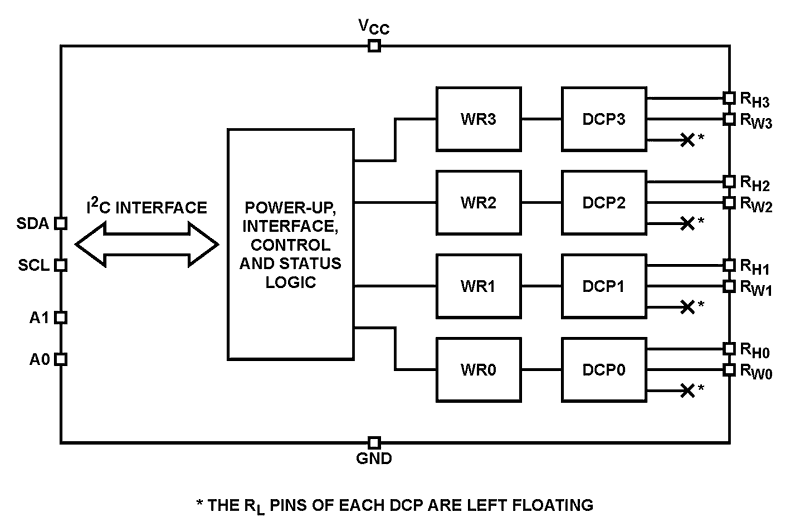
The ISL90842 integrates four digitally controlled potentiometers (DCP) configured as variable resistors on a monolithic CMOS integrated circuit. The digitally controlled potentiometers are implemented with a combination of resistor elements and CMOS switches. The position of the wipers are controlled by the user through the I2C bus interface. Each potentiometer has an associated Wiper Register (WR) that can be directly written to and read by the user. The contents of the WR controls the position of the wiper. The DCPs can be used as two-terminal variable resistors in a wide variety of applications including control, parameter adjustments, and signal processing.
| Part Number | Status | Samples | Stock | RoHS | Package | Budgetary Price (USD) | Lead Count (#) | Carrier Type | Moisture Sensitivity Level (MSL) | Resistance Options (kΩ) | Pb (Lead) Free | Pb Free Category | Temp. Range (°C) | Country of Assembly | Country of Wafer Fabrication |
|---|---|---|---|---|---|---|---|---|---|---|---|---|---|---|---|
| ISL90842UIV1427Z | Obsolete | N/A | In Stock | RoHS:EN | TSSOP | 1ku | $4.46 | 14# | Tube | 2 | 50kΩ | Yes | Pb-Free 100% Matte Tin Plate w/Anneal-e3 | -40 to +85°C | THAILAND | SINGAPORE |
| ISL90842UIV1427Z-TK | Obsolete | N/A | Out of Stock | RoHS:EN | TSSOP | 1ku | $4.46 | 14# | Reel | 2 | 50kΩ | Yes | Pb-Free 100% Matte Tin Plate w/Anneal-e3 | -40 to +85°C | THAILAND | SINGAPORE |
| ISL90842WIV1427Z | Obsolete | N/A | Out of Stock | RoHS:EN | TSSOP | 14# | Tube | 2 | 10kΩ | Yes | Pb-Free 100% Matte Tin Plate w/Anneal-e3 | -40 to +85°C | |||
| ISL90842WIV1427Z-TK | Obsolete | N/A | Out of Stock | RoHS:EN | TSSOP | 14# | Reel | 2 | 10kΩ | Yes | Pb-Free 100% Matte Tin Plate w/Anneal-e3 | -40 to +85°C |
Filters
Applied Filters
- Manual - Development ToolsPDF 2.16 MB AN1555 Sep 17, 2025
- Application NotePDF 281 KB an1425 May 22, 2008AI-generated Summary: Digitally Controlled Potentiometers (DCPs) offer precise resistance control with configurations in both serial and parallel modes, featuring fixed resistors and various resistance options. The ISL22317 model provides 1% precision with 128 taps and can function as a two-terminal variable resistor or three-terminal potentiometer, delivering high accuracy and low temperature coefficient. DCPs can outperform DACs in fine tuning within limited ranges, offering better resolution with fewer bits. Resolution varies with voltage and tap count, as detailed in the provided tables. Usage guidelines and liability disclaimers emphasize proper application and safety considerations.
- Application NotePDF 251 KB an1699 Jan 19, 2004AI-generated Summary: This document outlines important legal disclaimers and usage guidelines for semiconductor products. It emphasizes user responsibility for product design, disclaims liability for damages, and prohibits unauthorized modifications or reverse engineering. Products are categorized by quality grades with specific application recommendations. Users must comply with safety, environmental, and export regulations. Renesas disclaims warranties and liability for improper use or noncompliance. Contact information for global sales offices is provided.
- Application NotePDF 513 KB an1173 Jan 19, 2004AI-generated Summary: The document explains how to trim DC/DC converter modules and discrete circuits using digital potentiometers (DCPs) like the ISL95810UIU8. It details resistor values for DOSA and Vicor modules, showing how DCPs adjust output voltage within a ±10% range by changing code values. It also covers output voltage setting and margining techniques for POLA and DOSA modules using external resistors and FETs, highlighting that replacing these with DCPs enables software-controlled voltage adjustment with multiple steps.
- Application NotePDF 503 KB an9675 Aug 13, 1999AI-generated Summary: Effective Number of Bits (ENOB) depends critically on precise coherence in A/D sampling, with small frequency shifts significantly impacting accuracy. Unwrapping reconstructs coherently sampled sine waves, while windowing controls spectral leakage by shaping the acquisition window. Resampling and interpolation adjust sample sets to avoid leakage in FFT analysis. Different window functions balance side lobe levels and bandwidth, affecting spectral resolution and leakage reduction.
- Application NotePDF 287 KB an9705 Feb 21, 1997AI-generated Summary: Coherent sampling requires the ratio of signal frequency to sampling frequency to be a rational number, expressed as ko/N. When this condition is not met, frequency smearing occurs across bins. Data Acquisition Systems (DAS) can mitigate this by windowing, fixing sampling frequency and tuning input frequency, or fixing input frequency and tuning sampling frequency. The latter two methods are practical for most systems. Pseudo-code illustrates the frequency response for non-integer ko values.
Recommended Documents (1)
Datasheets (1)
- Manual - Development ToolsPDF 2.16 MB AN1555 Sep 17, 2025
Manuals & Guides (1)
- Application NotePDF 281 KB an1425 May 22, 2008AI-generated Summary: Digitally Controlled Potentiometers (DCPs) offer precise resistance control with configurations in both serial and parallel modes, featuring fixed resistors and various resistance options. The ISL22317 model provides 1% precision with 128 taps and can function as a two-terminal variable resistor or three-terminal potentiometer, delivering high accuracy and low temperature coefficient. DCPs can outperform DACs in fine tuning within limited ranges, offering better resolution with fewer bits. Resolution varies with voltage and tap count, as detailed in the provided tables. Usage guidelines and liability disclaimers emphasize proper application and safety considerations.
- Application NotePDF 251 KB an1699 Jan 19, 2004AI-generated Summary: This document outlines important legal disclaimers and usage guidelines for semiconductor products. It emphasizes user responsibility for product design, disclaims liability for damages, and prohibits unauthorized modifications or reverse engineering. Products are categorized by quality grades with specific application recommendations. Users must comply with safety, environmental, and export regulations. Renesas disclaims warranties and liability for improper use or noncompliance. Contact information for global sales offices is provided.
- Application NotePDF 513 KB an1173 Jan 19, 2004AI-generated Summary: The document explains how to trim DC/DC converter modules and discrete circuits using digital potentiometers (DCPs) like the ISL95810UIU8. It details resistor values for DOSA and Vicor modules, showing how DCPs adjust output voltage within a ±10% range by changing code values. It also covers output voltage setting and margining techniques for POLA and DOSA modules using external resistors and FETs, highlighting that replacing these with DCPs enables software-controlled voltage adjustment with multiple steps.
- Application NotePDF 503 KB an9675 Aug 13, 1999AI-generated Summary: Effective Number of Bits (ENOB) depends critically on precise coherence in A/D sampling, with small frequency shifts significantly impacting accuracy. Unwrapping reconstructs coherently sampled sine waves, while windowing controls spectral leakage by shaping the acquisition window. Resampling and interpolation adjust sample sets to avoid leakage in FFT analysis. Different window functions balance side lobe levels and bandwidth, affecting spectral resolution and leakage reduction.
- Application NotePDF 287 KB an9705 Feb 21, 1997AI-generated Summary: Coherent sampling requires the ratio of signal frequency to sampling frequency to be a rational number, expressed as ko/N. When this condition is not met, frequency smearing occurs across bins. Data Acquisition Systems (DAS) can mitigate this by windowing, fixing sampling frequency and tuning input frequency, or fixing input frequency and tuning sampling frequency. The latter two methods are practical for most systems. Pseudo-code illustrates the frequency response for non-integer ko values.
Application Notes & White Papers (5)
Product Notices (PCN, EOL, etc) (1)
No Results Found.
Make sure all keywords are spelled correctly.
Try fewer, different, or more general terms to vary your search.
If you have filters applied, consider deselecting some to broaden your results.
- Search our extensive knowledgebase, designed to help customers with their FAQs.
- Get help from our expert Renesas technical staff and community on our support forums.
No Results Found.
Make sure all keywords are spelled correctly.
Try fewer, different, or more general terms to vary your search.
If you have filters applied, consider deselecting some to broaden your results.
- Search our extensive knowledgebase, designed to help customers with their FAQs.
- Get help from our expert Renesas technical staff and community on our support forums.
No Results Found.
Make sure all keywords are spelled correctly.
Try fewer, different, or more general terms to vary your search.
If you have filters applied, consider deselecting some to broaden your results.
- Search our extensive knowledgebase, designed to help customers with their FAQs.
- Get help from our expert Renesas technical staff and community on our support forums.
No Results Found.
Make sure all keywords are spelled correctly.
Try fewer, different, or more general terms to vary your search.
If you have filters applied, consider deselecting some to broaden your results.
- Search our extensive knowledgebase, designed to help customers with their FAQs.
- Get help from our expert Renesas technical staff and community on our support forums.
No Results Found.
Make sure all keywords are spelled correctly.
Try fewer, different, or more general terms to vary your search.
If you have filters applied, consider deselecting some to broaden your results.
- Search our extensive knowledgebase, designed to help customers with their FAQs.
- Get help from our expert Renesas technical staff and community on our support forums.
No Results Found.
Make sure all keywords are spelled correctly.
Try fewer, different, or more general terms to vary your search.
If you have filters applied, consider deselecting some to broaden your results.
- Search our extensive knowledgebase, designed to help customers with their FAQs.
- Get help from our expert Renesas technical staff and community on our support forums.
Marketing Collateral (1)
Other (1)
No Results Found.
Make sure all keywords are spelled correctly.
Try fewer, different, or more general terms to vary your search.
If you have filters applied, consider deselecting some to broaden your results.
- Search our extensive knowledgebase, designed to help customers with their FAQs.
- Get help from our expert Renesas technical staff and community on our support forums.
Filters
Applied Filters
Software & Tools
Filter by Type
Filter by Provider
Sample Code
Filter by Application
Filter by Function
Filter by Compiler
Filter by IDE
Simulation Models
Partner Solutions
No Results Found.
Make sure all keywords are spelled correctly.
Try fewer, different, or more general terms to vary your search.
If you have filters applied, consider deselecting some to broaden your results.
- Search our extensive knowledgebase, designed to help customers with their FAQs.
- Get help from our expert Renesas technical staff and community on our support forums.
Software & Tools (1)
No Results Found.
Make sure all keywords are spelled correctly.
Try fewer, different, or more general terms to vary your search.
If you have filters applied, consider deselecting some to broaden your results.
- Search our extensive knowledgebase, designed to help customers with their FAQs.
- Get help from our expert Renesas technical staff and community on our support forums.
No Results Found.
Make sure all keywords are spelled correctly.
Try fewer, different, or more general terms to vary your search.
If you have filters applied, consider deselecting some to broaden your results.
- Search our extensive knowledgebase, designed to help customers with their FAQs.
- Get help from our expert Renesas technical staff and community on our support forums.
No Results Found.
Make sure all keywords are spelled correctly.
Try fewer, different, or more general terms to vary your search.
If you have filters applied, consider deselecting some to broaden your results.
- Search our extensive knowledgebase, designed to help customers with their FAQs.
- Get help from our expert Renesas technical staff and community on our support forums.
Knowledge Base
-
What is the default wiper tap position for the ISL90842?
Question:What is the default wiper tap position for this part? Answer: The default wiper tap position is 128.

Support Communities


