

| CAD Model: | View CAD Model |
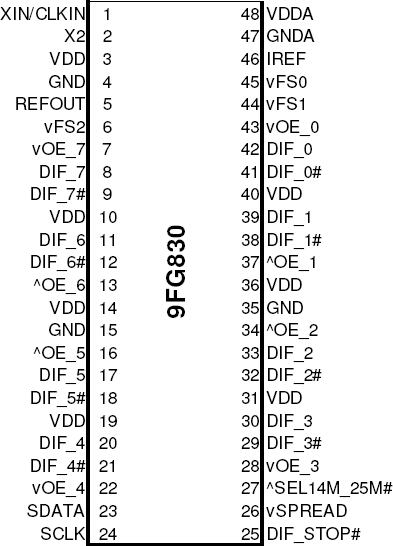
| Pkg. Type: | TSSOP |
| Pkg. Code: | PAG48 |
| Lead Count (#): | 48 |
| Pkg. Dimensions (mm): | 12.5 x 6.1 x 1.0 |
| Pitch (mm): | 0.5 |
| Moisture Sensitivity Level (MSL) | 1 |
| Pb (Lead) Free | Yes |
| ECCN (US) | EAR99 |
| HTS (US) | 8542.39.0090 |
| Lead Count (#) | 48 |
| Carrier Type | Tube |
| Moisture Sensitivity Level (MSL) | 1 |
| Qty. per Reel (#) | 0 |
| Qty. per Carrier (#) | 39 |
| Package Area (mm²) | 76.3 |
| Pitch (mm) | 0.5 |
| Pkg. Dimensions (mm) | 12.5 x 6.1 x 1.0 |
| Pb (Lead) Free | Yes |
| Pb Free Category | e3 Sn |
| Temp. Range (°C) | 0 to 70°C |
| Advanced Features | Programmable Clock, Spread Spectrum, Reference Output |
| App Jitter Compliance | PCIe Gen1, PCIe Gen2, PCIe Gen3 |
| Architecture | Common |
| C-C Jitter Max P-P (ps) | 50 |
| Core Voltage (V) | 3.3 |
| Diff. Output Signaling | HCSL |
| Diff. Outputs | 8 |
| Diff. Termination Resistors | 32 |
| Input Freq (MHz) | 14.3182 - 14.3182, 25 - 25 |
| Input Type | Crystal, LVCMOS |
| Inputs (#) | 1 |
| Length (mm) | 12.5 |
| MOQ | 156 |
| Output Freq Range (MHz) | 100 - 100, 125 - 125, 133.33 - 133.33, 166.67 - 166.67, 200 - 200, 266.67 - 266.67, 333.33 - 333.33, 400 - 400 |
| Output Skew (ps) | 50 |
| Output Type | HCSL, LVCMOS |
| Output Voltage (V) | 0.8V, 3.3V |
| Outputs (#) | 9 |
| PLL | Yes |
| Phase Jitter Max RMS (ps) | 0.2 |
| Pkg. Type | TSSOP |
| Power Consumption Typ (mW) | 594 |
| Price (USD) | $10.22316 |
| Product Category | PCI Express Clocks |
| Prog. Clock | No |
| Prog. Interface | SMBUS |
| Reference Output | Yes |
| Requires Terms and Conditions | Does not require acceptance of Terms and Conditions |
| Spread Spectrum | Yes |
| Supply Voltage (V) | 3.3 - 3.3 |
| Tape & Reel | No |
| Thickness (mm) | 1 |
| Width (mm) | 6.1 |
| Xtal Freq (MHz) | 14.318 - 14.318, 25 - 25 |
| Xtal Inputs (#) | 1 |
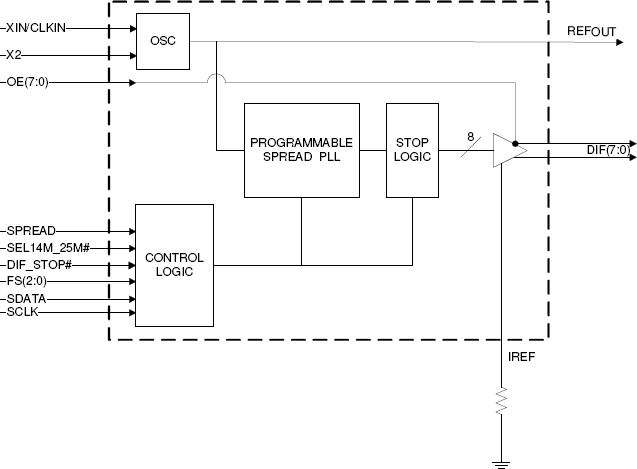
The 9FG830 is a Frequency Timing Generator that provides 8 HCSL differential output pairs. These outputs support PCI-Express Gen3, and QPI applications. The part supports Spread Spectrum and synthesizes several additional output frequencies from either a 14.31818 MHz crystal, a 25 MHz crystal or reference input clock. The 9FG830 also outputs a copy of the reference clock. Complete control of the device is available via strapping pins or via the SMBus interface.
