Features
- 120µA typical supply current for both channels
- 30pA max input bias current
- 100dB CMRR, PSRR
- 0.7µV/°C offset voltage temperature coefficient
- 180kHz 3dB Bandwidth - ISL28271
- 100kHz 3dB Bandwidth - ISL28272
- 0.5V/µs slew rate
- Single supply operation
- Rail-to-rail input and output (RRIO)
- Input is capable of swinging above V+ and below V- (ground sensing)
- 0.081%1 typical gain error - ISL28271
- -0.19%1 typical gain error - ISL28272
- Pb-free available (RoHS compliant)
Description
Support is limited to customers who have already adopted these products.
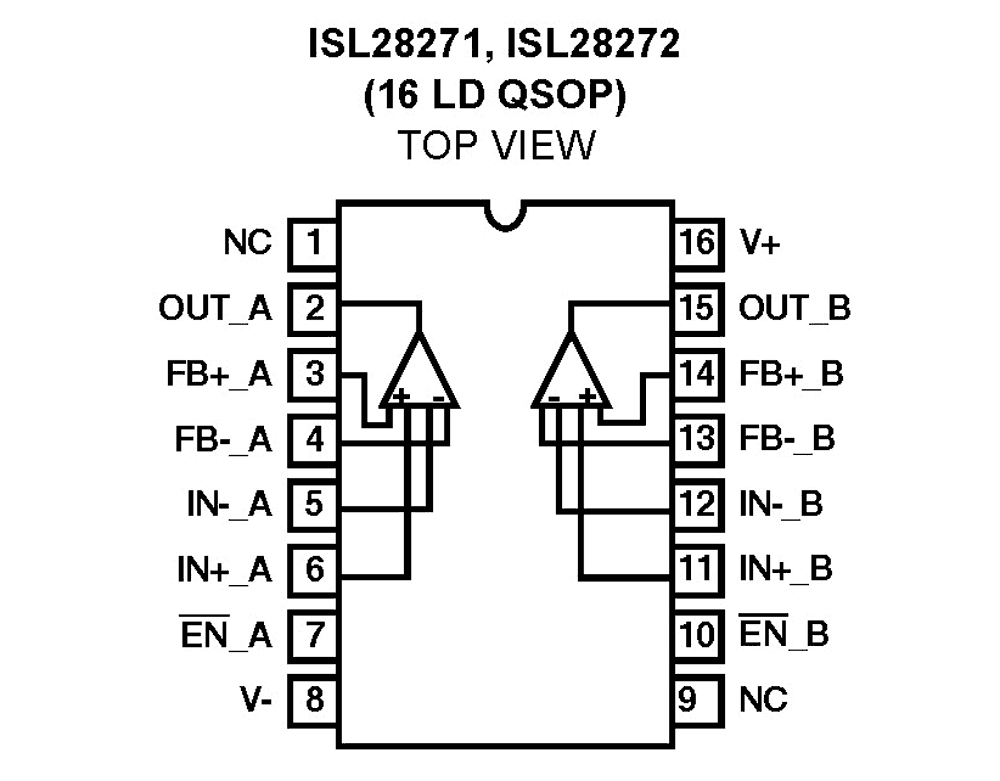
The ISL28271 and ISL28272 are dual micropower instrumentation amplifiers (in-amps) optimized for single supply operation over the +2. 4V to +5. 5V range. Both devices feature an Input Range Enhancement Circuit (IREC) which maintains CMRR performance for input voltages equal to the positive and negative supply rails. The input signal is capable of swinging 10% above the positive supply rail and to 100mV below the negative supply with only a slight degradation of the CMRR performance. The output operation is rail-to-rail. The ISL28271 is compensated for a minimum gain of 10 or more. For higher gain applications, the ISL28272 is compensated for a minimum gain of 100. The in-amps have CMOS input devices for maximum input common voltage range. The amplifiers can be operated from one lithium cell or two Ni-Cd batteries.
Applications
- Battery- or solar-powered systems
- Strain gauge
- Sensor signal conditioning
- Medical devices
- Industrial instrumentations
| Part Number | Status | Samples | Stock | Package | Lead Count (#) | Carrier Type | Pb (Lead) Free | Temp. Range (°C) |
|---|---|---|---|---|---|---|---|---|
| ISL28271FAZ | Obsolete | N/A | In Stock | QSOP | 16# | Tube | No | -40 to +125°C |
| ISL28271FAZ-T7 | Obsolete | N/A | Out of Stock | QSOP | 16# | Reel | No | -40 to +125°C |
Filters
Applied Filters
- Application NotePDF 564 KB an1993 May 22, 2018AI-generated Summary: Voltage feedback (VFB) amplifiers use a differential input pair, a high-impedance stage, and an output buffer to convert input voltage differences into output voltage. The VFB amplifier's gain decreases at a dominant pole frequency due to compensation capacitors. Current feedback (CFB) amplifiers include a class AB input amplifier, current mirror, high-impedance stage, and output buffer. CFB amplifiers provide faster switching and higher slew rates by drawing charge/discharge currents directly from supply rails, unlike VFB amplifiers which are limited by biasing current sources.
- End Of Life NoticePDF 200 KB PLC15033 Jun 11, 2015
- Product Change NoticePDF 529 KB PCN12091 Dec 04, 2012
- Application NotePDF 1.59 MB an1298 Jan 22, 2009AI-generated Summary: The document explains various instrumentation amplifier configurations, including difference amplifiers, two-amplifier, and classic three-amplifier topologies, focusing on gain setting, common mode rejection ratio (CMRR), and resistor matching requirements. It highlights the importance of resistor tolerance for high CMRR and discusses input impedance and voltage limitations. The document also describes monolithic instrumentation amplifiers with integrated resistor trimming, gain setting via external resistors, and key specifications such as input stage types, supply current, bandwidth, and noise performance.
- Application NotePDF 357 KB an1694 Jan 19, 2004AI-generated Summary: The document outlines the four fundamental internal blocks of an operational amplifier and presents a simple 2:1 stage circuit diagram. It includes important legal notices from Renesas Electronics regarding the use, liability, and intellectual property rights of their semiconductor products. The document clarifies product quality grades, intended applications, and restrictions on use in life-critical or hazardous systems. It emphasizes compliance with applicable laws and safety responsibilities when using Renesas products. Contact information for Renesas sales offices worldwide is also provided.
- Application NotePDF 1.02 MB an1613 Jan 19, 2004AI-generated Summary: The document details the process of importing SPICE netlists into Allegro Design Entry CIS for simulation. It guides users through verifying no errors during schematic translation, associating and replacing symbols for SPICE models, and mapping model pins to symbol pins. It also explains setting up new projects, creating simulation profiles, adding libraries, and configuring analysis types such as AC Sweep/Noise. The instructions emphasize selecting appropriate symbols based on pin count and ensuring all files reside in the same directory for smooth simulation setup.
- Application NotePDF 556 KB an1561 Jan 19, 2004AI-generated Summary: This document investigates radiated interference in audio circuits using precision amplifiers. It compares the ISL28291 bipolar input and EL5220 MOSFET input operational amplifiers across frequencies from 100kHz to 6GHz. Results show the EL5220 exhibits significantly lower interference, especially in Bluetooth frequency bands. Higher feedback resistor values and RFI capacitors reduce interference, but placing the antenna near the IC increases it. MOSFET inputs prove less susceptible to interference than bipolar types. Antenna placement and radiation patterns critically affect circuit performance in sensitive audio applications.
- Application NotePDF 2.04 MB an1560 Jan 19, 2004AI-generated Summary: This document explains how to accurately measure voltage and current noise in operational amplifiers down to 0.1Hz. It details the importance of setting the post amplifier gain to overcome the dynamic signal analyzer's noise floor, using external AC coupling to avoid measurement errors, and employing a Faraday cage to reduce environmental noise. It also discusses selecting the appropriate series resistor to distinguish current noise from Johnson noise and optimizing measurement algorithms to separate internal and external noise components.
- Application NotePDF 976 KB an1556 Jan 19, 2004AI-generated Summary: The document details building an accurate SPICE model for low noise, low power precision amplifiers, focusing on the ISL28127 device. It explains the modeling of various amplifier stages, including the voltage noise stage, input stage, gain stages, mid supply reference, common mode gain, supply isolation, and output stage. Key modeling techniques involve noise reduction, gain setting, current sourcing, and output short circuit protection. The document also describes how voltage-controlled current sources operate within the model to simulate amplifier behavior accurately.
- Application NotePDF 843 KB an535 Jun 05, 2002AI-generated Summary: A Data Acquisition System (DAS) requires careful design of signal conditioning, transducer selection, and signal transmission to ensure high accuracy. Signal conditioning includes multiplexing, amplification, filtering, and calibration, ideally performed near the transducer. Transducers convert physical variables to electrical signals, often voltage, with low source resistance preferred. Signal paths can be single-ended or differential; differential paths better reject common mode noise, especially for low-level signals. Shielded twisted pairs and balanced lines reduce interference. Filters, typically Butterworth low-pass, prevent aliasing and maintain signal integrity.
Recommended Documents (1)
Datasheets (1)
Manuals & Guides (1)
- Application NotePDF 564 KB an1993 May 22, 2018AI-generated Summary: Voltage feedback (VFB) amplifiers use a differential input pair, a high-impedance stage, and an output buffer to convert input voltage differences into output voltage. The VFB amplifier's gain decreases at a dominant pole frequency due to compensation capacitors. Current feedback (CFB) amplifiers include a class AB input amplifier, current mirror, high-impedance stage, and output buffer. CFB amplifiers provide faster switching and higher slew rates by drawing charge/discharge currents directly from supply rails, unlike VFB amplifiers which are limited by biasing current sources.
- Application NotePDF 1.59 MB an1298 Jan 22, 2009AI-generated Summary: The document explains various instrumentation amplifier configurations, including difference amplifiers, two-amplifier, and classic three-amplifier topologies, focusing on gain setting, common mode rejection ratio (CMRR), and resistor matching requirements. It highlights the importance of resistor tolerance for high CMRR and discusses input impedance and voltage limitations. The document also describes monolithic instrumentation amplifiers with integrated resistor trimming, gain setting via external resistors, and key specifications such as input stage types, supply current, bandwidth, and noise performance.
- Application NotePDF 357 KB an1694 Jan 19, 2004AI-generated Summary: The document outlines the four fundamental internal blocks of an operational amplifier and presents a simple 2:1 stage circuit diagram. It includes important legal notices from Renesas Electronics regarding the use, liability, and intellectual property rights of their semiconductor products. The document clarifies product quality grades, intended applications, and restrictions on use in life-critical or hazardous systems. It emphasizes compliance with applicable laws and safety responsibilities when using Renesas products. Contact information for Renesas sales offices worldwide is also provided.
- Application NotePDF 1.02 MB an1613 Jan 19, 2004AI-generated Summary: The document details the process of importing SPICE netlists into Allegro Design Entry CIS for simulation. It guides users through verifying no errors during schematic translation, associating and replacing symbols for SPICE models, and mapping model pins to symbol pins. It also explains setting up new projects, creating simulation profiles, adding libraries, and configuring analysis types such as AC Sweep/Noise. The instructions emphasize selecting appropriate symbols based on pin count and ensuring all files reside in the same directory for smooth simulation setup.
- Application NotePDF 556 KB an1561 Jan 19, 2004AI-generated Summary: This document investigates radiated interference in audio circuits using precision amplifiers. It compares the ISL28291 bipolar input and EL5220 MOSFET input operational amplifiers across frequencies from 100kHz to 6GHz. Results show the EL5220 exhibits significantly lower interference, especially in Bluetooth frequency bands. Higher feedback resistor values and RFI capacitors reduce interference, but placing the antenna near the IC increases it. MOSFET inputs prove less susceptible to interference than bipolar types. Antenna placement and radiation patterns critically affect circuit performance in sensitive audio applications.View More (8)
Application Notes & White Papers (8)
- End Of Life NoticePDF 200 KB PLC15033 Jun 11, 2015
- Product Change NoticePDF 529 KB PCN12091 Dec 04, 2012
Product Notices (PCN, EOL, etc) (3)
No Results Found.
Make sure all keywords are spelled correctly.
Try fewer, different, or more general terms to vary your search.
If you have filters applied, consider deselecting some to broaden your results.
- Search our extensive knowledgebase, designed to help customers with their FAQs.
- Get help from our expert Renesas technical staff and community on our support forums.
No Results Found.
Make sure all keywords are spelled correctly.
Try fewer, different, or more general terms to vary your search.
If you have filters applied, consider deselecting some to broaden your results.
- Search our extensive knowledgebase, designed to help customers with their FAQs.
- Get help from our expert Renesas technical staff and community on our support forums.
No Results Found.
Make sure all keywords are spelled correctly.
Try fewer, different, or more general terms to vary your search.
If you have filters applied, consider deselecting some to broaden your results.
- Search our extensive knowledgebase, designed to help customers with their FAQs.
- Get help from our expert Renesas technical staff and community on our support forums.
No Results Found.
Make sure all keywords are spelled correctly.
Try fewer, different, or more general terms to vary your search.
If you have filters applied, consider deselecting some to broaden your results.
- Search our extensive knowledgebase, designed to help customers with their FAQs.
- Get help from our expert Renesas technical staff and community on our support forums.
No Results Found.
Make sure all keywords are spelled correctly.
Try fewer, different, or more general terms to vary your search.
If you have filters applied, consider deselecting some to broaden your results.
- Search our extensive knowledgebase, designed to help customers with their FAQs.
- Get help from our expert Renesas technical staff and community on our support forums.
No Results Found.
Make sure all keywords are spelled correctly.
Try fewer, different, or more general terms to vary your search.
If you have filters applied, consider deselecting some to broaden your results.
- Search our extensive knowledgebase, designed to help customers with their FAQs.
- Get help from our expert Renesas technical staff and community on our support forums.
Marketing Collateral (1)
Other (1)
No Results Found.
Make sure all keywords are spelled correctly.
Try fewer, different, or more general terms to vary your search.
If you have filters applied, consider deselecting some to broaden your results.
- Search our extensive knowledgebase, designed to help customers with their FAQs.
- Get help from our expert Renesas technical staff and community on our support forums.
No Results Found.
Make sure all keywords are spelled correctly.
Try fewer, different, or more general terms to vary your search.
If you have filters applied, consider deselecting some to broaden your results.
- Search our extensive knowledgebase, designed to help customers with their FAQs.
- Get help from our expert Renesas technical staff and community on our support forums.