
Overview
Description
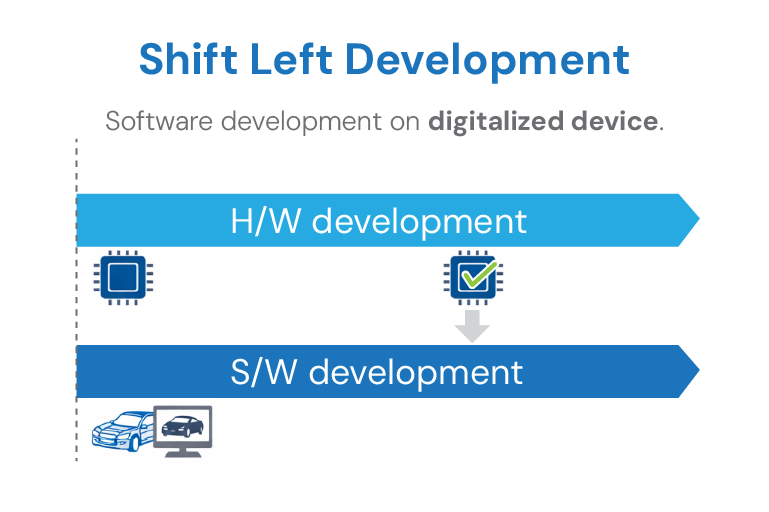
The RoX (R‑Car Open Access) Virtual Platform (VPF) accelerates in-vehicle software development for next-generation vehicles by allowing users to start development activities prior to hardware availability, enabling a shift-left development strategy. Using digital twins, users can simulate R‑Car functions on RoX VPF and conduct system verification for early software development.
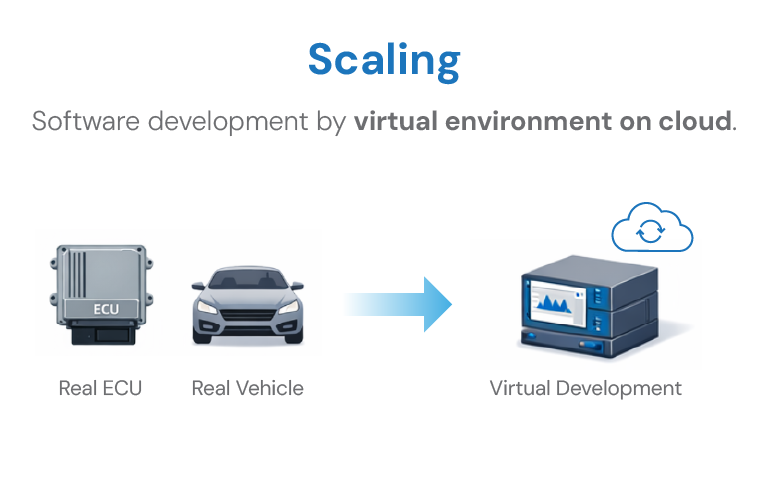
It offers the ability to scale development by increasing the number of verification and validation environments without requiring real ECUs or vehicles. The platform enables seamless migration to actual hardware once available, thus reducing rework. Renesas offers two main virtual platform environments: RFS2 and VDK.
RFS2 (R-Car Fast Simulator) is a Renesas-developed, second-generation function simulator that uses high-level abstraction models to enable high-speed simulation for early, application-specific development. The R‑Car Virtual Platform (RFS2) is ideal for scalable, shift-left customer software development, supporting a wide range of application frameworks such as Classic and Adaptive AUTOSAR, QNX, Linux, and Android Auto.
VDK (Virtual Development Kit) is co-developed with Synopsys and provides a fully functional model of an R‑Car System-on-Chip (SoC), capable of executing unmodified production software and enabling various use cases for software porting, integration, and testing from hypervisor to application layers. For more details, explore Synopsys Electronic Digital Twin. The R‑Car Virtual Platform (VDK) is ideal for integrating and testing automotive OS software platforms on R‑Car SoC–based HPC/ECUs, including drivers, hypervisors, operating systems, middleware, and application frameworks, while also enabling full binary software stack validation with a focus on safety-critical applications.
VDK–RFS Co-simulation is a Renesas solution designed to address unsupported customer use cases that cannot be met by either platform individually.
Availability
- RFS2 is available on Renesas inside the R-Car RoX Software Development Kit
- VDK is available in collaboration with Synopsys, leveraging industry‑proven virtual prototyping technology. For inquiry or further information, please contact Synopsys.
| Category | Renesas RFS1 | Synopsys VDK | Renesas RFS2 |
|---|---|---|---|
| Target SW | x86 binary | ARM® binary | ARM® binary |
| Sim speed of CPU | > 1/1 | > 1/17 | > 1/2 |
| Supports multiprocessing | No | Yes | Yes |
| Hypervisor support | No | Yes | Yes |
| Sim speed enhancement tech. for CPU | Host compilation and Host execution | ARM fast model | HyperCore (Fast ARM model) Fast RH850 core (G4MH) model |
| Sim speed enhancement tech. for IP models (only some IP Models can be applied) | Host PC IF (USB, PCIe) API model (NPU, GPU, DRM) GPGPU accel. | N/A | Virtio HyperFusion (API model) HyperAccel (GPGPU accel.) HyperSim (multi threading) |
| Useable to evaluate Renesas DRV/MW/FWK | Cannot run many Renesas Drv/MW/FWK | Can run many Renesas Drv/MW/FWK | Can run many Renesas Drv/MW/FWK |
| IP list supported limitation | CPU CR/CM; 3rd party IP | ISP Core | N/A |
| Debugging method (for SW application) | VSCode Terminal (gdb) e2 studio | 3rd party GUI TRACE32 e2 studio | Terminal (gdb) |
| License fee (Customer/Renesas) | None | Yes | Yes |
Features
- Renesas RFS2
- Based on the QEMU open-source simulator, widely used by software developers across IT and embedded systems
- Provides full transparency and debuggability, allowing users to inspect, modify, and debug source code
- Flexible and customizable, enabling easy integration and adaptation to specific development needs
- Community-driven and cross-platform, benefiting from open-source contributions and supporting multi-architecture emulation (e.g., x86, Arm)
- High performance, accelerating development with fast simulation speeds and advanced CPU models
- Integrates with other tools, enhancing usability with support for libvirt, virt-manager, and Docker
- Synopsys VDK
- Executes unmodified, target-compiled production binaries for application (AP) cores, real-time (RT) cores, DSPs, and NPUs (as applicable)
- Models R‑Car–specific peripherals and interfaces, such as Ethernet and CAN
- Provides user-controlled abstraction levels to balance simulation accuracy and performance
- Supports multithreaded simulation for scalable HPC and multi‑ECU development
- Supports VNE (Virtualizer Native Execution) on Arm-based host servers
- Interfaces with common automotive engineering tools and test environments
- Cloud-ready and CI/CD-ready, supporting modern DevOps and continuous validation workflows
Target Devices
Design & Development
Videos & Training
This demonstration showcases an ADAS front camera application running on the Renesas Fast Simulator V2 (RFS2) virtual platform, which simulates the R-Car X5H board. The application runs inside a guest virtual machine on a host PC using Ubuntu 22.04, without graphics processing unit (GPU) acceleration.
The video highlights two key capabilities of the platform: fast Linux boot times and successful execution of the ADAS reference application on the simulated R-Car X5H environment. By enabling software development and validation before physical hardware is available, RFS2 helps accelerate development workflows and reduce time to market.
News & Blog Posts
Support

Support Communities

