

Using an MCU or SoC to scan a keypad is a less-than-ideal solution for human input. It often makes sense to offload keypad scanning to a dedicated IC to reduce the power and I/O burden on larger, less efficient, and more expensive devices. Using a GreenPAK™ as a keypad scanner provides a flexible, reliable solution that won’t kill your power budget or your BOM cost. While GreenPAK with I2C can perform this function, using GreenPAK’s Asynchronous State Machine (ASM) unlocks the full potential and enables up to 54 key scanning.
GreenPAK Benefits for Keypad Scanning
GreenPAK Offers Lots of Flexibility
- Integrated delays for programmable button debounce
- ASM that can quickly and reliably scan up to 54 buttons in a 20-pin device
- VDD that is 1.8 to 5.0 V
- Flexible GPIO routing, ensuring the least complexity in printed circuit board (PCB) routing
GreenPAK Lowers Power Consumption
- Being low powered allows it to operate continuously without ruining the power budget while the main microcontroller (MCU) or system on chip (SoC) is in standby
GreenPAK Enhances System Stability
- Zero code while implementing features in hardware ensures stability
- Integration of many components ensures fewer points of failure
Keypad Scanner, a Stately Design
How does it work?
1. Once powered, GreenPAK's ASM cycles through each state, sending out a logic HIGH to each row using the 8-bit ASM output in a 1-hot configuration.
2. When a key is pressed, the circuit is complete, and the HIGH signal is picked up by the corresponding column input. GreenPAK then generates an interrupt, stopping the ASM and notifying the MCU or SoC, which can be in sleep mode to save power.
3. From here, the MCU or SoC needs to simply send the I2C read commands to determine the active row and column and decode the key pressed from that information.
4. After completing the I2C read, the MCU or SoC can send a RESET signal to GreenPAK, which then releases the ASM to continue scanning.
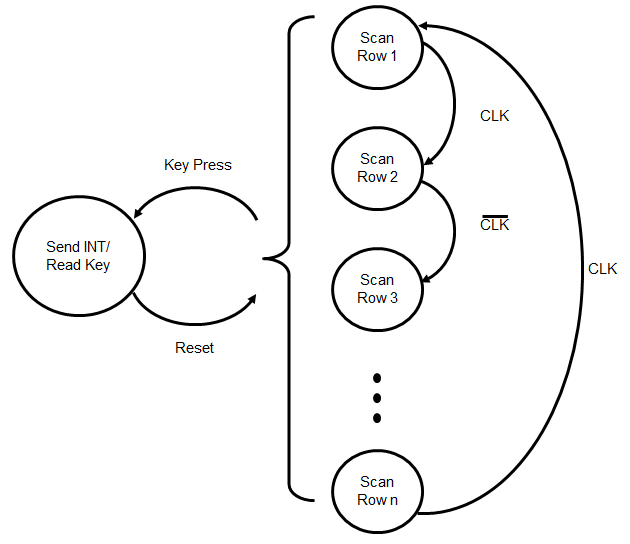
Keypad Scanner State Diagram
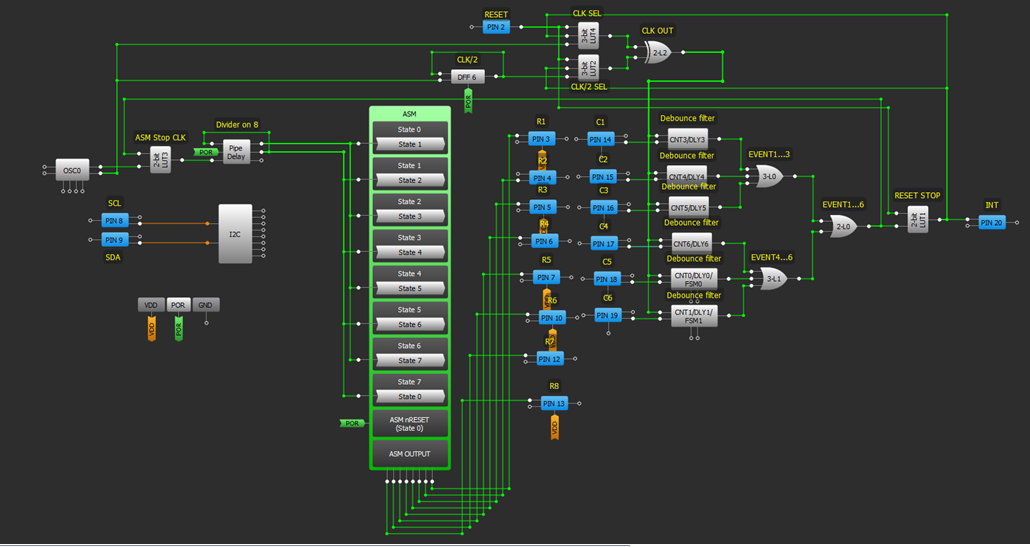
48 Key Scanner GreenPAK Implementation
GreenPAK can often implement multiple functions. Just one GreenPAK device can implement a keypad scanner in conjunction with other functions like glue logic, timing adjustment, reset, power sequencing, LED control, and more, depending on design requirements and resource configuration.
Below are just a few GreenPAK devices that can perform a keypad scan function.
| GreenPAK Part Number | Max Keys | Programmable Debounce |
|---|---|---|
| SLG46533V/M | 16 | Yes |
| SLG46536V | 16 | Yes |
| SLG46537V/M | 54 | Yes |