
Package Information
| CAD Model: | View CAD Model |
| Pkg. Type: | DFN |
| Pkg. Code: | LFP |
| Lead Count (#): | 12 |
| Pkg. Dimensions (mm): | 4.0 x 4.0 x 0.90 |
| Pitch (mm): | 0.5 |
Environmental & Export Classifications
| Moisture Sensitivity Level (MSL) | 3 |
| Pb (Lead) Free | Yes |
| RoHS (HIP2104FRAANZ-T7A) | Download |
| ECCN (US) | |
| HTS (US) |
Product Attributes
| Lead Count (#) | 12 |
| Carrier Type | Reel |
| Moisture Sensitivity Level (MSL) | 3 |
| Pb (Lead) Free | Yes |
| Pb Free Category | Pb-Free 100% Matte Tin Plate w/Anneal-e3 |
| Temp. Range (°C) | -40 to +125°C |
| Bootstrap Supply Voltage (Max) (V) | 60 |
| Charge Pump | No |
| Fall Time | 17 |
| Input Logic Level | 3.3V/TTL |
| Length (mm) | 4 |
| MOQ | 250 |
| Parametric Category | Half-Bridge FET Drivers |
| Peak Pull-down Current (A) | 2 |
| Peak Pull-up Current (A) | 1 |
| Pitch (mm) | 0.5 |
| Pkg. Dimensions (mm) | 4.0 x 4.0 x 0.90 |
| Pkg. Type | DFN |
| Price (USD) | $1.76151 |
| Qualification Level | Standard |
| Rise Time (μs) | 0.021 |
| Thickness (mm) | 0.9 |
| Turn-Off Prop Delay (ns) | 27 |
| Turn-On Prop Delay (ns) | 23 |
| VBIAS (Max) (V) | 14 |
| Width (mm) | 4 |
Resources for HIP2104
Description
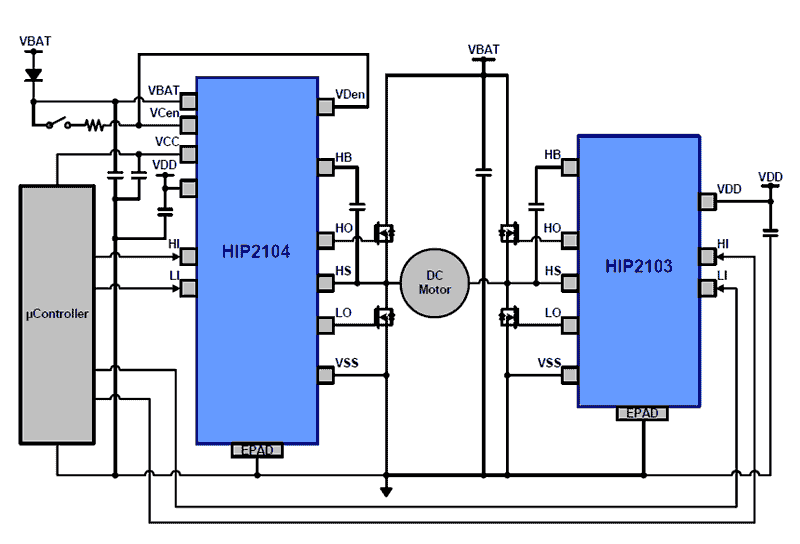
The HIP2103 and HIP2104 are half-bridge drivers designed for applications using DC motors, 3-phase brushless DC motors, or other similar loads. The two inputs (HI and LI) independently control the high-side driver (HO) and the low-side driver (LO). HI and LI can be configured to enable/disable the device, which lowers the number of connections to a microcontroller and the cost. The low IDD bias current in the Sleep Mode prevents battery drain when the device is not in use, which eliminates the need for an external switch to disconnect the driver from the battery. Integrated pull-down resistors on all of the inputs (LI, HI, VDen, and VCen) reduce the need for external resistors. An active low resistance pull-down on the LO output ensures that the low-side bridge FET remains off during the Sleep Mode or when VDD is below the Undervoltage Lockout (UVLO) threshold. The HIP2104 has a 12V linear regulator and a 3. 3V linear regulator with separate enable pins. The 12V regulator provides internal bias for VDD and the 3. 3V regulator provides bias for an external microcontroller (and/or other low voltage ICs), which eliminates the need for discrete LDOs or DC/DC converters.