
Package Information
| CAD Model: | View CAD Model |
| Pkg. Type: | PDIP |
| Pkg. Code: | EFV |
| Lead Count (#): | 20 |
| Pkg. Dimensions (mm): | 26.2 x 6.6 x 3.94 |
| Pitch (mm): | 2.5 |
Environmental & Export Classifications
| Moisture Sensitivity Level (MSL) | Not Applicable |
| Pb (Lead) Free | Yes |
| ECCN (US) | EAR99 |
| HTS (US) | 8542.33.0001 |
Product Attributes
| Lead Count (#) | 20 |
| Carrier Type | Tube |
| Moisture Sensitivity Level (MSL) | Not Applicable |
| Pitch (mm) | 2.5 |
| Pkg. Dimensions (mm) | 26.2 x 6.6 x 3.94 |
| Pb (Lead) Free | Yes |
| Pb Free Category | Pb-Free 100% Matte Tin Plate w/Anneal-e3 |
| Temp. Range (°C) | -40 to +85°C |
| 2nd Harmonic (dB) | -51 |
| 3rd Harmonic (dB) | -55 |
| Bandwidth (MHz) | 125 |
| CMRR (dB) | 53 |
| Channels (#) | 4 |
| Diff Gain (%) | 0.03 |
| Diff Phase (°) | 0.03 |
| Distortion Conditions | 2Vpp, 10MHz |
| Enable | Yes |
| Gain Min | 1 |
| IBIAS (nA) | 4000 |
| IOUT (A) | 0.02 |
| IS per Amp (mA) | 7.5 |
| Length (mm) | 26.2 |
| MOQ | 360 |
| Noise VN (nV/√Hz) | 4.5 |
| Offset Voltage (Max) (mV) | 3 |
| Output Headroom (V) | 2 |
| PSRR (db) | 60 |
| Pkg. Type | PDIP |
| Qualification Level | Standard |
| Rail-to-Rail Input | No |
| Rail-to-Rail Output | No |
| Slew Rate (V/µs) | 475 |
| Thermal Shutdown | No |
| Thickness (mm) | 3.94 |
| Topology [Rail 1] | CFA |
| VOUT (V) | 6 |
| VS (Max) (V) | 30 |
| VS (Min) (V) | 9 |
| Width (mm) | 6.6 |
Resources for HA5024
Description
Support is limited to customers who have already adopted these products.
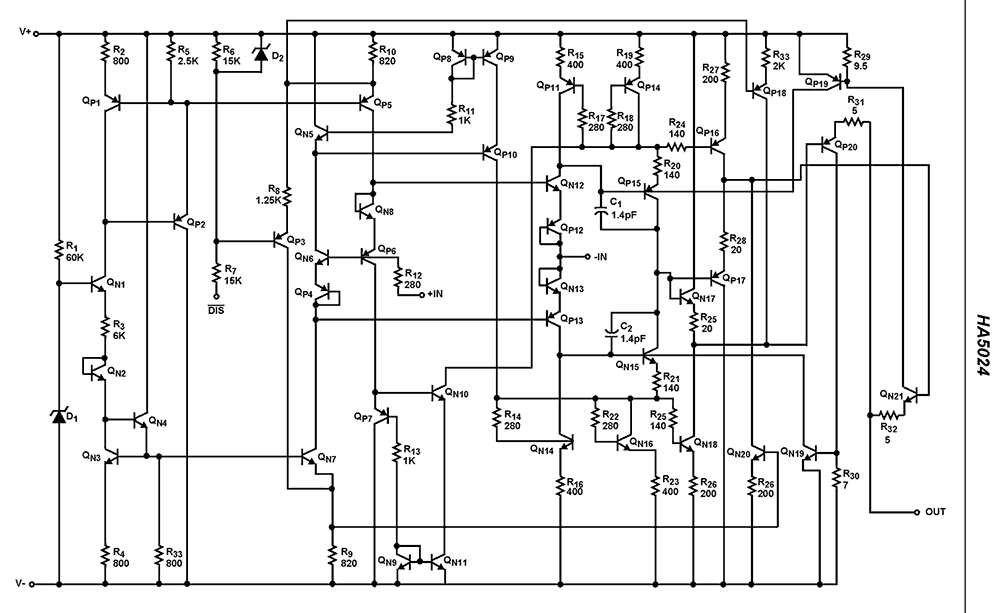
The HA5024 is a quad version of the popular Intersil HA5020. It features wide bandwidth and high slew rate, and is optimized for video applications and gains between 1 and 10. It is a current feedback amplifier and thus yields less bandwidth degradation at high closed loop gains than voltage feedback amplifiers. The low differential gain and phase, 0. 1dB gain flatness, and ability to drive two back terminated 75Ω cables, make this amplifier ideal for demanding video applications. The HA5024 also features a disable function that significantly reduces supply current while forcing the output to a true high impedance state. This functionality allows 2:1 and 4:1 video multiplexers to be implemented with a single IC. The current feedback design allows the user to take advantage of the amplifier's bandwidth dependency on the feedback resistor. By reducing RF, the bandwidth can be increased to compensate for decreases at higher closed loop gains or heavy output loads.